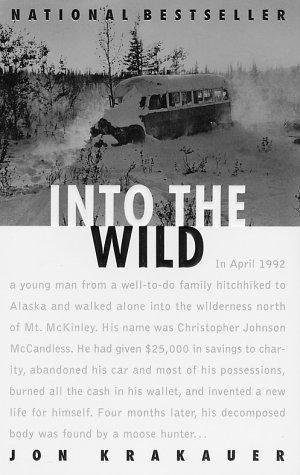
Into the Wild
by Jon Krakauer · 1996
A well-off college graduate gives away his savings, abandons his identity, and hikes into the Alaskan wilderness with barely any supplies -- and Krakauer spends the book trying to figure out whether that was idealism, recklessness, or both.
Worth reading? Into the Wild works because Krakauer refuses to settle the question of whether Chris McCandless was admirable or reckless -- he builds the case for both and lets them sit in tension. The chapters comparing McCandless to other wilderness-seekers, Krakauer's own risky younger self included, are what elevate this past a single tragic profile.
| Author | Jon Krakauer |
|---|---|
| Published | 1996 |
| Publisher | Anchor Books |
| Category | Biographies & Memoirs |
| Favorite quote | “Unlike Muir and Thoreau, McCandless went into the wilderness not primarily to ponder nature or the world at large but, rather, to explore the inner country of his own soul.” |
The Verdict
Krakauer’s decision to include his own reckless younger self, a solo winter climb up an Alaskan peak that could easily have killed him too, is what keeps the book from tipping into either hagiography or condemnation. He’s arguing McCandless’s impulse is more recognizable than most readers want to admit, even if the execution was fatally unprepared.
The reconstruction work is genuinely impressive – Krakauer tracks down nearly everyone who crossed paths with McCandless during his two years of wandering, piecing together a fuller picture than the young man’s own sparse journal entries could provide alone.
Read it if you want investigative nonfiction that holds real sympathy and real criticism at the same time without picking a side for you. Skip it if you’ve already decided McCandless was simply foolish and don’t want that judgment complicated.
you want investigative nonfiction that takes its subject's choices seriously without either romanticizing or dismissing them outright
you already think Christopher McCandless was simply foolish and don't want a book that keeps complicating that judgment with sympathy and comparison
Book Summary
Christopher McCandless, a 24-year-old college graduate from a well-off family, gave away his savings, cut off contact with his family, adopted the name "Alexander Supertramp," and spent two years wandering the American West before hiking alone into the Alaskan wilderness in 1992 with minimal supplies, where he died four months later.
Krakauer investigates McCandless's motivations by reconstructing his journey through interviews with people who met him along the way, his own journal entries, and the books he carried and annotated -- Thoreau, Tolstoy, London -- building a picture of a young man pursuing a specific, literary idea of self-reliant wilderness experience.
The book widens beyond McCandless alone, including a chapter on Krakauer's own reckless solo climb of an Alaskan peak as a young man, using the comparison to argue that McCandless's impulse wasn't unique or inexplicable, just more fatally unprepared than most who share it.
Top 7 Lessons from Into the Wild
- McCandless's journey was shaped heavily by specific books he carried and annotated -- particularly Thoreau, Tolstoy, and Jack London -- showing how literary ideas about self-reliance and nature directly influenced his real decisions.
- Krakauer reconstructs McCandless's final months mainly through interviews with people who met him briefly along his journey, since McCandless traveled largely alone and left behind only a partial record.
- The book identifies specific, avoidable errors in McCandless's preparation -- misidentifying an edible plant, an unnoted river crossing that became impassable -- treating his death as the result of concrete mistakes, not just fate.
- Krakauer includes his own account of a reckless solo winter ascent of an Alaskan peak as a young man, using the parallel to argue that McCandless's impulse toward risk and self-testing is more common, and more understandable, than most readers assume.
- McCandless's estrangement from his family, rooted in discovering complicated truths about his father's past, is treated as a real driver of his need to remake his own identity, not just youthful whimsy.
- The book sparked ongoing debate, including from Alaskans who saw McCandless as underprepared and disrespectful of the wilderness's real dangers -- Krakauer engages that criticism directly rather than ignoring it.
- Krakauer revisits and revises his own theory of what specifically killed McCandless across different editions of the book, modeling how nonfiction conclusions can and should update with new evidence.
Top 2 Quotes from Into the Wild
"Unlike Muir and Thoreau, McCandless went into the wilderness not primarily to ponder nature or the world at large but, rather, to explore the inner country of his own soul."
Jon Krakauer, Into the Wild
"McCandless came into Alaska with insufficient provisions, and he lacked certain pieces of equipment deemed essential by many Alaskans: a large-caliber rifle, map and compass, an ax. This has been regarded as evidence not just of stupidity but of the even greater sin of arrogance."
Jon Krakauer, Into the Wild
Frequently Asked Questions
Is Into the Wild worth reading?
Yes -- Krakauer treats a genuinely difficult question, whether McCandless's choices were admirable or reckless, with real seriousness instead of settling it for you.
What is Into the Wild about?
The true story of Christopher McCandless, a young man who gave away his savings and hiked alone into the Alaskan wilderness in 1992, and Krakauer's investigation into his motivations and death.
How did Christopher McCandless die?
He died of starvation in the Alaskan wilderness after being unable to leave his campsite, likely worsened by misidentifying a plant as safe to eat -- Krakauer's specific theory has shifted across editions of the book.
Was Into the Wild made into a movie?
Yes -- the 2007 film adaptation was directed by Sean Penn and starred Emile Hirsch.
Is Into the Wild critical of Christopher McCandless?
It's mixed -- Krakauer takes McCandless's choices seriously and draws sympathetic parallels to his own reckless youth, while also documenting specific, avoidable mistakes that contributed to his death.
Ready to read it?
Get Into the Wild on Amazon