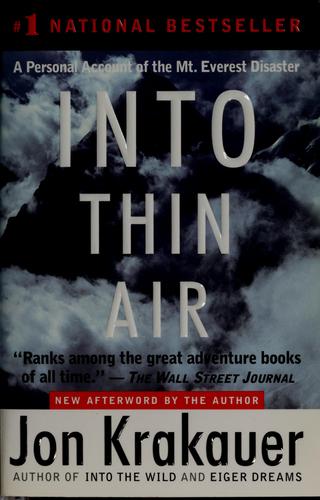
Into Thin Air
by Jon Krakauer · 1997
A journalist sent to write about commercial Everest expeditions ends up living through the 1996 disaster that killed eight climbers in a single storm, and turns his own survivor's guilt into one of the most scrutinized accounts of what actually went wrong on the mountain.
Worth reading? Into Thin Air earns its status as the defining Everest disaster book because Krakauer was actually on the mountain, and he writes with the specific, damning detail of someone reconstructing exactly how a series of individually small decisions -- turnaround times ignored, oxygen miscalculated, guides overextended -- compounded into eight deaths.
| Full Title | Into Thin Air: A Personal Account of the Mount Everest Disaster |
|---|---|
| Author | Jon Krakauer |
| Published | 1997 |
| Publisher | Villard |
| Category | Biographies & Memoirs |
| Favorite quote | “Above the comforts of Base Camp, the expedition in effect became a nearly Darwinian process of natural selection.” |
The Verdict
What makes this more than a survival story is Krakauer’s refusal to treat the deaths as bad luck. He reconstructs specific choices – ignored turnaround times, a bottleneck at the Hillary Step, miscalculated oxygen – and argues plainly that better decisions would have meant fewer deaths.
That specificity is also what got him into public disputes with other survivors, most notably guide Anatoli Boukreev, whose own account pushes back hard on parts of Krakauer’s narrative. Reading both books side by side is more illuminating than reading either alone, but Into Thin Air stands on its own as the more widely read and more carefully constructed account.
The passages on his own guilt over a fellow climber’s death are the book’s most uncomfortable and most honest, and they keep the book from reading as a clean journalistic autopsy.
Read it if you want a firsthand disaster account that names names and reckons honestly with its own author’s role. Skip it if you’d rather read a no-blame, purely factual account – this book takes clear positions, and not everyone who was there agrees with them.
you want a firsthand disaster account written by someone who was actually there, willing to name specific decisions and specific people he believes contributed to the deaths, including scrutinizing his own choices
you want a purely objective, no-blame account -- Krakauer names names and assigns responsibility, which drew public disputes from other survivors and guides who were on the mountain
Book Summary
Krakauer joined a 1996 commercial Everest expedition on assignment for Outside magazine to report on the growing industry of guided climbs for paying clients, and was on the mountain when a sudden, violent storm hit during multiple teams' summit attempts, trapping climbers above the "death zone" without oxygen or shelter and killing eight people in a single day, among the deadliest incidents in Everest's history at the time.
The book reconstructs, hour by hour, the specific decisions that compounded into disaster: guides ignoring pre-agreed turnaround times to get clients to the summit, oxygen supplies miscalculated, a bottleneck at the Hillary Step that delayed descent into worsening weather, and radio and communication failures that left stranded climbers without rescue coordination. Krakauer doesn't present the disaster as inevitable bad luck -- he argues specific, nameable choices made it worse than it needed to be.
Krakauer is also unsparing about his own role and survivor's guilt, including choices he made that he believes may have contributed to a fellow climber's death, and the book's emotional weight comes as much from his own reckoning as from the reporting. The account was controversial -- guide Anatoli Boukreev and others publicly disputed specific details and Krakauer's characterizations, leading Boukreev to write his own rebuttal account, The Climb.
Top 8 Lessons from Into Thin Air
- The disaster resulted from a compounding series of individually survivable decisions -- ignored turnaround times, miscalculated oxygen, a summit-day bottleneck -- rather than one single catastrophic failure.
- Commercial guiding on Everest created pressure to get paying clients to the summit even when conditions or schedule suggested turning back, a structural incentive problem the book treats as a root cause.
- Krakauer names specific guides and decisions he believes contributed to the deaths, making the book as much an argument about accountability as a survival narrative.
- The 'death zone' above 26,000 feet leaves almost no margin for delay -- oxygen deprivation impairs judgment severely at that altitude, meaning small slowdowns (like a bottleneck at the Hillary Step) become lethal.
- Radio and communication failures during the storm left some climbers without rescue coordination even when help might have been reachable, a logistics failure as damaging as the weather itself.
- Krakauer is candid about his own survivor's guilt, including a choice he made in the confusion of the storm that he believes may have contributed to fellow climber Andy Harris's death.
- The book's account was publicly disputed by guide Anatoli Boukreev, who wrote his own competing memoir, The Climb, illustrating how contested even a well-reported disaster account can be among its own survivors.
- The commercial Everest industry the book scrutinizes has continued to grow since 1996, and the book is frequently cited in ongoing debates about overcrowding and guide-client safety ratios on the mountain.
Top 4 Quotes from Into Thin Air
"Above the comforts of Base Camp, the expedition in effect became a nearly Darwinian process of natural selection."
Jon Krakauer, Into Thin Air
"There were many, many fine reasons not to go, but attempting to climb Everest is an intrinsically irrational act."
Jon Krakauer, Into Thin Air
"The plain truth is that I knew better but went to Everest anyway."
Jon Krakauer, Into Thin Air
"Achieving the summit of a mountain was tangible, immutable, concrete."
Jon Krakauer, Into Thin Air
Frequently Asked Questions
Is Into Thin Air worth reading?
Yes -- it's a firsthand, detailed reconstruction of a real disaster, written by a journalist who was actually on the mountain, and it remains the defining account of the 1996 Everest tragedy.
What is Into Thin Air about?
Jon Krakauer's account of the 1996 Mount Everest disaster, in which a sudden storm killed eight climbers during commercial guided summit attempts, and the specific decisions he argues compounded the tragedy.
Is Into Thin Air controversial?
Yes -- guide Anatoli Boukreev and others publicly disputed some of Krakauer's characterizations and details, and Boukreev wrote a competing account, The Climb, in response.
Is Into Thin Air a true story?
Yes, it's a firsthand memoir and journalistic account based on Krakauer's own experience on the mountain during the 1996 disaster.
Do you need mountaineering knowledge to understand it?
No -- Krakauer explains altitude physiology, climbing logistics, and Everest-specific terminology as the narrative unfolds.
Ready to read it?
Get Into Thin Air on Amazon