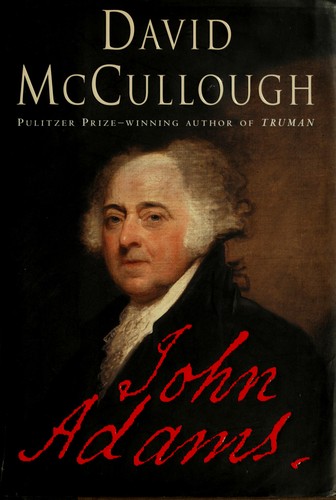
John Adams
by David McCullough · 2001
The founder who signed the Declaration, won independence in Paris, and lost the popularity contest to Jefferson and Washington finally gets the biography that makes his case.
Worth reading? McCullough's John Adams succeeds by rehabilitating a founder who's usually a supporting character in someone else's story. Using Adams's extraordinary correspondence with Abigail as its spine, the book makes the case that Adams's stubbornness and lack of Jefferson's charisma shouldn't obscure how central, and how right, he often was.
| Author | David McCullough |
|---|---|
| Published | 2001 |
| Publisher | Simon & Schuster |
| Category | History |
The Verdict
McCullough’s gift is making a difficult, unglamorous man sympathetic without flattering him. Adams comes across as genuinely principled and genuinely hard to like, and the book doesn’t try to resolve that tension, it just shows you both sides on nearly every page.
The Abigail letters do more narrative work than any battle scene or political maneuver. You get Adams’s private doubts in real time, which is a level of access most founding-father biographies can’t match because the correspondence doesn’t exist for their subjects.
Read it if you want the deepest, most humanizing account of a founder usually reduced to a supporting role. Skip it if 750 pages of dense 18th-century politics and correspondence isn’t what you’re looking for right now.
you want the definitive, deeply sourced biography of America's second president, built substantially on his decades of letters with Abigail Adams
you want a short, breezy introduction -- this is a doorstop biography that rewards patience more than it accommodates a casual reader
Book Summary
McCullough traces Adams from a Massachusetts farm through his defense of British soldiers after the Boston Massacre, his push for independence in the Continental Congress, his diplomatic mission to secure French and Dutch support during the Revolution, and his single term as the second president, wedged uncomfortably between Washington's universal reverence and Jefferson's mythology.
The book leans heavily on the thousand-plus letters between John and Abigail Adams, using their marriage, an unusually equal partnership for the era, as both a narrative device and evidence that Adams's private judgment was sharper and more self-aware than his public reputation for prickliness suggested.
McCullough also uses the biography to reframe the Adams-Jefferson relationship: two men who were revolutionary allies, then bitter political rivals during the 1800 election, then reconciled correspondents in old age, both dying, famously, on the same day -- July 4, 1826, the fiftieth anniversary of the Declaration.
Top 7 Lessons from John Adams
- Adams defended British soldiers after the Boston Massacre because he believed in the right to counsel even for an unpopular client, a principle he held before it was politically convenient.
- Adams's diplomatic work securing loans and support from France and the Netherlands during the Revolution was as consequential to independence as any battlefield victory, though it gets far less attention.
- The Adams-Jefferson correspondence, especially the reconciliation after decades of political rivalry, shows how two founders who deeply disagreed politically could still recognize each other's historical importance.
- Adams and Abigail's marriage functioned as an intellectual partnership, with Abigail's letters shaping his political thinking, at a time when that kind of spousal collaboration was unusual in public record.
- Adams's single term as president was defined by keeping the U.S. out of war with France despite enormous political pressure to fight, a decision that cost him reelection but that he considered his proudest achievement.
- Adams and Jefferson dying on the same day, July 4, 1826, the fiftieth anniversary of the Declaration, is one of the strangest coincidences in American history and closes the book's arc almost too neatly.
- McCullough's biography helped shift Adams's modern reputation from a minor, cranky founder to a central, principled figure worthy of comparison to Washington and Jefferson.
Frequently Asked Questions
Is John Adams worth reading?
Yes -- it won the Pulitzer Prize for Biography and is widely considered the definitive Adams biography, though it's a long, dense read.
Why is John Adams less famous than Washington or Jefferson?
Adams lacked Washington's military mythology and Jefferson's rhetorical legacy, and his single, contentious presidential term left him without the kind of clean historical narrative the other two got.
How much of the book is based on letters?
A large portion draws on the correspondence between John and Abigail Adams, over a thousand letters, which McCullough uses as both source material and narrative structure.
Did the book inspire the HBO miniseries?
Yes -- McCullough's biography was adapted into the 2008 HBO miniseries John Adams starring Paul Giamatti.
Is this a good introduction to the founding era?
It's more rewarding as a deep dive than an introduction -- readers new to the period may want a shorter overview first, given the book's length and density.
Ready to read it?
Get John Adams on Amazon