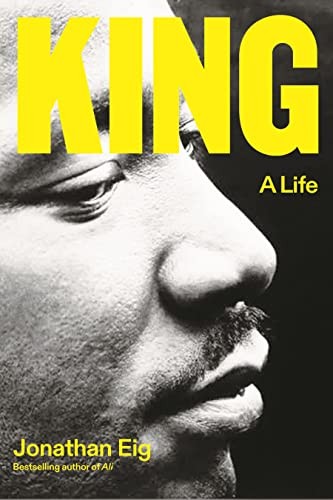
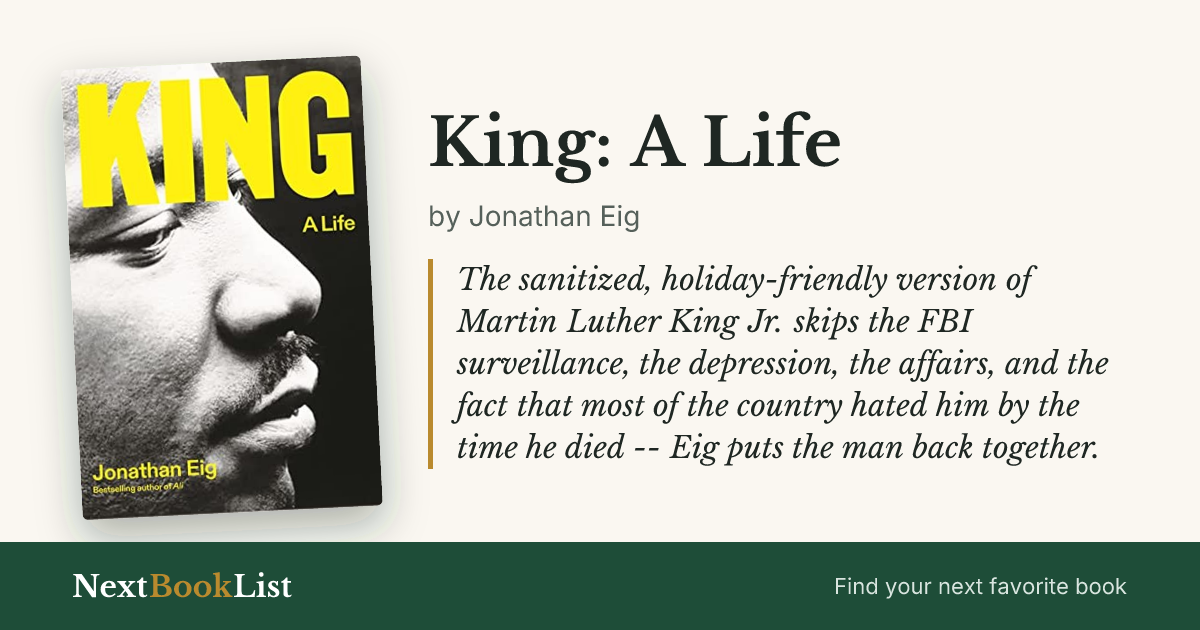
King: A Life
by Jonathan Eig · 2023
The sanitized, holiday-friendly version of Martin Luther King Jr. skips the FBI surveillance, the depression, the affairs, and the fact that most of the country hated him by the time he died -- Eig puts the man back together.
Worth reading? Eig's real achievement is restoring the King that the 'I Have a Dream' myth erased -- a man who was, by the time of his assassination, deeply unpopular with the American public, exhausted, depressed, and radicalizing toward economic justice in ways that made even his own allies nervous.
| Full Title | King: A Life |
|---|---|
| Author | Jonathan Eig |
| Published | 2023 |
| Publisher | Farrar, Straus and Giroux |
| Category | History |
| Favorite quote | “The arc of the moral universe is long, but it bends toward justice.” |
The Verdict
Eig’s book does something the national holiday version of King never does: it makes you sit with how unpopular he actually was at the end. Not beloved, not a unifying consensus figure – a man most of the country, including plenty of former allies, had turned on by 1968. The assassination didn’t just end his life, it rehabilitated his reputation in ways his actual final years never earned from the public in real time.
The FBI material is the hardest section to read, and it should be. This wasn’t background surveillance of a political movement – it was a targeted campaign to break one man, personally, using tactics designed to humiliate rather than inform. Eig doesn’t soften it, and the book is better for refusing to.
Read it if you want the full, complicated King back – not the poster, the man. Skip it if the quote-poster version is the one you’d rather keep; this book won’t let you keep it uncomplicated.
you want the first major King biography in decades built on newly declassified FBI files and unreleased interviews, not the softened version taught in schools
you want the inspirational, quote-poster version of King -- this book insists on the full, harder, more human person underneath it
Book Summary
The King remembered on the national holiday -- the dreamer, the unifier, the man everyone claims to agree with in hindsight -- is largely a retrospective invention. Eig shows that by 1968, most Americans, including many white liberals who'd supported the early civil rights movement, viewed King as a dangerous radical, and his approval ratings were strikingly low right up until his assassination made him safe to celebrate.
King's FBI surveillance file, expanded through newly declassified material, reveals just how much of the federal government's resources were aimed at destroying him personally, not just monitoring a political movement -- J. Edgar Hoover treated King as a personal enemy, and the surveillance extended into King's private life in ways designed to humiliate rather than inform.
King's final years pivoted hard toward economic justice and an anti-war stance on Vietnam, positions that cost him allies and public support precisely because they moved past the more comfortable, already-won arguments about legal segregation into the harder, unresolved territory of poverty and militarism -- ground his legacy has largely avoided revisiting.
Top 8 Lessons from King: A Life
- The version of a historical figure a country chooses to celebrate is often a retrospective invention -- King was deeply unpopular by 1968, not the consensus hero the holiday suggests.
- Government surveillance of a civil rights leader can shift from monitoring to active sabotage -- Hoover's FBI targeted King's personal life specifically to discredit him.
- Moving from a widely-supported cause (ending legal segregation) to a harder one (economic justice, opposing the Vietnam War) can cost a leader the coalition that made him famous.
- Public memory tends to flatten a complicated, conflicted person into a simple symbol -- King's real depression, doubt, and personal failings get erased in the poster version.
- A leader's family and inner circle often carry the private cost of a public movement -- Coretta Scott King's role and burden get restored here, not left as a footnote.
- Assassination can retroactively sanitize a figure's reputation -- King became far more broadly acceptable in death than he ever was in the final years of his life.
- The civil rights movement was never a single unified strategy -- King's positioning between more militant and more moderate factions was a constant, exhausting balancing act, not a settled leadership style.
- Primary-source access (newly declassified FBI files, unreleased interviews) can meaningfully change a historical account decades after a figure's death, not just add footnotes to an already-settled story.
Top 5 Quotes from King: A Life
"I have a dream that my four little children will one day live in a nation where they will not be judged by the color of their skin but by the content of their character."
Jonathan Eig, King: A Life
"Injustice anywhere is a threat to justice everywhere."
Jonathan Eig, King: A Life
"Darkness cannot drive out darkness; only light can do that. Hate cannot drive out hate; only love can do that."
Jonathan Eig, King: A Life
"The arc of the moral universe is long, but it bends toward justice."
Jonathan Eig, King: A Life
"Our lives begin to end the day we become silent about things that matter."
Jonathan Eig, King: A Life
Frequently Asked Questions
Is King: A Life worth reading?
Yes -- it's the most complete, least sanitized King biography available, and it uses newly declassified material most earlier biographies didn't have.
What is King: A Life about?
It covers Martin Luther King Jr.'s full life, from his upbringing through the civil rights movement to his assassination, with heavy use of FBI surveillance files and unreleased interviews.
Does King: A Life cover King's FBI surveillance?
Yes, extensively -- it draws on newly declassified files to show how far Hoover's FBI went to monitor and discredit King personally.
Is King: A Life critical of Martin Luther King Jr.?
It's honest rather than critical -- it doesn't diminish King's importance, but it doesn't sand down his personal struggles or his declining popularity in his final years either.
How does King: A Life compare to earlier King biographies, like Taylor Branch's trilogy?
Branch's trilogy is broader movement history; Eig's book is a tighter, single-volume life of King himself, benefiting from decades of additional archival access.
Ready to read it?
Get King: A Life on Amazon