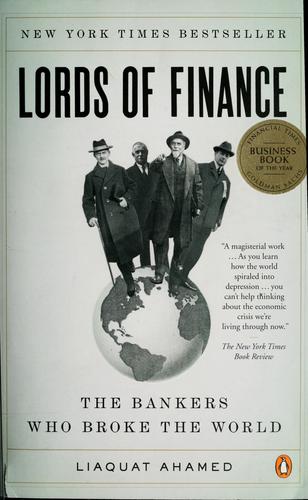
Lords of Finance
by Liaquat Ahamed · 2009
The Pulitzer-winning history of the four central bankers whose decisions helped cause the Great Depression.
Worth reading? Ahamed turns central banking history into a genuine character study: four powerful men, each convinced of their own orthodoxy, whose collective decisions after World War I helped set up the Great Depression. It's history, not a how-to, but the pattern, confident experts, rigid rules, no room for the unexpected, is exactly why it's still cited in monetary-policy debates today. Skip it if you want current tactical advice rather than a century-old cautionary tale.
| Full Title | Lords of Finance: The Bankers Who Broke the World |
|---|---|
| Author | Liaquat Ahamed |
| Published | 2009 |
| Category | Business & Money |
The Verdict
Ahamed turns central banking history into a genuine character study: four powerful men, each convinced of their own orthodoxy, whose collective decisions after World War I helped set up the Great Depression. It’s history, not a how-to, but the pattern, confident experts, rigid rules, no room for the unexpected, is exactly why it’s still cited in monetary-policy debates today. Skip it if you want current tactical advice rather than a century-old cautionary tale.
readers who want to understand monetary policy through the story of the people who wielded it badly
you want a technical economics textbook rather than narrative history
Book Summary
The Pulitzer-winning history of the four central bankers whose decisions helped cause the Great Depression. It earns its place as the most readable account of how monetary orthodoxy can fail catastrophically. Rigid adherence to the gold standard blinded central bankers to the damage their policies were causing. Confident experts following a fixed rulebook can still walk an economy into disaster. The practical move is to read it for the pattern of institutional overconfidence, not for tactical monetary-policy advice, the specific gold-standard mechanics are historical, the human failure mode isn't.
Top 14 Lessons from Lords of Finance
- Rigid adherence to the gold standard blinded central bankers to the damage their own policies were causing.
- Confident experts following a fixed rulebook can still walk an economy into disaster.
- Four men. Strong (Fed), Norman (Bank of England), Moreau (Banque de France), Schacht (Reichsbank), shaped policy through ego and rivalry.
- Montagu Norman, gold's most fervent advocate, raised rates to protect gold even as the economy needed help.
- Deflationary policy meant to restore stability deepened the very crisis it was supposed to prevent.
- Central-bank decisions in one country cascade unpredictably into others through currency and trade links.
- John Maynard Keynes spent the period criticizing the central bankers' orthodoxy.
- The Paris Peace Conference's reparations demands on Germany were, per Ahamed, a great blunder.
- Herd mentality at the 1929 crash was, in his telling, unstoppable once it took hold.
- Institutions built for a previous crisis are often badly suited to the next, different one.
- Even the most sophisticated economists of the era couldn't predict or guard against the disaster.
- The book won the 2010 Pulitzer Prize for History and was published amid the 2008 crisis.
- Benjamin Strong's death removed the one banker with enough stature to coordinate policy globally.
- Ahamed, a former hedge-fund manager, renders the bankers as characters, not abstract economic forces.
Frequently Asked Questions
Is Lords of Finance worth reading?
Yes, if the description fits you, readers who want to understand monetary policy through the story of the people who wielded it badly. Skip it if you want a technical economics textbook rather than narrative history.
What is the main idea of Lords of Finance?
Ahamed traces how four powerful central bankers' rigid commitment to the gold standard and monetary orthodoxy helped cause the Great Depression.
Who should read Lords of Finance?
Readers who want monetary policy explained through the people who wielded it, not a textbook. Skip it if you want current tactical advice rather than a century-old cautionary tale.
What will you get out of Lords of Finance?
A clearer, opinionated take you can act on, plus the sharpest lessons pulled into a short list so you don't have to read the whole book to decide.
Ready to read it?
Get Lords of Finance on Amazon