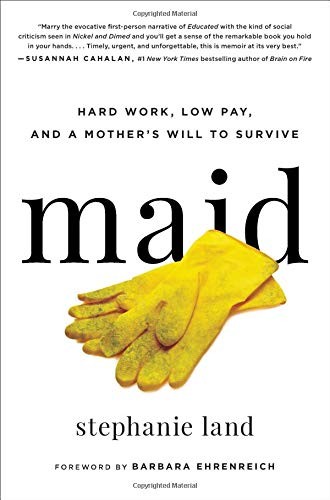
Maid
by Stephanie Land · 2019
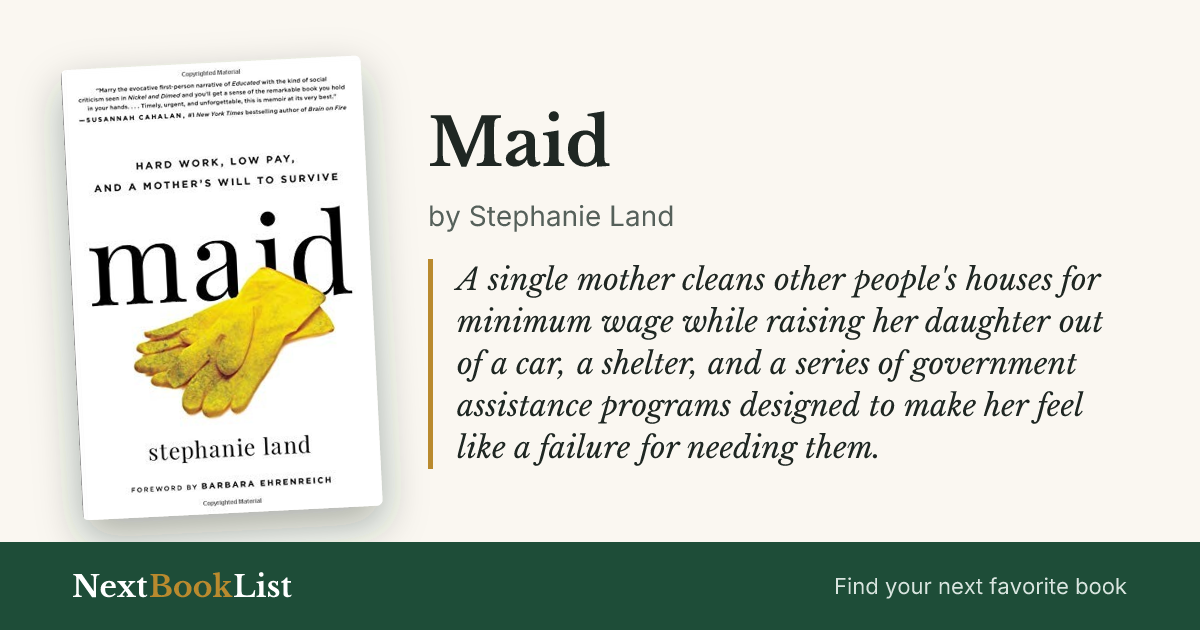
A single mother cleans other people's houses for minimum wage while raising her daughter out of a car, a shelter, and a series of government assistance programs designed to make her feel like a failure for needing them.
Worth reading? Maid earns its comparisons to Nickel and Dimed because Land isn't observing poverty from the outside -- she's inside it, doing the actual cleaning, filling out the actual assistance paperwork, absorbing the actual judgment from people who assume a maid must have done something to deserve her situation. What makes the book more than misery memoir is her precision about the specific, grinding logistics of being poor in America -- the math never works, by design, and she shows exactly how.
| Full Title | Maid: Hard Work, Low Pay, and a Mother's Will to Survive |
|---|---|
| Author | Stephanie Land |
| Published | 2019 |
| Publisher | Hachette Books |
| Category | Biographies & Memoirs |
| Favorite quote | “It seemed like no matter how much I tried to prove otherwise, 'poor' was always associated with dirty.” |
The Verdict
Read this one for the specific numbers, not just the feeling. Land is precise about exactly how much a cleaning job paid, exactly what a housing subsidy covered and didn’t, exactly how a food stamp allotment ran out three days before the next one arrived. That precision is what separates Maid from a general misery narrative – it’s an itemized account of how the math of poverty actually fails to work, and it doesn’t let the reader retreat into vague sympathy instead of specific understanding.
you want a firsthand account of what the actual mechanics of American poverty look like -- the math of food stamps, the humiliation of means-testing, the physical toll of manual labor -- from someone who lived it, not a policy summary of it
you're looking for a redemption arc that resolves poverty as a personal failing overcome through grit alone -- Land is careful to show how much of her survival depended on programs and luck, not just willpower, and the book resists the bootstraps framing
Book Summary
Land became a single mother at twenty-eight after an unplanned pregnancy and a volatile relationship, and spent years cleaning houses for a maid service while raising her daughter Mia through a stretch of homelessness, government-assistance housing, and constant financial precarity. The book moves house by house through her cleaning clients, using each home as a lens onto a different slice of the class divide she's cleaning inside of but can never afford to live inside.
The memoir's real argument is structural: Land documents in granular detail how assistance programs (food stamps, subsidized childcare, Section 8 housing) are simultaneously necessary to survive and designed with enough friction, stigma, and cliff-edges that climbing out of poverty while using them is nearly impossible. Every step toward stability -- a slightly better job, a small raise -- risks disqualifying her from the very assistance she needs to take that step.
Top 8 Lessons from Maid
- The 'benefits cliff' built into assistance programs meant that earning slightly more money could disqualify Land from food stamps or childcare subsidies she needed more than the raise -- the system actively punishes upward movement.
- Land's work as a maid put her inside the homes of people who never saw her as a full person -- clients who left her handwritten judgmental notes but rarely learned her name, illustrating how invisible labor and the people doing it can be to those who depend on it.
- Physical exhaustion from manual labor compounded the mental load of single parenting and bureaucratic paperwork -- Land documents this as a specific, cumulative toll, not just generic 'being tired.'
- The shame of using public assistance was, in Land's account, as exhausting as the material deprivation itself -- being questioned and judged at every grocery store checkout and caseworker meeting wore her down as much as the lack of money did.
- Domestic violence and its aftermath (a volatile relationship with Mia's father) shaped Land's financial precarity as much as low wages did -- her poverty wasn't purely a labor-market problem, it was also an escape-and-recovery problem.
- Land is explicit that a scholarship, a subsidized apartment, and a handful of lucky breaks were what got her out, not willpower alone -- the book resists the narrative that hard work alone should have been enough, because for years it wasn't.
- Each cleaning client's home reveals a different symptom of wealth inequality -- neglect, isolation, and hoarding show up as often as obvious affluence, complicating any simple story about what money buys people.
- Writing itself becomes Land's escape route -- she describes stealing time to write in parking lots and shelters, treating the act of documenting her situation as a form of control she couldn't otherwise exert over her life.
Top 3 Quotes from Maid
"We were expected to live off minimum wage, to work several jobs at varying hours, to afford basic needs while fighting for safe places to leave our children."
Stephanie Land, Maid
"It seemed like no matter how much I tried to prove otherwise, 'poor' was always associated with dirty."
Stephanie Land, Maid
"Each morning brought a constant, lip-chewing stress over making it to work and getting home without my car breaking down."
Stephanie Land, Maid
Frequently Asked Questions
Is Maid worth reading?
Yes -- it's one of the most detailed firsthand accounts of the actual mechanics of American poverty, told by someone who lived inside it rather than studied it.
Is Maid the basis for the Netflix show?
Yes, the 2021 Netflix limited series Maid is loosely inspired by Stephanie Land's memoir, though it takes significant creative liberties with the story.
Does Maid blame poor people for their own poverty?
No -- the book is explicit that assistance programs, bad luck, and structural design (not personal failure) shaped Land's years of precarity, and it resists a bootstraps framing.
Is Maid similar to Nickel and Dimed?
Yes, it's frequently compared to Barbara Ehrenreich's Nickel and Dimed (Ehrenreich wrote the foreword), but Land is writing from lived experience rather than an investigative stint.
Ready to read it?
Get Maid on Amazon