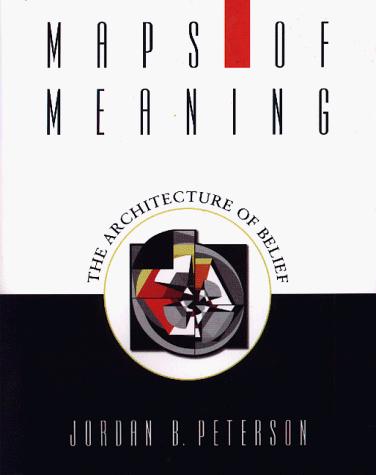
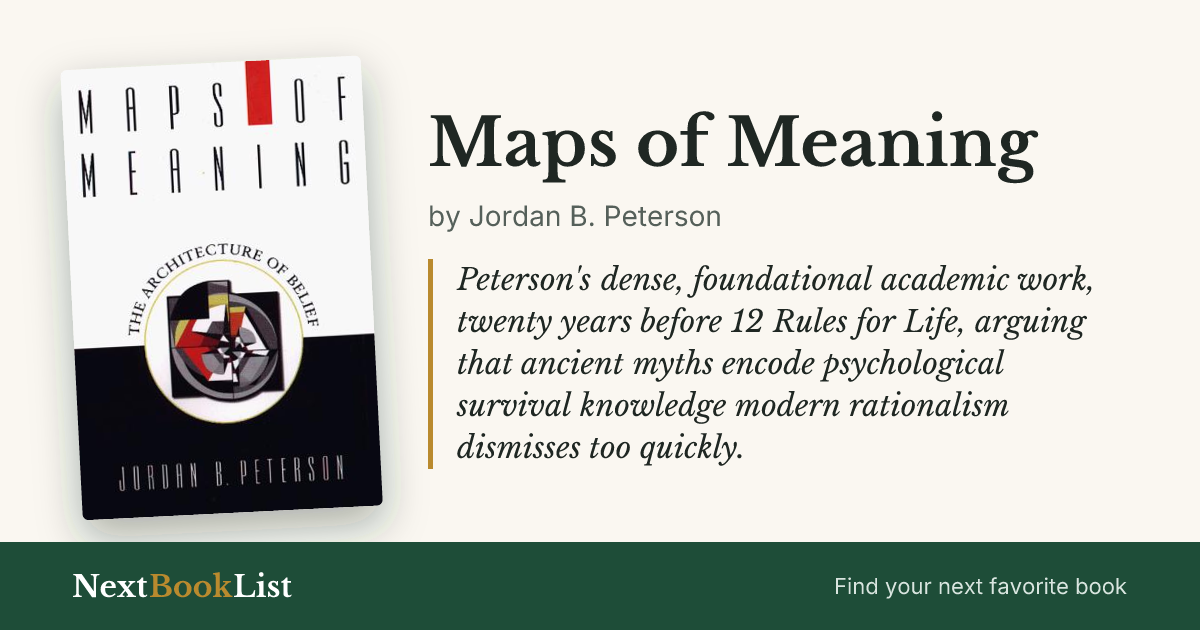
Maps of Meaning
by Jordan B. Peterson · 1999
Peterson's dense, foundational academic work, twenty years before 12 Rules for Life, arguing that ancient myths encode psychological survival knowledge modern rationalism dismisses too quickly.
Worth reading? Written years before Peterson became a public figure, Maps of Meaning is his attempt to fuse neuropsychology, Jungian and Freudian mythology, and comparative religion into a single framework arguing that ancient myths and religious stories encode genuine psychological survival knowledge, order versus chaos, known versus unknown, that modern secular rationalism dismisses too quickly at its own peril. Every idea in Peterson's later popular books traces back to this denser academic source. Read it if 12 Rules for Life left you wanting the underlying theory. Skip it as a first Peterson book, it's a genuinely difficult academic text, not a self-help book.
| Full Title | Maps of Meaning: The Architecture of Belief |
|---|---|
| Author | Jordan B. Peterson |
| Published | 1999 |
| Category | Self-Improvement & Psychology |
The Verdict
This is Peterson before the public persona, writing a genuinely difficult academic book that took him over a decade to complete. Every idea he later popularized traces back here. Read 12 Rules for Life first if you’re new to him; come back to this once you want the theory underneath the rules.
readers who've read 12 Rules for Life and want the denser academic scaffolding underneath it
you want Peterson's accessible, popular writing, start with 12 Rules for Life instead
Book Summary
Peterson's central claim: before science, humans encoded survival-relevant psychological knowledge in myth and religious narrative, not as literal historical or scientific claims but as maps for navigating the tension between order (the known, structured, safe) and chaos (the unknown, unstructured, dangerous). He argues modern rationalism, in dismissing myth as merely false, threw away real psychological wisdom along with the literal claims worth discarding.
Drawing on Jung, Freud, neuropsychology, and comparative mythology across cultures, Peterson builds a framework where recurring mythological structures (the hero's journey, the flood, the underworld descent) represent genuine patterns in how human minds process danger, meaning, and transformation, patterns he later simplified into the more accessible rules of his popular books.
Top 7 Lessons from Maps of Meaning
- Ancient myths may encode real psychological survival knowledge, not just historically false stories.
- The order/chaos framework, known/structured versus unknown/unstructured, recurs across cultures for a psychological reason.
- Dismissing myth as merely 'false' can discard real wisdom along with literal inaccuracy.
- Neuropsychology and comparative mythology can be read together, not treated as separate, unrelated fields.
- Recurring mythological structures (hero's journey, flood, descent) may reflect real patterns in how minds process danger and transformation.
- This book is the theoretical foundation Peterson later simplified into his popular, more accessible writing.
- Reading the dense academic source material can deepen, or complicate, how you read a later popular simplification.
Frequently Asked Questions
Is Maps of Meaning worth reading?
Yes, if you've read Peterson's more popular books and want the denser academic theory underneath them. It's a genuinely difficult text, not an easy read.
What is Maps of Meaning about?
Jordan Peterson's academic framework fusing neuropsychology, Jungian and Freudian mythology, and comparative religion to argue that ancient myths encode real psychological survival knowledge about order and chaos.
Should I read Maps of Meaning before 12 Rules for Life?
No, most readers should start with 12 Rules for Life or Peterson's more accessible work first. Maps of Meaning is denser and academic, better read as a follow-up once you want the underlying theory.
Ready to read it?
Get Maps of Meaning on Amazon