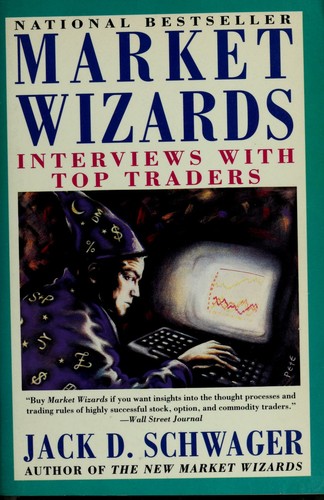
Market Wizards
by Jack D. Schwager · 1989
The original trader-interview book. Schwager sat down with the era's best traders and just asked them how they actually think, no theory, no gurus.
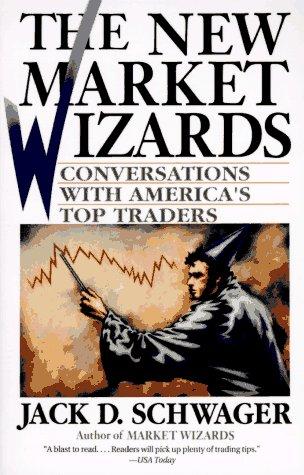
Worth reading? Market Wizards works because Schwager gets out of the way and lets the interviews carry the book -- traders like Paul Tudor Jones, Ed Seykota, and Michael Marcus describe wildly different approaches to markets, and the pattern that emerges isn't a shared technique, it's shared discipline: strict risk management, emotional control, and a refusal to force trades that don't fit their edge. Pair it with The New Market Wizards for a second round of interviews with a new set of traders.
| Full Title | Market Wizards: Interviews with Top Traders |
|---|---|
| Author | Jack D. Schwager |
| Published | 1989 |
| Category | Business & Money |
| Favorite quote | “The elements of good trading are: 1) cutting losses, 2) cutting losses, and 3) cutting losses.” |
The Verdict
Schwager’s format, letting successful traders explain themselves in their own words rather than filtering them through a single theory, is why the book has aged better than most trading literature from the same era. The lack of a unified system is the point: read it for the discipline patterns that recur, not for a method to copy.
you want to hear how genuinely successful traders describe their own process, in their own words, across very different styles
you want a single unified trading system, the whole point of the book is that top traders succeed through very different, sometimes contradictory approaches, not one method
Book Summary
There's no single "correct" way to trade successfully -- the traders Schwager interviews range from trend-followers to fundamental macro traders to pure discretionary gut-feel traders, and several openly contradict each other's stated philosophy. What's consistent across nearly all of them isn't strategy, it's process discipline: rigorous risk management (position sizing, stop losses), emotional detachment from any single trade, and the willingness to sit out when their specific edge isn't present.
Several traders describe losing periods or even blowups earlier in their careers that taught them the risk-management discipline that made their later success possible -- the book's implicit argument is that surviving your own worst trading mistakes, and extracting the right lesson from them, is as important to eventual success as any specific strategy.
Top 7 Lessons from Market Wizards
- There's no single winning trading style -- successful traders in the book range from trend-following to discretionary macro to pure technical.
- Risk management (position sizing, stop losses) is the consistent thread across nearly every trader interviewed, regardless of strategy.
- Emotional detachment from any individual trade matters more than being right on every call.
- Sit out of the market when your specific edge isn't present, rather than forcing trades to stay active.
- Early-career losses or blowups, examined honestly, often taught the traders the discipline behind their later success.
- Trade a style that fits your own psychology -- a strategy that works for one trader can fail for another with different temperament.
- Preserving capital during losing streaks matters more than maximizing gains during winning ones.
Top 3 Quotes from Market Wizards
"The elements of good trading are: 1) cutting losses, 2) cutting losses, and 3) cutting losses."
Jack D. Schwager, Market Wizards
"I am always thinking about losing money as opposed to making money."
Jack D. Schwager, Market Wizards
"Everybody gets what they want out of the market."
Jack D. Schwager, Market Wizards
Frequently Asked Questions
Is Market Wizards worth reading?
Yes, especially for traders and investors who want firsthand accounts from proven traders rather than secondhand theory. It's structured as interviews, so the value comes from pattern-matching across very different styles.
Who is interviewed in Market Wizards?
Prominent traders of the era including Paul Tudor Jones, Ed Seykota, Michael Marcus, and Bruce Kovner, among others, each interviewed by Jack Schwager about their specific approach and philosophy.
Is there a common trading strategy in Market Wizards?
No -- the traders use very different, sometimes contradictory strategies. What's consistent across most of them is disciplined risk management and emotional control, not a shared specific technique.
What's the difference between Market Wizards and The New Market Wizards?
Market Wizards (1989) is the original set of interviews. The New Market Wizards (1992) is a follow-up with an entirely new set of traders, continuing the same interview format.
Ready to read it?
Get Market Wizards on Amazon