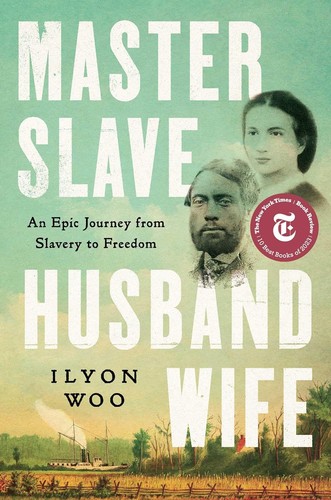
Master Slave Husband Wife
by Ilyon Woo · 2023
In 1848, Ellen Craft, light-skinned enough to pass as white, disguised herself as a disabled male slaveholder, and her husband William posed as her enslaved servant, so the two of them could travel by train and steamboat, in plain sight, out of Georgia and into freedom.
Worth reading? Woo's reconstruction of the Crafts' escape reads with real procedural tension -- every disguise detail (a sling for the arm Ellen couldn't risk signing documents with, dark glasses, a bandage for her beardless face) is a specific problem the couple had to solve in real time, not just costume dressing. It earns comparison to a heist story more than a standard slave-narrative arc.
| Full Title | Master Slave Husband Wife: An Epic Journey from Slavery to Freedom |
|---|---|
| Author | Ilyon Woo |
| Published | 2023 |
| Publisher | Simon & Schuster |
| Category | History |
| Favorite quote | “Whether or not they had children while enslaved, this much is clear: the Crafts had their future children in mind when they resolved to be free.” |
The Verdict
What makes this land is the specificity: Woo doesn’t summarize the Crafts’ escape in a paragraph, she walks through every physical problem they had to solve – the sling, the bandage, the deepened voice, the constant risk of a stranger asking one question too many. That’s what gives it heist-story tension instead of the flatter arc a lot of escape narratives settle for.
The back third, covering the Crafts’ years as abolitionist speakers and their second escape after the Fugitive Slave Act, is less kinetic than the opening chapters, but it’s the part that reframes the whole story: freedom wasn’t a finish line, it was a status that federal law could revoke.
Read it if you want an escape story with genuine procedural tension and the historical weight to back it up. Skip the second half only if you’re purely here for the escape itself – but you’d be missing the point Woo is actually making.
you want a true escape story with the tension of a heist -- the Crafts' plan works because of specific, clever details, and the book tracks every one of them
you want a story that ends the moment freedom is reached -- the book follows the Crafts well past their escape, into abolitionist speaking tours and a second flight from the Fugitive Slave Act, which some readers may find slower than the escape itself
Book Summary
Ellen Craft's escape plan depended on exploiting the exact assumptions of the society enslaving her: a white-passing woman disguised as an infirm white male slaveholder could travel openly by train and steamboat with a Black "manservant" (her actual husband, William) attending her, because no one expected a slaveholder to be traveling in the opposite direction of what the disguise implied.
The plan required solving specific physical problems in real time -- Ellen couldn't read or write, so the sling disguised her inability to sign hotel registers; she couldn't grow a beard, so bandages covered her jaw; her voice and stature had to hold up under direct scrutiny from strangers who had every social incentive to defer to a wealthy white man, not question him.
The Crafts' story didn't end at freedom -- they became prominent abolitionist speakers in the North, until the Fugitive Slave Act of 1850 made even free-state safety conditional, forcing a second escape, this time to England, which reframes their story as an ongoing fight for security rather than a single triumphant crossing.
Top 8 Lessons from Master Slave Husband Wife
- A escape or resistance plan can work precisely by exploiting the exact assumptions the oppressive system relies on -- here, deference to apparent white male authority.
- Successful high-stakes plans are often built from specific, unglamorous problem-solving (a sling to hide an inability to sign papers) rather than dramatic heroics alone.
- Reaching legal freedom in a free state didn't guarantee lasting safety -- the Fugitive Slave Act of 1850 made formerly free people newly vulnerable to recapture.
- Formerly enslaved people who escaped often took on public, political roles (abolitionist speaking tours) rather than disappearing into private life once free.
- A disguise or deception depending on social hierarchy works partly because people in power rarely question someone who appears to already hold it.
- The psychological toll of sustained deception under mortal risk (Ellen maintaining a male disguise for days among strangers) is its own form of endurance, distinct from physical danger alone.
- A couple's escape plan required each partner to play a role that inverted their real relationship (wife as master, husband as slave) as a survival strategy, not merely a story detail.
- Freedom achieved through escape was frequently provisional, not final -- legal and political shifts (like new federal law) could undo it years later.
Top 2 Quotes from Master Slave Husband Wife
"Whether or not they had children while enslaved, this much is clear: the Crafts had their future children in mind when they resolved to be free."
Ilyon Woo, Master Slave Husband Wife
"How much are you willing to give up, sacrifice personally, for what you believe in, for events in another part of the country, for souls on the other side of the world?"
Ilyon Woo, Master Slave Husband Wife
Frequently Asked Questions
Is Master Slave Husband Wife worth reading?
Yes -- it's a Pulitzer Prize-winning account of one of the most audacious escapes from slavery on record, built with real procedural tension around exactly how Ellen and William Craft pulled it off.
What is Master Slave Husband Wife about?
The 1848 escape of Ellen and William Craft from slavery in Georgia, with Ellen disguised as a white male slaveholder and William posing as her servant, followed by their years as abolitionist speakers and a second escape to England after the Fugitive Slave Act.
Is Master Slave Husband Wife based on a true story?
Yes, entirely -- it's narrative nonfiction built from the Crafts' own writings, abolitionist records, and historical research.
Does the book end when the Crafts reach freedom?
No -- roughly the back third covers their lives afterward, including a second flight from the U.S. after the Fugitive Slave Act of 1850 made them newly unsafe even in free states.
How is this different from other slavery-era escape narratives?
The specificity of the disguise and the sustained, in-person deception under direct scrutiny gives it more heist-story tension than a typical escape narrative, without losing the historical weight of what was actually at stake.
Ready to read it?
Get Master Slave Husband Wife on Amazon