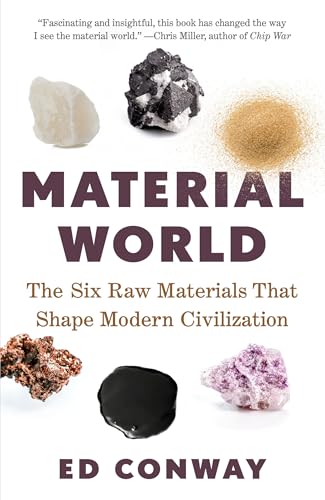
Material World
by Ed Conway · 2023
Sand, salt, iron, copper, oil, and lithium built the world you live in, and the fight to control them will shape what comes next.
Worth reading? Conway's premise is that we've mistaken the digital, service-based economy for the whole economy, when underneath it sits a physical world of mining, smelting, and refining most people never see. Compared to Material World's narrower cousins (The Rare Metals War on rare earths alone, The War Below on lithium and copper mining conflicts specifically), this book takes the widest lens: six materials, sand, salt, iron, copper, oil, and lithium, and traces each from the ground to the products built on it. It earns comparisons to a Michael Lewis-style narrative economics book: vivid on-the-ground reporting (a Taiwanese chip fab, a Chilean lithium pool, a Siberian mine) rather than dry commodity analysis. Read it if you want the physical supply chain made visible and interesting. Skip it if you want deep policy analysis on any one material -- the breadth is the point, not the depth.
| Full Title | Material World: The Six Raw Materials That Shape Modern Civilization |
|---|---|
| Author | Ed Conway |
| Published | 2023 |
| Publisher | Knopf |
| Category | Business & Money |
| Favorite quote | “These fundamental materials have created empires, razed civilizations and fed our ingenuity and our greed for thousands of years. Without them, our modern world would not exist, and the battle to control them will determine our future.” |
The Verdict
Conway’s real argument is that the “weightless” digital economy is a comforting illusion: strip it back and you find sand, salt, iron, copper, oil, and lithium doing all the actual work, mined and refined by a supply chain most people never think about.
you want a physical, supply-chain-level understanding of the economy underneath the 'ethereal' one of apps and information
you want depth on any single material's environmental politics -- this is deliberately broad across six materials, not deep on one
Book Summary
We live in what feels like an "ethereal world" of information and services, but that world still rests entirely on physical extraction. Every phone, data center, and solar panel begins with something dug out of the ground.
Six materials, sand, salt, iron, copper, oil, and lithium, underpin nearly everything in modern civilization, from concrete and glass to steel, electronics, and batteries, and each has its own supply chain choke points and geopolitical stakes.
Humanity's rate of extraction has accelerated dramatically and recently: more raw material was dug out of the earth in 2017 alone than in all of human history before 1950, a fact that undercuts the idea that the digital economy has made physical resources less important.
Top 8 Lessons from Material World
- The 'ethereal' digital economy still runs entirely on physical extraction -- every device starts with something dug from the ground.
- Sand isn't just sand -- the specific silica used in chips and glass is a scarcer, more contested resource than most people assume.
- Copper is the metal the electrification and green-energy transition depends on most, and its supply is tightening faster than demand realizes.
- More raw material was extracted from the earth in 2017 alone than in all of human history before 1950.
- Iron and steel remain the literal foundation of modern infrastructure, unglamorous but irreplaceable.
- Lithium's extraction (often from evaporation pools) looks environmentally gentler than mining but has its own serious water and land costs.
- Each of the six materials has its own chokepoints and dominant players, echoing the same concentration-risk pattern Chip War describes for semiconductors.
- Conway's on-the-ground reporting (fabs, mines, refineries) makes the case that physical supply chains are more fragile, and more interesting, than most people assume.
Top 3 Quotes from Material World
"These fundamental materials have created empires, razed civilizations and fed our ingenuity and our greed for thousands of years. Without them, our modern world would not exist, and the battle to control them will determine our future."
Ed Conway, Material World
"Though it can feel like we now live in a weightless world of information -- what Ed Conway calls 'the ethereal world' -- our twenty-first-century lives are still very much rooted in the material."
Ed Conway, Material World
"We dug more stuff out of the earth in 2017 than in all of human history before 1950."
Ed Conway, Material World
Frequently Asked Questions
Is Material World worth reading?
Yes, if you want a wide, vivid tour of the six raw materials (sand, salt, iron, copper, oil, lithium) that the modern economy actually runs on. It's broad rather than deep on any single one.
What are the six materials in Material World?
Sand, salt, iron, copper, oil, and lithium -- Conway argues these underpin nearly everything in modern civilization, from concrete and chips to batteries and steel.
How does Material World compare to The Rare Metals War or The War Below?
Material World is the widest-lens book of the three, covering six materials broadly. The Rare Metals War and The War Below each go deeper on a narrower slice: rare earths globally, and lithium/copper mining conflicts in the U.S. specifically.
Ready to read it?
Get Material World on Amazon