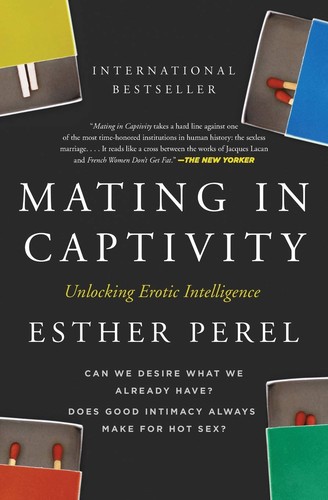
Mating in Captivity
by Esther Perel · 2006
The book that named the problem every long-term couple half-recognizes: security and desire pull in opposite directions, and most relationship advice only knows how to build the first one.
Worth reading? Perel's central argument cuts against most relationship advice: closeness, predictability, and security -- the very things that make a relationship feel safe -- can actively work against erotic desire, which thrives on mystery, distance, and a bit of the unknown. It's a different lens than Gottman's stability-focused principles or Johnson's attachment repair -- neither addresses why a securely bonded couple might still watch desire quietly fade, and Perel writes directly into that gap.
| Full Title | Mating in Captivity: Unlocking Erotic Intelligence |
|---|---|
| Author | Esther Perel |
| Published | 2006 |
| Category | Self-Improvement & Psychology |
| Favorite quote | “Love rests on two pillars: surrender and autonomy.” |
The Verdict
Perel, a couples therapist, wrote this after noticing a pattern that standard relationship advice couldn’t explain: couples who’d done everything “right” – built trust, communicated well, resolved conflict – and still felt their desire fading. The security-versus-desire tension she names is uncomfortable precisely because it doesn’t have a clean fix, but naming it accurately is worth more than a false promise of resolution.
you're in a stable, secure long-term relationship and want to understand why desire has faded even though nothing is 'wrong'
you're looking for communication scripts or conflict-resolution technique. Perel is working the erotic/desire angle specifically, not the day-to-day cooperation Gottman and Johnson cover
Book Summary
Love seeks closeness and security; desire needs distance, autonomy, and a sense of the partner as still somewhat unknown -- and modern relationships, which ask one person to be best friend, co-parent, financial partner, and erotic partner simultaneously, put unprecedented strain on holding both at once. The domestic, merged closeness that makes a partnership function well can be the same thing that quietly erodes erotic charge.
Perel pushes back on the idea that total transparency and eliminating all mystery between partners is automatically healthy -- she argues maintaining some sense of your partner as a separate, autonomous person with their own inner world (rather than a fully known, predictable extension of yourself) is part of what keeps desire alive, and couples who over-merge often unknowingly trade passion for security.
Top 7 Lessons from Mating in Captivity
- Security and desire pull in different directions -- closeness that helps a partnership can work against erotic charge.
- Desire is fed by distance, autonomy, and mystery, not just emotional intimacy and predictability.
- Total transparency between partners isn't automatically healthy for desire -- some sense of the other as separate matters.
- Modern relationships ask one partner to fill roles (friend, co-parent, lover, financial partner) that used to be spread across a wider social network.
- Merging too completely with a partner can quietly erode the erotic charge that depends on some remaining separateness.
- Desire often requires deliberately protecting space and novelty, not just working on communication and conflict.
- A stable, well-functioning partnership and a passionate one require some genuinely different, sometimes competing, conditions.
Top 3 Quotes from Mating in Captivity
"Love rests on two pillars: surrender and autonomy."
Esther Perel, Mating in Captivity
"Fire needs air. Desire needs space."
Esther Perel, Mating in Captivity
"We seek a steady, reliable anchor in our partner, along with an exciting, mysterious lover."
Esther Perel, Mating in Captivity
Frequently Asked Questions
Is Mating in Captivity worth reading?
Yes, especially for couples in a stable, secure relationship wondering why desire has cooled even though nothing feels wrong. It addresses a gap most relationship advice, focused on communication and conflict, doesn't cover.
What is the main idea of Mating in Captivity?
Security and desire pull in different directions -- the closeness and predictability that make a relationship feel safe can work against the mystery and autonomy that keep erotic desire alive.
Is Mating in Captivity about sex or about relationships generally?
Both -- Perel connects the erotic dimension of a relationship to broader dynamics of closeness, autonomy, and how much a couple has merged into one unit versus stayed two distinct people.
How is this different from Hold Me Tight or The Seven Principles for Making Marriage Work?
Those books focus on emotional connection, conflict, and attachment security. Mating in Captivity focuses specifically on why secure, well-functioning relationships can still lose erotic desire, a different problem from conflict or disconnection.
Ready to read it?
Get Mating in Captivity on Amazon