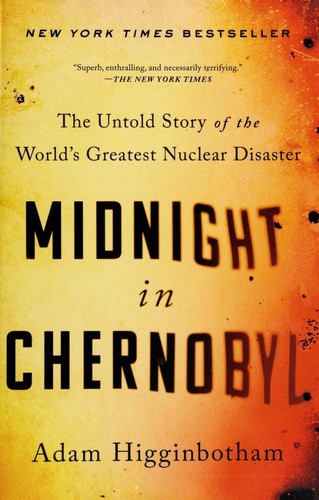
Midnight in Chernobyl
by Adam Higginbotham · 2019
A Soviet safety test goes wrong at 1:23 a.m., and Higginbotham spends a decade of reporting to show exactly how a rushed test, a flawed reactor design, and a system built to hide bad news turned one night into the world's worst nuclear accident.
Worth reading? Higginbotham spent over a decade tracking down engineers, firefighters, and officials who lived through the Chernobyl disaster, and it shows: this is the most granular, best-sourced account of exactly how a safety test went wrong and how the Soviet system's instinct to hide failure turned a containable accident into a catastrophe. It reads like a thriller despite being exhaustively documented, and it's the book to read if you only read one on Chernobyl.
| Full Title | Midnight in Chernobyl: The Untold Story of the World's Greatest Nuclear Disaster |
|---|---|
| Author | Adam Higginbotham |
| Published | 2019 |
| Publisher | Simon & Schuster |
| Category | History |
The Verdict
Higginbotham spent over a decade chasing down the engineers, firefighters, and officials who actually lived through Chernobyl, and the payoff is a book that reads like a thriller while being the best-documented account of the disaster in print. The reactor’s design flaw, the rushed test, and the Soviet instinct to bury bad news all get traced in granular, well-sourced detail.
If you’re only going to read one book on Chernobyl, make it this one. Read it for the definitive account of how a fixable technical problem, combined with a system built to hide risk, became the worst nuclear disaster in history. Skip it only if you want something shorter – this is thorough, not brief.
you want the definitive, deeply reported account of Chernobyl -- the technical failure, the botched Soviet response, and the human cost -- told with the tension of a thriller
you want a quick primer -- this is long and detailed, built from a decade of interviews and archives, closer to definitive history than a fast overview
Book Summary
Chernobyl wasn't simply an accident -- it was the product of a flawed reactor design (the RBMK's known instability at low power) combined with a rushed safety test and a political culture that punished honesty about risk, so warning signs got buried well before the explosion.
The Soviet system's instinct to control information made the disaster dramatically worse. Higginbotham documents how officials delayed evacuation, downplayed radiation exposure, and suppressed technical details, costing lives that better information could have saved.
Individual competence and courage (plant workers, firefighters, later cleanup crews) operated inside a system actively working against transparency, producing a disaster where heroism and institutional failure happened side by side, not in sequence.
Top 8 Lessons from Midnight in Chernobyl
- The RBMK reactor's known design instability at low power was a pre-existing risk factor, not a freak one-off failure.
- A rushed safety test, run under management pressure to complete it on schedule, was the immediate trigger for the explosion.
- A political culture that punishes honesty about risk buries warning signs long before a disaster actually happens.
- Delayed evacuation and downplayed radiation exposure, driven by information control, cost lives that better transparency could have saved.
- Individual courage (firefighters, plant workers) and systemic institutional failure can occur in the same event, side by side.
- Technical failures in complex systems often trace back to organizational incentives, not just engineering mistakes.
- Secrecy as a default governmental instinct actively worsens the human cost of a disaster, beyond the physical event itself.
- Long-term reporting and archival access, done patiently over years, uncovers a truer picture than an event's initial official account.
Frequently Asked Questions
Is Midnight in Chernobyl worth reading?
Yes -- it's widely regarded as the definitive account of the disaster, built from over a decade of interviews and newly declassified archives.
What is Midnight in Chernobyl about?
The 1986 Chernobyl nuclear disaster, covering the reactor design flaws, the botched safety test that triggered the explosion, and the Soviet system's secrecy that worsened the human cost.
Is Midnight in Chernobyl a quick read?
No -- it's long and highly detailed, closer to definitive history than a short primer, though it's written with real narrative tension.
How is Midnight in Chernobyl different from the HBO Chernobyl miniseries?
It covers similar ground but with far more documented technical and political detail, drawing on original interviews and archives rather than dramatized composite characters.
Ready to read it?
Get Midnight in Chernobyl on Amazon