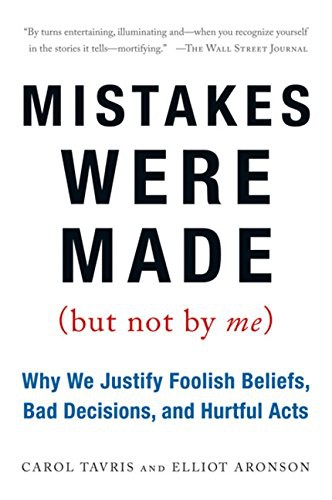
Mistakes Were Made (But Not by Me)
by Carol Tavris & Elliot Aronson · 2007
Two social psychologists explain why the people least likely to admit they're wrong are usually the ones most certain they're right, and why that pattern shows up in everyone, including you.
Worth reading? Tavris and Aronson (Aronson is one of the researchers who helped establish cognitive dissonance theory itself) build the case that self-justification isn't a character flaw limited to bad or dishonest people -- it's a universal psychological mechanism everyone uses to reduce the discomfort of holding contradictory beliefs about themselves, which is exactly why confident people, experts, and people in positions of authority are often the most resistant to admitting error, not the least. The book applies this mechanism across memory, relationships, the justice system, and politics, and the through-line is genuinely uncomfortable: the reader is never exempted from the pattern being described.
| Full Title | Mistakes Were Made (But Not by Me): Why We Justify Foolish Beliefs, Bad Decisions, and Hurtful Acts |
|---|---|
| Author | Carol Tavris & Elliot Aronson |
| Published | 2007 |
| Category | Self-Improvement & Psychology |
| Favorite quote | “The road to the hell of atrocity is paved with the small, self-justifying steps that got us there.” |
The Verdict
Aronson’s direct role in establishing cognitive dissonance theory gives this genuine research authority beyond typical pop psychology, and Tavris’s writing keeps it readable without losing that rigor. The book’s real achievement is making self-justification visible in the reader’s own thinking, not just diagnosing it in other people.
you want the definitive social psychology treatment of self-justification and cognitive dissonance, written by two researchers who helped define the field
you want a self-help book with a step-by-step fix -- this is more explanatory than prescriptive, focused on understanding the mechanism rather than a program to change it
Book Summary
Cognitive dissonance -- the psychological discomfort of holding two contradictory beliefs simultaneously, such as "I am a competent, ethical person" and "I made a decision that caused harm" -- gets resolved not by changing behavior but usually by changing the belief that's easier to change, which is typically the interpretation of what happened, not the self-image. This produces self-justification: reconstructing memory and interpretation to preserve a positive self-image rather than genuinely reckoning with error.
The authors show this mechanism operating at escalating stakes across domains: individuals misremembering past decisions to make themselves look more consistent and correct, married couples entrenching in mutual blame rather than repair, and -- most consequentially -- police, prosecutors, and expert witnesses doubling down on initial judgments (a suspect's guilt, a diagnosis, a theory) even after contradicting evidence emerges, because admitting the initial judgment was wrong threatens professional identity more than doubling down does.
Top 7 Lessons from Mistakes Were Made (But Not by Me)
- Cognitive dissonance -- the discomfort of holding contradictory self-beliefs -- typically gets resolved by changing the interpretation of events, not the underlying behavior.
- Self-justification is a universal psychological mechanism, not a character flaw limited to dishonest or bad people.
- Confident experts and authority figures are often more resistant to admitting error than less confident people, not less.
- Memory itself can be reconstructed over time to make past decisions look more consistent and correct than they actually were.
- Professional identity (a detective's certainty, a doctor's diagnosis) can make admitting an initial error feel more threatening than doubling down on it.
- Relationships entrench in mutual blame partly because each side's self-justification narrative makes their own position feel obviously correct.
- Recognizing your own capacity for self-justification, not just noticing it in others, is the harder and more useful application of this research.
Top 2 Quotes from Mistakes Were Made (But Not by Me)
"The road to the hell of atrocity is paved with the small, self-justifying steps that got us there."
Carol Tavris & Elliot Aronson, Mistakes Were Made (But Not by Me)
"Most people, when directly confronted by evidence that they are wrong, do not change their point of view or course of action but justify it even more tenaciously."
Carol Tavris & Elliot Aronson, Mistakes Were Made (But Not by Me)
Frequently Asked Questions
Is Mistakes Were Made (But Not by Me) worth reading?
Yes -- it's the definitive social psychology treatment of self-justification and cognitive dissonance, written by researchers who helped establish the underlying theory, and it applies genuinely uncomfortably to the reader as much as anyone else.
What is the main idea of Mistakes Were Made (But Not by Me)?
Self-justification is a universal psychological mechanism for resolving the discomfort of contradictory self-beliefs, and it's often strongest in confident experts and authority figures, not weakest -- the book traces this pattern across memory, relationships, and institutions like the justice system.
What is cognitive dissonance?
The psychological discomfort of holding two contradictory beliefs simultaneously (like 'I am competent' and 'I made a harmful mistake'), which the mind typically resolves by adjusting the interpretation of events rather than the underlying self-image.
Does this book offer a fix for self-justification?
It's more explanatory than prescriptive -- the authors focus on making the mechanism visible and understandable rather than providing a structured program to eliminate it, though awareness of the pattern is presented as a meaningful first step.
Ready to read it?
Get Mistakes Were Made (But Not by Me) on Amazon