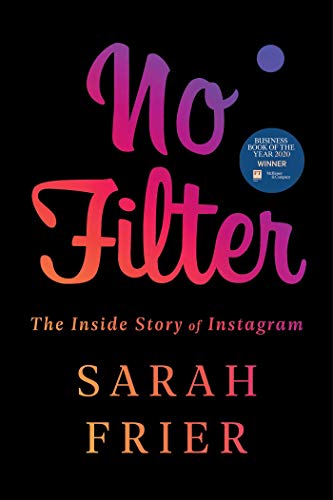
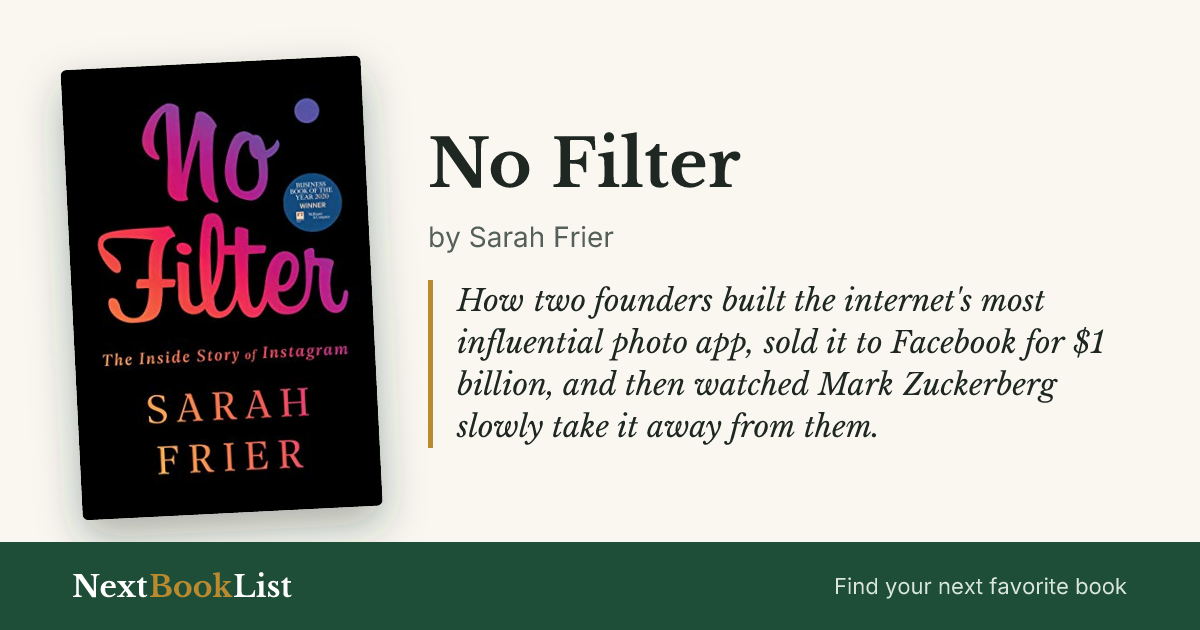
No Filter
by Sarah Frier · 2020
How two founders built the internet's most influential photo app, sold it to Facebook for $1 billion, and then watched Mark Zuckerberg slowly take it away from them.
Worth reading? No Filter is the best account of Instagram's rise because Frier gets both sides on the record -- Kevin Systrom and Mike Krieger's founder-led product instincts, and the Facebook pressure that eventually pushed them out. Skip it if you want growth tactics; this is a corporate power story, not a playbook.
| Full Title | No Filter: The Inside Story of Instagram |
|---|---|
| Author | Sarah Frier |
| Published | 2020 |
| Publisher | Simon & Schuster |
| Category | Business & Money |
| Favorite quote | “It used to be that the internet reflected humanity, but now humanity is reflecting the internet.” |
The Verdict
Frier’s access to Systrom and Krieger is what makes this work – you get the founders’ actual reasoning for the decisions that made Instagram different (the square photo constraint, the filter-first simplicity) instead of an outsider’s guess at it. That discipline is the most useful part of the book if you care about product, not growth hacks.
The second half is the more interesting story, though: watching a genuinely independent, well-run acquisition slowly get pulled into its parent company’s orbit until the founders who built its identity don’t have room to keep building it their way. If you’ve ever wondered what it actually costs a founder to sell to a bigger company – even a “good” acquisition, even one that made you rich – this is the case study.
you want to understand the tension between a founder's vision for a product and a parent company's demand to grow it at any cost
you're only interested in Instagram as a marketing channel -- this is a founder-and-power-struggle story, not a how-to-grow-your-account guide
Book Summary
Instagram succeeded initially because Systrom and Krieger obsessed over a narrow, disciplined product vision -- square photos, simple filters, no clutter -- at a moment when most competitors were adding features. That restraint, not raw growth tactics, is what made the app feel different enough to take off.
After Facebook's 2012 acquisition, Instagram operated with unusual independence for years -- its own team, its own product decisions -- which is part of why it kept innovating (Stories, cloned deliberately from Snapchat, being the clearest example) instead of stagnating inside a larger company.
That independence eroded as Instagram's growth started to look like a threat to Facebook's core app rather than a complement to it. Zuckerberg increasingly pushed Instagram to integrate with and support Facebook's metrics and ad business, and the founders' exit in 2018 reflected a loss of the autonomy that had made the product succeed in the first place.
Top 8 Lessons from No Filter
- A tightly scoped, disciplined product vision (square photos, simple filters, nothing else) can beat a feature-bloated competitor even with far fewer resources.
- An acquired startup can thrive inside a larger parent company for years if it's given real operational independence, not just money and technical resources.
- Cloning a competitor's core feature (Stories, taken from Snapchat) can work if you execute distribution and integration better than the originator, even without inventing the idea.
- A parent company's growth incentives (Facebook's ad business, user-engagement metrics) can eventually conflict with an acquired product's original design philosophy.
- Founder autonomy inside an acquisition is never permanent -- it's held only as long as the parent company sees more value in independence than in control.
- Growth of an internal product to the point of rivaling or exceeding the parent company's core app is often treated as an internal threat, not a win to be celebrated company-wide.
- Founders who built a company's cultural identity can become expendable once their product's success starts drawing resources and attention away from the acquirer's flagship.
- Influencer culture and platform incentives evolve together -- Instagram's growth engine and the modern influencer economy were built in tandem, not created first and monetized later.
Top 4 Quotes from No Filter
"Instagram's early popularity was less about the technology and more about the psychology -- about how it made people feel. The filters made reality look like art. And then, in cataloging that art, people would start to think about their lives differently, and themselves differently, and their place in society differently."
Sarah Frier, No Filter
"It used to be that the internet reflected humanity, but now humanity is reflecting the internet."
Sarah Frier, No Filter
"A filter on Instagram was like if Twitter had a button to make you more clever."
Sarah Frier, No Filter
"The more you give up who you are to be liked by other people, it's a formula for chipping away at your soul. You become a product of what everyone else wants, and not who you're supposed to be."
Sarah Frier, No Filter
Frequently Asked Questions
Is No Filter worth reading?
Yes, if you want to understand how Instagram was actually built and why its founders eventually left Facebook. It's well-reported and reads fast.
Does No Filter cover the Facebook acquisition in detail?
Yes -- the 2012 acquisition, the years of relative independence that followed, and the growing tension with Zuckerberg that led to Systrom and Krieger's 2018 departure are the core of the book.
Is No Filter useful for social media marketers?
Indirectly -- it explains why Instagram's product decisions (Stories, the algorithm shift, influencer features) happened, which is useful context, but it's not a marketing how-to.
How is No Filter different from other Facebook/Meta books like An Ugly Truth?
An Ugly Truth focuses on Facebook's core platform and its content-moderation and political crises. No Filter is narrower and more founder-focused, centered specifically on Instagram's product story and its slow absorption into Facebook.
Ready to read it?
Get No Filter on Amazon