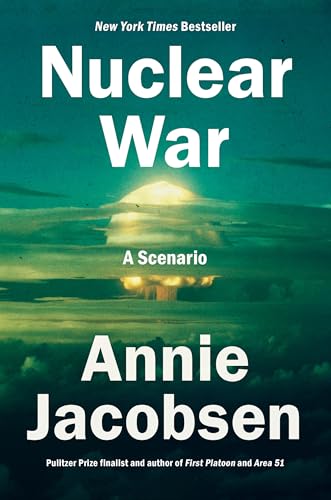
Nuclear War
by Annie Jacobsen · 2024
Jacobsen lays out, minute by minute, exactly how a single North Korean missile launch turns into the end of civilization in under an hour -- and every step of the chain is built from real declassified protocol, not speculation.
Worth reading? Jacobsen's real argument isn't that nuclear war is likely, it's that the system built to prevent it runs on a decision window measured in minutes, handed to one person, with almost no room for the process to slow down or double-check itself once it starts.
| Full Title | Nuclear War: A Scenario |
|---|---|
| Author | Annie Jacobsen |
| Published | 2024 |
| Publisher | Dutton |
| Category | History |
| Favorite quote | “Nuclear war is insanity. Its aftermath, unfathomable. But by preparing for it, we can understand it. And by understanding it, maybe, just maybe, we can prevent it.” |
The Verdict
Jacobsen’s format is simple and brutal: a single missile launch, a clock that starts running, and a minute-by-minute account of what actually happens next inside the real chain of command. No dramatization needed. The protocols themselves are the horror.
What sticks with you isn’t the physics of the weapons, it’s the timeline. Six minutes to decide. No institutional brake strong enough to stop a launch once it’s ordered. A system built entirely around speed, because the alternative – slowing down to verify – is the one thing the process wasn’t designed to survive.
Read it if you want to understand, in concrete terms, exactly how close the system sits to catastrophe on an ordinary day. Skip it if you’re looking for something that ends on a reassuring note – this book isn’t interested in comforting you, and it shouldn’t be.
you want to understand how close the nuclear launch process actually is to full annihilation, explained through named officials, real chain-of-command procedures, and zero Hollywood exaggeration
you want reassurance -- this book is built to unsettle you, and it does, methodically, for 400 pages
Book Summary
The entire American nuclear response process is built around a president who has roughly six minutes to decide whether to launch a retaliatory strike after a warning of incoming missiles -- not because six minutes is enough time to verify anything, but because that's what's left after accounting for detection, communication, and missile flight time. The system was never designed for careful deliberation; it was designed to be fast.
Jacobsen's scenario shows how quickly a limited, contained nuclear exchange becomes total -- once the first launch detection happens, the protocols on both sides are built to assume the worst and respond at full scale, because a leader who hesitates to verify a false alarm risks losing the ability to respond at all. The system's safeguards against accidental war and its safeguards against being too slow to respond are in direct tension, and speed usually wins.
Nuclear command authority is far more concentrated in a single person than most people realize -- there's no institutional check built to stop a president from launching, only advisors in the room who can talk, and a clock that doesn't wait for them to finish. The book's most unsettling case is how little redundancy exists between "the president decides" and "the missiles launch."
Top 8 Lessons from Nuclear War
- The presidential decision window for a nuclear response is measured in single-digit minutes, not hours -- there's no built-in pause for deliberation.
- A limited nuclear strike is far more likely to escalate to a full exchange than to stay contained, because both sides' protocols assume worst-case intent by default.
- There is no formal mechanism that can override a president's launch order in real time -- advisors can object, but they can't stop it.
- Missile-defense systems are far less reliable than public messaging suggests -- interception is closer to a coin flip than a guarantee.
- Communication infrastructure (the systems that relay launch orders and confirmations) is itself a point of catastrophic failure risk during the crucial minutes of a crisis.
- The people actually inside the nuclear chain of command -- silo crews, submarine officers, base commanders -- describe a job that runs on rehearsed procedure specifically because there's no time to improvise.
- A single miscalculated launch, even an accidental or unauthorized one, can trigger a retaliatory response before anyone has time to confirm it was a mistake.
- The gap between how citizens imagine nuclear war unfolding (slow, negotiated, reversible) and how the actual protocols are built to unfold (fast, automatic, escalatory) is enormous.
Top 1 Quotes from Nuclear War
"Nuclear war is insanity. Its aftermath, unfathomable. But by preparing for it, we can understand it. And by understanding it, maybe, just maybe, we can prevent it."
Annie Jacobsen, Nuclear War
Frequently Asked Questions
Is Nuclear War: A Scenario worth reading?
Yes -- it's one of the clearest, most unsettling explanations available of exactly how fast and how automatic the path to nuclear war actually is.
What is Nuclear War: A Scenario about?
It walks through a single hypothetical nuclear attack, minute by minute, using real declassified protocols and interviews to show how the American response system would actually function.
Is Nuclear War: A Scenario based on real information?
Yes -- Jacobsen draws on declassified government documents and interviews with former officials who worked inside the nuclear command chain, not speculation or fiction.
Do you need a military or policy background to read this book?
No -- Jacobsen writes for a general audience and explains the chain of command and the technology as she goes.
How does Nuclear War: A Scenario compare to Jacobsen's other books, like The Pentagon's Brain?
Similar deep-research style, but narrower and more urgent -- this one is built around a single ticking-clock scenario instead of a broad institutional history.
Ready to read it?
Get Nuclear War on Amazon