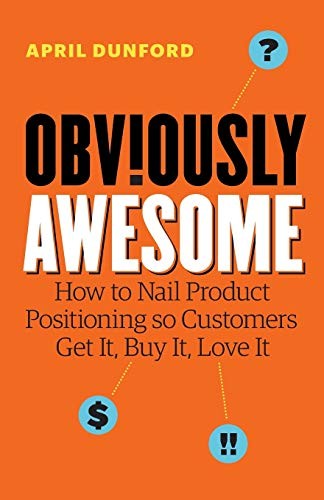
Obviously Awesome
by April Dunford · 2019
The book that explains why a worse product with better positioning keeps beating you.
Worth reading? Positioning has one classic reference -- Geoffrey Moore's "Crossing the Chasm" -- and Obviously Awesome is the modern, tactical version of it. Moore gives you the theory of market adoption curves; Dunford gives you a ten-component worksheet you can run in an afternoon with your actual sales team. If you've read Chasm and still can't explain why deals stall, this is the book that fixes it. Read it if your product keeps losing to worse competitors, or your sales team can't agree on what you're actually selling. Skip it if your problem is top-of-funnel awareness, not positioning -- this book won't get you more leads, it'll just make the leads you have convert better.
| Full Title | Obviously Awesome: How to Nail Product Positioning so Customers Get It, Buy It, Love It |
|---|---|
| Author | April Dunford |
| Published | 2019 |
| Publisher | Ambient Press |
| Category | Business & Money |
| Favorite quote | “Positioning is the act of deliberately defining how you are the best at something that a defined market cares a lot about.” |
The Verdict
Dunford ran positioning at enough B2B companies to know the difference between a good tagline and an actual strategy – and this book is the ten-step process she used to fix it, stripped of consulting jargon. If your product keeps losing pitches it should win, the problem usually isn’t the pitch.
you've got a product that's genuinely better than the competition but somehow still losing deals
you want copywriting tricks -- this is the strategy work that has to happen before you write a single headline
Book Summary
Positioning isn't marketing copy. It's the context you deliberately set before a customer ever reads your headline -- which competitive alternatives they're comparing you to, which attributes matter, and which market category frames the whole conversation. Get that context wrong and no amount of clever copywriting saves you.
Dunford's ten-component framework forces you to name your real competitive alternatives (sometimes "do nothing" or a spreadsheet, not the funded startup down the street), list the attributes only you have, translate those into value a specific customer segment actually cares about, and then pick the smallest market category where you can credibly claim to be the best.
Positioning isn't a launch-day task you check off once. Markets shift, competitors reposition, and your best-fit customer segment changes as you grow -- so the real skill is treating positioning as a recurring exercise, not a one-time document that sits in a slide deck.
Top 10 Lessons from Obviously Awesome
- Positioning is the strategic context that makes everything else -- copy, sales pitch, pricing -- land or fail.
- Customers judge you against competitive alternatives, and that alternative might be 'do nothing,' not the obvious rival.
- List every attribute only you have, then translate each one into value a specific customer segment actually cares about.
- Find your best-fit customers first -- the ones who get value fastest -- and build the pitch around them, not everyone.
- The market category you pick sets the customer's comparison set before you say another word.
- Winning a small, specific category you obviously dominate beats fighting for 'best' in a huge one.
- Positioning decays as the market changes -- revisit it, don't treat it as done.
- Get sales, product, and marketing aligned on the same positioning or every team pitches a different product.
- Borrowing momentum from a rising trend only works if the tie to your product is credible, not forced.
- Test positioning in real sales conversations, not in a conference room debate.
Top 2 Quotes from Obviously Awesome
"Positioning is the act of deliberately defining how you are the best at something that a defined market cares a lot about."
April Dunford, Obviously Awesome
"If you don't consciously position your product, your market will do it for you -- and they will usually get it wrong."
April Dunford, Obviously Awesome
Frequently Asked Questions
Is Obviously Awesome worth reading?
Yes, if you're the one responsible for explaining what your product is and why it wins. It's the most practical positioning framework in print. Skip it if you need top-of-funnel tactics, not strategic framing.
What is the main idea of Obviously Awesome?
Positioning is a deliberate choice -- competitive alternatives, unique attributes, target market, and market category -- not a copywriting exercise. Get the strategy right first.
Who should read Obviously Awesome?
Founders, product marketers, and sales leaders who can't agree on what they're actually selling or why deals stall against worse competitors.
Should I read Crossing the Chasm first?
Not required. Chasm gives you the adoption-curve theory; Obviously Awesome gives you the worksheet. Either order works, but most people get more immediate value starting here.
Ready to read it?
Get Obviously Awesome on Amazon