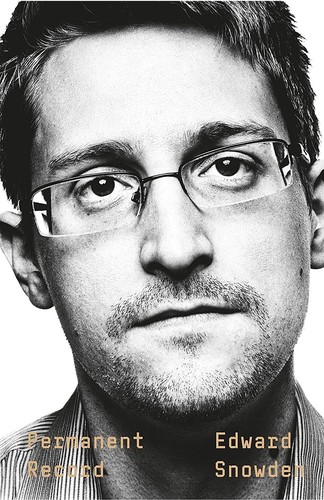
Permanent Record
by Edward Snowden · 2019
The NSA contractor who leaked the largest trove of classified surveillance documents in history explains, in his own words, why he decided the public had a right to know what its government was doing to it.
Worth reading? Permanent Record is at its best in its first half, where Snowden traces how an idealistic, technically gifted kid ends up inside the intelligence community and slowly realizes the scale of what it's building without public consent. The second half, covering the leak and its aftermath, is more familiar territory if you followed the news in 2013, but Snowden's own voice -- careful, technical, genuinely conflicted about patriotism versus complicity -- is worth reading in his own words rather than secondhand.
| Author | Edward Snowden |
|---|---|
| Published | 2019 |
| Publisher | Metropolitan Books |
| Category | Biographies & Memoirs |
| Favorite quote | “Arguing that you don't care about the right to privacy because you have nothing to hide is no different than saying you don't care about free speech because you have nothing to say.” |
The Verdict
Handle this one with the seriousness it deserves: whatever you think of Snowden’s choices, the book is a firsthand account of someone who gave up his country, his relationship, and his freedom of movement over a conviction about what governments owe their citizens. It’s worth reading his actual reasoning rather than the flattened hero-or-traitor version that dominates most discussion of him.
The most useful thing the book does is slow down the moment of realization – Snowden doesn’t leak the day he learns something troubling. He spends years rationalizing, gathering more context, trying to work the problem through internal channels first. That patience is what separates his account from a simple story of sudden conscience, and it’s also what makes the eventual decision to leak feel less impulsive than the public narrative around him often assumes.
you want Snowden's own account of how a systems administrator ended up with access to -- and a conscience about -- the US government's mass surveillance programs, told with more technical precision and less score-settling than you might expect
you're looking for a neutral, both-sides account of whether the leaks were justified -- this is Snowden's own defense of his actions, written from exile, and it doesn't pretend to be otherwise
Book Summary
Snowden traces his path from a technically gifted, politically conventional kid steeped in early internet culture to a systems administrator with privileged access across the US intelligence community, and describes the gradual, uncomfortable realization that the surveillance infrastructure he was helping build and maintain had grown far beyond what any oversight body understood or the public had consented to.
The book's second half covers the mechanics and moral calculus of the 2013 leak -- what he took, how he got it to journalists, and why he chose exile over trial -- while making an extended argument that privacy is a precondition for other freedoms, not a luxury to be traded away for security, and that mass, suspicionless surveillance of a citizenry is incompatible with a functioning democracy regardless of the good intentions of any individual agency.
Top 8 Lessons from Permanent Record
- Snowden's path into the intelligence community wasn't ideological rebellion from the start -- he describes himself as a fairly conventional, patriotic young technologist, which makes his later disillusionment more credible than if he'd always been an outsider.
- The book argues privacy isn't about having something to hide, but about maintaining a private self at all -- a space where you're not performing for an audience, which mass surveillance eliminates by default.
- Snowden makes clear that no single law authorized the scope of the programs he found -- they grew through a series of individually defensible-seeming expansions after 9/11 that collectively exceeded any public mandate.
- The decision to go to journalists rather than release documents unfiltered was deliberate -- Snowden wanted editorial judgment applied to what became public, distinguishing his leak from a pure data dump.
- His account of choosing exile over facing trial in the US reflects his argument that the relevant laws (the Espionage Act) don't allow a public-interest defense, making a fair trial on the actual merits impossible as currently written.
- The book treats his family, particularly his father's background in the Coast Guard and his own upbringing near NSA facilities, as formative to a worldview that saw government service as legitimate, which complicates any simple narrative of him as anti-government from the start.
- Snowden's technical descriptions of surveillance systems are notably precise and unsensational -- he's making an engineer's case as much as a moral one, which gives the book a different register than typical whistleblower memoirs.
- The book's closing argument is that a citizenry's freedoms are interdependent -- surrendering your own privacy isn't a personal choice in isolation, it normalizes the infrastructure that can be used against everyone else too.
Top 5 Quotes from Permanent Record
"The reason you're reading this book is that I did a dangerous thing for a man in my position: I decided to tell the truth."
Edward Snowden, Permanent Record
"Arguing that you don't care about the right to privacy because you have nothing to hide is no different than saying you don't care about free speech because you have nothing to say."
Edward Snowden, Permanent Record
"We'd do well to remember that at the end of the day, the law doesn't defend us; we defend the law. And when it becomes contrary to our morals, we have both the right and the responsibility to rebalance it toward just ends."
Edward Snowden, Permanent Record
"But for one brief and beautiful stretch of time -- a stretch that, fortunately for me, coincided almost exactly with my adolescence -- the Internet was mostly made of, by, and for the people."
Edward Snowden, Permanent Record
"Because a citizenry's freedoms are interdependent, to surrender your own privacy is really to surrender everyone's."
Edward Snowden, Permanent Record
Frequently Asked Questions
Is Permanent Record worth reading?
Yes, if you want Snowden's own detailed account rather than secondhand news coverage -- the first half on his path into intelligence work is especially strong.
Is Permanent Record one-sided?
Yes, deliberately -- it's Snowden's own defense of his actions, written from exile in Russia. Read it as his case, not a neutral history.
Do I need technical knowledge to understand Permanent Record?
No -- Snowden explains the technical concepts clearly for a general audience, though he does go into more system-level detail than most political memoirs.
Does Permanent Record cover what happened after the 2013 leak?
Yes, the second half covers the leak's mechanics, his flight to Hong Kong and then Russia, and his reasoning for choosing exile over a US trial.
Ready to read it?
Get Permanent Record on Amazon