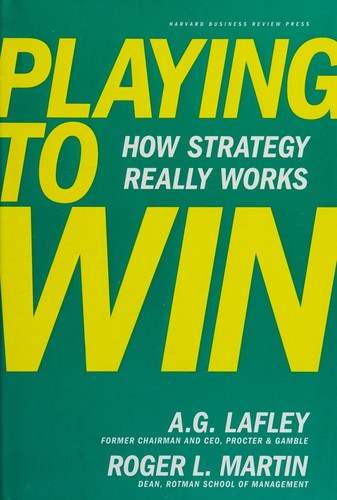
Playing to Win
by A.G. Lafley and Roger Martin · 2013
Former P&G CEO A.G. Lafley and strategist Roger Martin reduce corporate strategy to five cascading choices, built around the real decisions that turned around Procter & Gamble's biggest brands.
Worth reading? Playing to Win earns its reputation as one of the clearer strategy books written by people who actually ran the strategy, not just consulted on it. Lafley and Martin's five-question cascade (What's our winning aspiration? Where will we play? How will we win? What capabilities do we need? What management systems are required?) is genuinely reusable outside P&G, and the case studies on Olay's repositioning and Pampers' entry into China ground the framework in specifics instead of leaving it abstract.
| Full Title | Playing to Win: How Strategy Really Works |
|---|---|
| Author | A.G. Lafley and Roger Martin |
| Published | 2013 |
| Publisher | Harvard Business Review Press |
| Category | Business & Money |
| Favorite quote | “Remember, strategy is choice.” |
The Verdict
The five-question cascade is the reason this book gets assigned in MBA programs, and it earns the reputation. Lafley and Martin force “strategy” back into decisions you can actually act on, instead of the vague aspirational language most strategy documents settle for.
What makes it land is the specificity – Olay’s repositioning and Pampers’ China entry are broken down as decisions, not case-study filler, so you can see how “where to play” and “how to win” actually interact in a real business.
Read it if you’re setting strategy for a team, brand, or business unit and want a framework built from real decisions instead of consulting jargon. Skip it if you’re looking for startup, personal, or career strategy – this one’s built for people running established brands.
you run a team, a business unit, or a company and want a strategy framework built from real P&G decisions (Olay, Pampers, SK-II) instead of abstract consulting theory
you're looking for startup or personal-career strategy advice -- this is a corporate-brand-management playbook written by and for people running large, established businesses
Book Summary
The book's core idea is that strategy is a cascade of five interlocking choices, not a single big decision: a winning aspiration, a choice of where to compete, a choice of how to win there, the capabilities required to win, and the management systems that sustain it.
Lafley and Martin argue most companies confuse strategy with planning or goal-setting, listing what they'd like to achieve rather than making the hard, exclusionary choices about where to compete and where not to that actual strategy requires.
The P&G case studies -- particularly Olay's repositioning from a drugstore brand to a prestige-adjacent skincare line, and Pampers' shift from selling diapers to selling "baby development" -- show the framework applied to real, high-stakes brand decisions rather than hypotheticals.
The book closes on the idea that strategy is inherently a set of testable choices, not a fixed plan: you form a hypothesis about where and how to win, test it against reality, and adjust.
Top 8 Lessons from Playing to Win
- Strategy is a cascade of five choices -- winning aspiration, where to play, how to win, required capabilities, and management systems -- not a single big decision or a wish list of goals.
- 'Where to play' means choosing a specific market, customer segment, or geography to compete in, which by definition means choosing not to compete everywhere.
- 'How to win' requires a genuine competitive advantage in the chosen arena, not just a general commitment to quality or effort.
- Most companies write down goals and call it strategy, without making the hard exclusionary choices about where to compete and where not to.
- Olay's shift from a mass-market drugstore brand to a prestige-adjacent skincare line succeeded because it changed 'where to play' (price tier, retail channel) and 'how to win' (product formulation, marketing) together, not separately.
- Capabilities and management systems have to match the strategic choice -- a 'premium' strategy without the R&D or marketing capability to support it will fail regardless of intent.
- Strategy should be treated as a testable hypothesis, not a fixed multi-year plan -- you make a choice, test it against market results, and revise.
- Good strategy makes a company's competitors' job harder by narrowing where and how the company competes, rather than trying to be strong everywhere at once.
Top 3 Quotes from Playing to Win
"Remember, strategy is choice."
A.G. Lafley and Roger Martin, Playing to Win
"No company can do everything well. If you try to do so, you will do everything weakly."
A.G. Lafley and Roger Martin, Playing to Win
"Don't start wars on multiple fronts at once. Plan for your competitors' reactions to your initial choices, and think multiple steps ahead. No single choice needs to last forever, but it should last long enough to confer the advantage you seek."
A.G. Lafley and Roger Martin, Playing to Win
Frequently Asked Questions
Is Playing to Win worth reading?
Yes, if you're responsible for setting strategy at a company or business unit -- it's one of the more concrete, case-study-grounded strategy frameworks available.
What is Playing to Win about?
A five-question strategy framework developed at Procter & Gamble, covering winning aspiration, where to play, how to win, required capabilities, and management systems, illustrated through real P&G brand decisions.
Is Playing to Win useful for startups?
Less so -- the framework and case studies are built around managing established brands at a large corporation, not early-stage company building.
Do I need a business background to read Playing to Win?
Basic familiarity with corporate strategy and brand management helps, but the five-question framework itself is explained clearly enough for a motivated general reader.
Ready to read it?
Get Playing to Win on Amazon