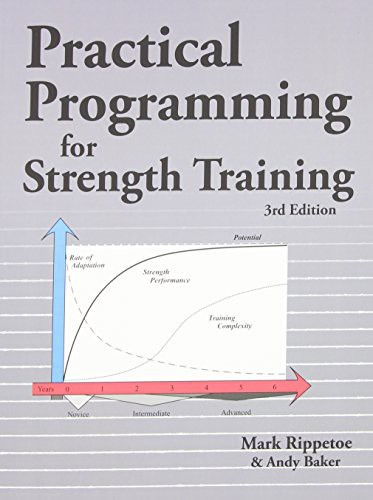
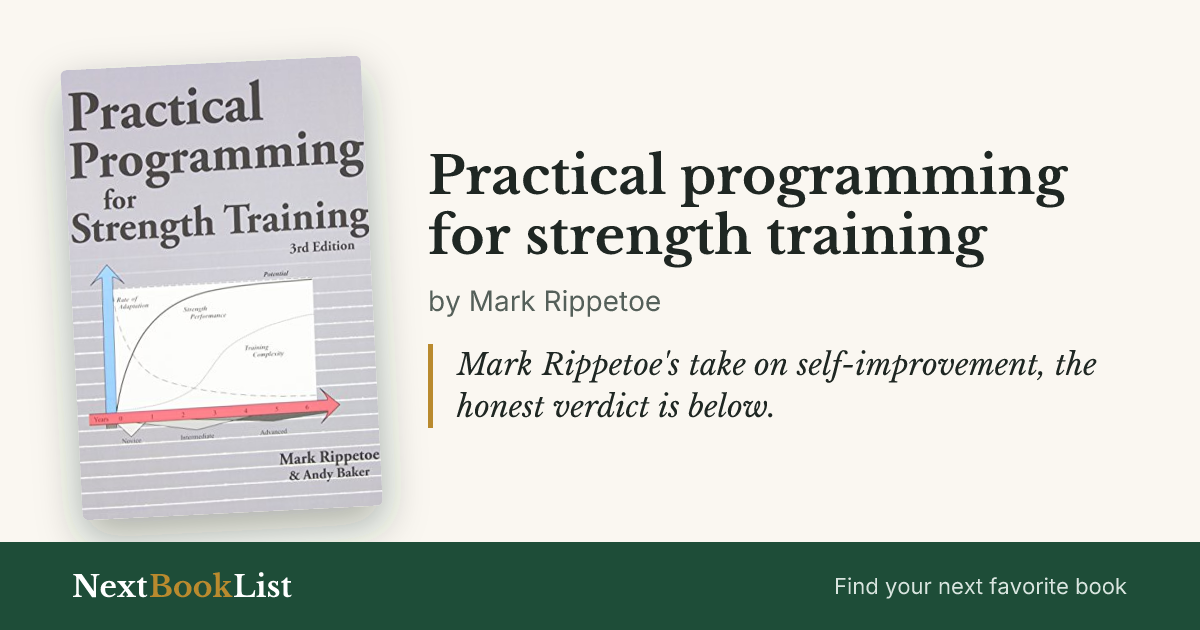
Practical programming for strength training
by Mark Rippetoe · 2006
Mark Rippetoe's take on self-improvement, the honest verdict is below.
Worth reading? Rippetoe's technical manual explains the physiology and programming behind getting stronger, dense but the best of its kind. Read it if you train seriously and want the 'why'; skip it if you just want a workout app, because this is textbook-level.
| Author | Mark Rippetoe |
|---|---|
| Published | 2006 |
| Category | Self-Improvement & Psychology |
| Favorite quote | “There is a difference between Exercise and Training.” |
The Verdict
Rippetoe’s technical manual explains the physiology and programming behind getting stronger, dense but the best of its kind. Read it if you train seriously and want the ‘why’; skip it if you just want a workout app, because this is textbook-level.
anyone weighing whether Practical programming for strength training belongs on their self-improvement and psychology shelf
you want a different angle than Mark Rippetoe's
Top 8 Lessons from Practical programming for strength training
- Strength is built by progressively overloading a small set of barbell lifts.
- The body adapts to stress; programming must increase load over time.
- Recovery and nutrition are where the growth actually happens.
- Novices can progress every session; intermediates need periodization.
- Form determines whether the target muscle takes the load.
- Specificity matters, train the movement you want to improve.
- Volume, intensity, and frequency trade off as you advance.
- Track loads precisely or you're guessing, not training.
Top 4 Quotes from Practical programming for strength training
"The key to successful training in this stage of development is to balance these two important and opposing phenomena -- the increased need for stress and the corresponding requisite increase in recovery time."
Mark Rippetoe, Practical programming for strength training
"There is a difference between Exercise and Training. Exercise is physical activity for its own sake, a workout done for the effect it produces today, during the workout or right after you're through. Training is physical activity done with a longer-term goal in mind, the constituent workouts of which are specifically designed to produce that goal."
Mark Rippetoe, Practical programming for strength training
"Humans are built to move. We evolved under conditions that required daily intense physical activity, and even among individuals with lower physical potential, that hard-earned genotype is still ours today."
Mark Rippetoe, Practical programming for strength training
"Myofibrillar hypertrophy, more actin, myosin, and other associated proteins are added to those already existing in the cell. More contractile elements within the cell mean more actin/myosin interactions and more force production."
Mark Rippetoe, Practical programming for strength training
Frequently Asked Questions
Is Practical Programming for Strength Training worth reading?
Yes for lifters ready to understand programming, not just lifts.
What is the main idea of Practical Programming for Strength Training?
That strength is a trainable adaptation best built through systematic, progressive overload.
Who should read it?
Serious trainees, coaches, and anyone past the beginner stage.
Ready to read it?
Get Practical programming for strength training on Amazon