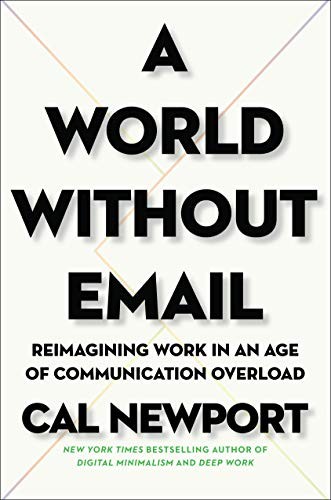
A World Without Email
by Cal Newport · 2021
Cal Newport's case that the real productivity killer is the 'hyperactive hive mind' workflow of constant ad hoc messaging, not any one inbox.
Worth reading? The most useful Newport book if you can actually change how your team works, and the most frustrating one if you can't. Inbox-zero tricks don't touch the problem he's describing; the fix is structural. Read it if you have any say over your team's workflow. Skip it if you're one person inside a broken system with no authority to fix it -- you'll agree with every page and be able to act on none of it.
| Full Title | A World Without Email: Reimagining Work in an Age of Communication Overload |
|---|---|
| Author | Cal Newport |
| Published | 2021 |
| Publisher | Portfolio |
| Category | Self-Improvement & Psychology |
| Favorite quote | “The hyperactive hive mind, though convenient, is a disastrously ineffective way to organize our efforts.” |
The Verdict
Newport’s argument here is narrower and more structural than Deep Work: it’s not that email is bad, it’s that most teams run on a “hyperactive hive mind” workflow of constant, unscheduled messaging, and that workflow is what’s actually exhausting everyone.
The fix isn’t a better inbox system. It’s replacing ad hoc requests with defined processes: office hours instead of instant replies, task boards instead of chat threads, protocols instead of renegotiating the same request every time it comes up.
That’s also the catch. This book requires organizational authority to act on. If you can change how your team works, it’s genuinely useful. If you’re one person inside someone else’s broken system, you’ll nod along and change nothing.
managers and teams with actual say over how they communicate, not just their own inbox habits
you're an individual contributor with zero influence over team workflow -- the fixes here are mostly structural
Book Summary
The "hyperactive hive mind" workflow -- ad hoc, unscheduled messages flying all day with no defined process -- is the default in most knowledge work, and it's why everyone feels busy but produces less than the hours suggest.
Checking a message pulls your full attention with it for longer than the seconds it takes to read, the same tax multitasking research already established. A constant stream of small interruptions costs far more than its total interruption time.
The fix isn't inbox-zero discipline, it's redesigning the workflow itself: process-driven task boards, defined communication protocols, scheduled office hours, and fewer ad hoc requests that force a reply.
Top 8 Lessons from A World Without Email
- The hyperactive hive mind -- constant unscheduled messaging -- is the real productivity killer, not any one email.
- Checking a message pulls your whole attention with it, even for a few seconds.
- Fix workflows, not inboxes -- inbox-zero tricks don't touch the root cause.
- Give recurring tasks a defined process instead of renegotiating them over chat every time.
- Office hours and scheduled check-ins remove the need for instant replies.
- A protocol -- a form, a queue, a standing process -- removes decisions from every single request.
- Batch communication into a few fixed windows instead of monitoring all day.
- Attention capital is worth protecting at the team level, not just personally.
Top 4 Quotes from A World Without Email
"As long as we remain committed to a workflow based on constant, ad hoc messaging, our Paleolithic brain will remain in a state of low-grade anxiety."
Cal Newport, A World Without Email
"The hyperactive hive mind, though convenient, is a disastrously ineffective way to organize our efforts."
Cal Newport, A World Without Email
"Email isn't additive; it's ecological. The office of 2021 is not the office of 1991 plus some extra capabilities; it's instead a different office altogether."
Cal Newport, A World Without Email
"From this perspective, the crowded email inbox is not just frustrating -- it's a matter of life or death."
Cal Newport, A World Without Email
Frequently Asked Questions
Is A World Without Email worth reading?
Yes, if you have influence over how your team communicates. It's less useful if you're a lone individual contributor stuck inside someone else's broken workflow.
What is the main idea of A World Without Email?
The problem isn't email itself, it's the 'hyperactive hive mind' workflow of constant, unscheduled messaging. Fixing it requires redesigning workflows and protocols, not managing your inbox better.
How does this compare to Deep Work?
Deep Work is about protecting your own individual focus. A World Without Email is about fixing the team-level system that keeps interrupting it. Read Deep Work for yourself, this one for your org.
Who should read A World Without Email?
Managers, team leads, and founders who can actually change workflow. Individual contributors with no structural say will find it more frustrating than useful.
Ready to read it?
Get A World Without Email on Amazon