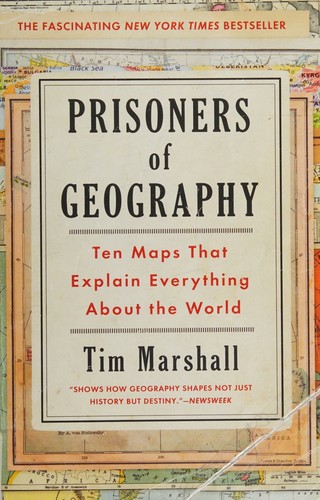
Prisoners of Geography
by Tim Marshall · 2015
Russia invades its neighbors on a cycle you can predict just by looking at a map -- it has no natural mountain borders to the west, so it keeps pushing its buffer zone out, generation after generation, regardless of who's in charge.
Worth reading? Marshall's core argument is unfashionable and correct: leaders change, ideologies change, but mountain ranges and river mouths don't -- and most of what looks like a nation's strange, aggressive, or paranoid foreign policy is actually just geography working exactly as it always has.
| Full Title | Prisoners of Geography: Ten Maps That Explain Everything About the World |
|---|---|
| Author | Tim Marshall |
| Published | 2015 |
| Publisher | Scribner |
| Category | History |
| Favorite quote | “The land on which we live has always shaped us.” |
The Verdict
Marshall’s trick is making an old, unfashionable idea feel fresh again: geography is destiny, or close enough to it. Every chapter picks a region, hands you its map, and shows you the mountain range or river mouth that’s been quietly running its foreign policy for centuries, regardless of who’s currently in charge.
The Russia chapter is the one people quote most, and for good reason – once you see the North European Plain as a wide-open invasion corridor with no natural stopping point before Moscow, half of Russia’s modern behavior stops looking paranoid and starts looking predictable. That’s the whole book’s method, applied ten times over.
Read it if you want a fast, durable framework for why nations act the way they do. Skip it if you need depth on one specific region – this book trades depth for breadth, ten chapters in one volume, and it’s honest about that tradeoff.
you want a fast, map-by-map explanation of why countries do what they do, without wading into a 600-page academic geopolitics text
you want deep, current-events-level nuance on any single region -- this is a wide survey, ten regions in one book, so each gets a chapter, not a monograph
Book Summary
Geography constrains politics more than politicians like to admit. Russia's repeated pushes into Eastern Europe aren't about any particular leader's ambition -- they're about the North European Plain, a flat corridor with no mountain barrier that has let invaders reach Moscow for centuries, which means Russia will keep trying to hold a buffer zone there regardless of who's in the Kremlin.
Access to warm-water ports, control of river systems, and natural mountain borders explain a huge amount of why certain countries became powerful and others stayed fragmented -- China's ability to unify around its river systems versus Africa's difficulty unifying across a continent carved up by colonial borders that ignored its actual terrain and ethnic geography.
The book's ten-map structure -- Russia, China, USA, Western Europe, Africa, the Middle East, India and Pakistan, Korea and Japan, Latin America, the Arctic -- isn't arbitrary; each region's defining conflicts trace back to a specific physical feature (a mountain range, a strait, a river mouth) that outlasts any single government's policy.
Top 8 Lessons from Prisoners of Geography
- Russia's repeated westward expansion into Eastern Europe is driven by the lack of a natural mountain barrier on the North European Plain, not by any one leader's personal ambition.
- Warm-water port access is a recurring, underrated driver of a country's foreign policy -- Russia's entire Crimea strategy traces back to needing a port that doesn't freeze.
- China's historical ability to unify around major river systems (the Yangtze, the Yellow River) explains its long tradition of centralized rule in a way ideology alone doesn't.
- Colonial-era borders in Africa were drawn on maps in European capitals with no regard for existing ethnic or geographic boundaries, and that mismatch still drives conflict today.
- The United States' geography -- ocean buffers on two sides, a navigable river system, arable land -- gave it a level of natural security that shaped its rise as a global power more than any single policy decision.
- Mountain ranges function as some of history's most durable political borders, because they're expensive to cross and easy to defend.
- The Middle East's modern conflicts often trace back to colonial-era border lines (drawn by Britain and France) that split ethnic and religious groups across states that didn't reflect any natural geographic logic.
- Arctic ice melt is opening a new geopolitical frontier -- new shipping routes and resource access are turning a once-irrelevant region into a coming arena of competition among Russia, the US, and others.
Top 5 Quotes from Prisoners of Geography
"The land on which we live has always shaped us."
Tim Marshall, Prisoners of Geography
"Geography has been overlooked in the study of international relations."
Tim Marshall, Prisoners of Geography
"The countries of northern Europe have been richer than those of the south for several centuries. The north industrialised earlier than the south and so has been more economically successful."
Tim Marshall, Prisoners of Geography
"There are fifty American states, but they add up to one nation in a way the twenty-eight sovereign states of the European Union never can."
Tim Marshall, Prisoners of Geography
"A Russian island in the Bering Strait is two and a half miles from an American island in the Strait, Little Diomede Island, and can be seen with the naked eye."
Tim Marshall, Prisoners of Geography
Frequently Asked Questions
Is Prisoners of Geography worth reading?
Yes -- it's a clear, fast way to understand why countries behave the way they do, using physical geography instead of ideology or personality as the explanation.
What is Prisoners of Geography about?
It walks through ten world regions -- Russia, China, the US, Western Europe, Africa, the Middle East, India and Pakistan, Korea and Japan, Latin America, and the Arctic -- explaining how mountains, rivers, and coastlines shape each region's conflicts and foreign policy.
Do you need a background in geopolitics to read this book?
No -- it's written for a general reader, with maps and plain explanations rather than academic jargon.
Is Prisoners of Geography still relevant given how fast geopolitics changes?
Its core argument (physical geography is durable) ages well even as current events shift, though specific policy details from 2015 will feel dated on any single news cycle.
How does this compare to a standard international relations textbook?
It's far more readable and map-driven, but shallower on any single region -- treat it as a framework for understanding geopolitics, not a substitute for deep regional study.
Ready to read it?
Get Prisoners of Geography on Amazon