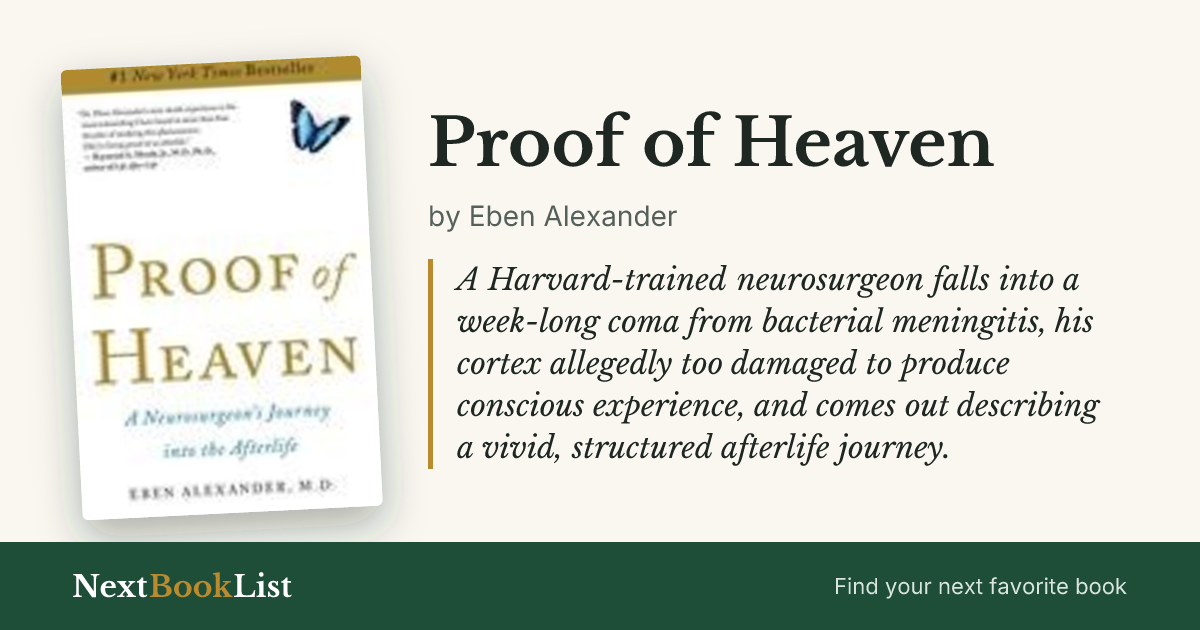
Proof of Heaven
by Eben Alexander · 2012
A Harvard-trained neurosurgeon falls into a week-long coma from bacterial meningitis, his cortex allegedly too damaged to produce conscious experience, and comes out describing a vivid, structured afterlife journey.
Worth reading? Proof of Heaven's selling point is Eben Alexander's medical credentials -- a neurosurgeon telling you his cortex was too damaged to hallucinate is a stronger rhetorical claim than a layperson making the same case. That claim didn't hold up well under scrutiny: a 2013 Esquire investigation and various neuroscientists disputed both his account of the severity of his cortical damage and his medical conduct around the case. The book is worth reading as a testimony and a data point in the near-death-experience genre, not as the scientific 'proof' its title claims.
| Full Title | Proof of Heaven: A Neurosurgeon's Journey into the Afterlife |
|---|---|
| Author | Eben Alexander |
| Published | 2012 |
| Publisher | Simon & Schuster |
| Category | Religion & Spirituality |
| Favorite quote | “Love is, without a doubt, the basis of everything.” |
The Verdict
Alexander’s medical credentials are the whole engine of this book’s persuasiveness – a neurosurgeon claiming his own cortex couldn’t have produced the experience carries more weight than the same claim from a layperson. That’s exactly the claim that came under the most direct fire after publication.
A 2013 Esquire investigation and several neuroscientists disputed both the severity of the cortical damage Alexander describes and details of how he presented his own case, and the book doesn’t grapple with any of that pushback because it came after publication. Read the account, then read the criticism – don’t take the title’s “proof” at face value.
Read it if you want a vivid, well-told near-death experience narrative and you’ll seek out the scientific pushback separately. Skip it if you want a book that engages honestly with the direct challenges to its own central claim.
you want a near-death experience account with the added weight of the narrator's medical credentials, and you're comfortable weighing his self-reported neurological interpretation against the real scientific criticism it received
you want a book that engages seriously with the scientific critiques of its own central claim -- Alexander's argument that his cortex was too damaged to produce the experience was directly disputed by neuroscientists and journalists after publication, and the book itself doesn't grapple with that pushback
Book Summary
Alexander describes falling into a week-long coma after contracting severe bacterial meningitis, during which he says his neocortex was so damaged that it should have been incapable of producing any conscious experience, memory, or hallucination by conventional neuroscience.
During the coma, Alexander describes a vivid, structured near-death experience -- travelling through a realistic, otherworldly landscape, guided by a young woman, and eventually reaching a place he interprets as a divine presence -- which he presents as evidence the mind can operate independently of the physical brain.
The book's central scientific claim -- that his cortex was too severely damaged to generate the experience through ordinary neurological means -- became the book's most contested point after publication; a 2013 Esquire magazine investigation, along with statements from neuroscientists, challenged both the medical details of his account and his framing of the case.
Alexander frames his experience as effectively converting him from a skeptical scientist to a believer in consciousness surviving death, presenting the book as a first-person scientific testimony rather than religious doctrine, though critics have argued the "proof" framing overstates what a single, unverifiable subjective account can establish.
Top 8 Lessons from Proof of Heaven
- Alexander's central claim -- that his cortex was too damaged during his coma to produce any conscious experience by conventional means -- was directly disputed after publication by neuroscientists and by a 2013 Esquire investigation into his medical records and professional history.
- A near-death experience, however vivid or medically dramatic its circumstances, remains a single, subjective, unverifiable account, and a narrator's medical credentials don't by themselves make an unfalsifiable claim provable.
- The book presents itself as scientific proof of an afterlife, a framing that goes well beyond what any single first-person account, verified or not, could establish.
- Public scrutiny of high-profile personal claims -- including a narrator's professional and medical history -- is a normal and appropriate part of evaluating extraordinary claims, and readers should seek out that scrutiny alongside the book itself.
- The near-death-experience genre, of which this book is one prominent example, reflects a broad and persistent public interest in evidence of consciousness surviving death, independent of how well any individual account holds up to investigation.
- Alexander's account follows a structured narrative arc -- an otherworldly landscape, a guide, a culminating divine presence -- that reads as a coherent story, which is part of what makes it persuasive as testimony even though structure isn't the same as evidence.
- The scrutiny that followed publication extended beyond the cortex-damage claim itself to Alexander's own account of his professional history and conduct, meaning the credibility questions aren't limited to just the central medical argument.
- The book's arc -- skeptical scientist transformed into believer by direct experience -- is a common structure across the near-death-experience genre, and its persuasive power comes from that arc as much as from any single verifiable detail.
Top 5 Quotes from Proof of Heaven
"A story -- a true story -- can heal as much as medicine can."
Eben Alexander, Proof of Heaven
"Communicating with God is the most extraordinary experience imaginable, yet at the same time it's the most natural one of all, because God is present in us at all times."
Eben Alexander, Proof of Heaven
"Laughter and irony are at heart reminders that we are not prisoners in this world, but voyagers through it."
Eben Alexander, Proof of Heaven
"Love is, without a doubt, the basis of everything."
Eben Alexander, Proof of Heaven
"The ascendance of the scientific method based solely in the physical realm over the past four hundred years presents a major problem: we have lost touch with the deep mystery at the center of existence -- our consciousness."
Eben Alexander, Proof of Heaven
Frequently Asked Questions
Is Proof of Heaven worth reading?
As a testimony and a genre entry, yes -- but not as the scientific proof its title promises. The book's central medical claim was directly disputed by neuroscientists and a 2013 Esquire investigation after publication.
What is Proof of Heaven about?
Neurosurgeon Eben Alexander describes a vivid near-death experience during a coma he says left his cortex too damaged to produce conscious experience by conventional means, which he interprets as evidence of an afterlife.
Was Proof of Heaven's central claim disputed?
Yes -- a 2013 Esquire magazine investigation and statements from neuroscientists challenged both the severity of Alexander's cortical damage and other details of his account.
Is Proof of Heaven scientifically verified?
No -- it's a single, subjective first-person account. The 'proof' in the title reflects Alexander's own framing, not independent scientific verification.
Ready to read it?
Get Proof of Heaven on Amazon