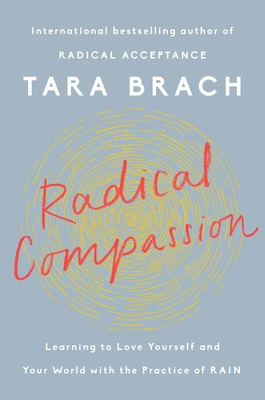
Radical Compassion
by Tara Brach · 2019
A four-step meditation practice for the moment you're about to spiral, taught by a psychologist who's actually watched thousands of people use it.
Worth reading? Radical Compassion earns its shelf space because it gives you an actual tool, not just the instruction to 'be kinder to yourself.' RAIN (Recognize, Allow, Investigate, Nurture) is Brach's four-step meditation for catching yourself mid-spiral and metabolizing the feeling instead of fighting or feeding it. She's a clinical psychologist and meditation teacher, and the book is full of real client and student stories rather than abstract theory. It's slower and more meditation-heavy than a pure self-help book, so if you want fast tactics, this isn't it. Read it if self-criticism is your actual problem and you want a practice, not just a mantra.
| Full Title | Radical Compassion: Learning to Love Yourself and Your World with the Practice of RAIN |
|---|---|
| Author | Tara Brach |
| Published | 2019 |
| Publisher | Viking |
| Category | Religion & Spirituality |
| Favorite quote | “The boundary to what we can accept is the boundary to our freedom.” |
The Verdict
Brach’s advantage over a lot of the self-compassion shelf is that she’s spent decades as both a clinical psychologist and a meditation teacher, so the book is full of specific client and student moments instead of abstract encouragement. RAIN gives you an actual four-step move for the exact second you notice yourself spiraling, which is more than most books in this space offer.
It’s slower than a typical self-help book, more meditation, more sitting with a feeling instead of fixing it fast. That’s the point, but it means if you want quick tactics you’ll get impatient. Read it if you actually want a practice for self-criticism, not just permission to be nicer to yourself. Skip it if you want something faster and less contemplative.
you want a concrete, repeatable technique for self-criticism and shame, not just the idea that you should be kinder to yourself
you want a purely secular, clinical approach -- Brach's practice is meditation-based and draws on Buddhist psychology throughout
Book Summary
Most emotional suffering comes from resisting or over-identifying with a difficult feeling rather than the feeling itself. Brach's core claim, echoed across the book's stories, is that the fight against an emotion usually hurts more than the emotion did.
RAIN, Recognize, Allow, Investigate, Nurture, is offered as a repeatable four-step practice for working with any difficult moment: name what's happening, let it be there without pushing it away, get curious about where it lives in the body and what it needs, then offer yourself the same care you'd offer a friend.
Self-compassion is not self-indulgence or an excuse to avoid responsibility. Brach repeatedly distinguishes it from self-pity: the nurturing step in RAIN is meant to restore enough stability that you can actually act clearly, not to let you off the hook.
Top 9 Lessons from Radical Compassion
- RAIN stands for Recognize, Allow, Investigate, Nurture -- a repeatable four-step practice for a difficult moment.
- Resisting a feeling usually causes more suffering than the feeling itself.
- Naming an emotion out loud or silently ('this is fear') creates immediate distance from it.
- Allowing a feeling to be present isn't the same as agreeing with it or acting on it.
- Investigating where an emotion lives in the body slows down the reactive story around it.
- Nurturing yourself the way you'd comfort a friend is a practiced skill, not a personality trait.
- Self-compassion is not self-indulgence -- it's what restores enough stability to act clearly.
- Shame specifically thrives in isolation and loses power the moment it's named to another person.
- A daily short practice compounds; RAIN is meant to be used in the moment, not just journaled about afterward.
Top 2 Quotes from Radical Compassion
"You can't be angry and compassionate at the same time."
Tara Brach, Radical Compassion
"The boundary to what we can accept is the boundary to our freedom."
Tara Brach, Radical Compassion
Frequently Asked Questions
Is Radical Compassion worth reading?
Yes, if self-criticism or shame is a real recurring problem for you and you want an actual technique, not just the general advice to be kinder to yourself.
What is the RAIN technique in Radical Compassion?
Recognize, Allow, Investigate, Nurture -- a four-step meditation for meeting a difficult feeling in the moment instead of fighting it or being swept away by it.
Is Radical Compassion religious?
It draws on Buddhist psychology and meditation, but Brach presents it in secular, practical language aimed at a general audience, not as religious instruction.
Does self-compassion mean letting yourself off the hook?
No -- Brach is explicit that self-compassion is meant to restore stability so you can act clearly, not an excuse to avoid responsibility.
Who is Radical Compassion for?
Anyone whose inner critic is loud and who wants a concrete, repeatable practice rather than another reminder that self-kindness matters.
Ready to read it?
Get Radical Compassion on Amazon