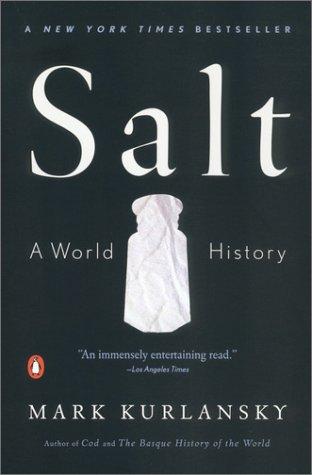
Salt: A World History
by Mark Kurlansky · 2002
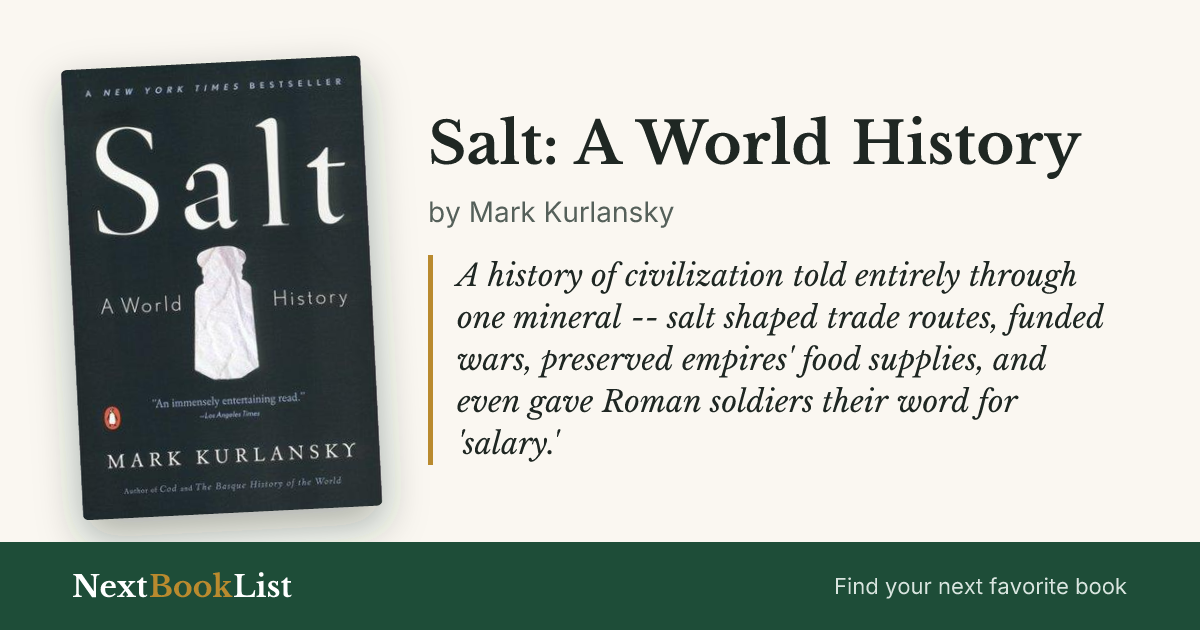
A history of civilization told entirely through one mineral -- salt shaped trade routes, funded wars, preserved empires' food supplies, and even gave Roman soldiers their word for 'salary.'
Worth reading? Salt works as a genre exercise -- Kurlansky takes an ordinary commodity and uses it as a lens across thousands of years of human history, from Chinese salt monopolies to Gandhi's Salt March. It's less a single narrative than a very well-researched anthology of salt's fingerprints across civilization, and readers who enjoy that format will get a lot out of it.
| Author | Mark Kurlansky |
|---|---|
| Published | 2002 |
| Publisher | Penguin Books |
| Category | History |
The Verdict
Kurlansky’s approach here is less about narrative drive and more about accumulation – chapter after chapter of salt showing up as the hidden hinge of some historical moment, from Chinese state monopolies to Roman soldier pay to Gandhi’s anti-colonial protest.
That structure makes the book easy to read in pieces rather than straight through, which is either a feature or a limitation depending on what you’re looking for. It rewards curiosity more than momentum.
The food-preservation chapters are the strongest, connecting salt directly to how entire regional economies (herring, cod, cured meats) developed around a substance most readers take for granted.
Read it if you want a sweeping, well-researched history built around a single overlooked commodity. Skip it if you want tight narrative momentum instead of an essentially episodic structure across eras and regions.
you want a sweeping, globe-spanning history built around a single, unglamorous commodity, in the same vein as Kurlansky's other single-subject histories
you want tight narrative momentum -- the book is organized more like an encyclopedia of salt's role across cultures and eras than a driving story with a beginning, middle, and end
Book Summary
Kurlansky traces salt's role as one of the first commodities important enough to shape trade routes, taxation systems, and even wars -- ancient China ran state salt monopolies to fund its government for centuries, and Venice built much of its early trading wealth on controlling Mediterranean salt production and distribution.
The book covers salt's essential role in food preservation before refrigeration existed, which made it critical to feeding armies, provisioning long sea voyages, and enabling the fish and meat trades (herring, cod, ham) that shaped entire regional economies -- salt wasn't a seasoning so much as the technology that let food travel and last.
Kurlansky also traces salt's political weight into the modern era, most notably Mahatma Gandhi's 1930 Salt March protesting the British colonial salt tax in India, using it as an example of how a substance so basic it's easy to overlook could become a flashpoint for anti-colonial resistance and a defining moment in the independence movement.
Top 8 Lessons from Salt: A World History
- Ancient Chinese dynasties ran state salt monopolies that functioned as a primary tax revenue source, showing how control of a basic commodity could fund entire governments for centuries.
- Before refrigeration, salt was the essential technology for preserving food over long distances and time, making it critical to provisioning armies, sea voyages, and regional trades like herring and cod fishing.
- Venice built significant early trading wealth on controlling Mediterranean salt production and distribution, illustrating how control of a basic resource could become genuine geopolitical leverage.
- The word 'salary' derives from the Latin word for salt, tied to a (partly disputed but widely repeated) tradition of Roman soldiers being paid in or with salt allowances.
- Gandhi's 1930 Salt March against British colonial salt taxation in India became a defining moment of nonviolent resistance in the Indian independence movement, showing how a mundane commodity could become a potent political symbol.
- Salt production methods -- solar evaporation, mined rock salt, boiled brine -- varied significantly by region and shaped where certain cities and trade hubs developed in the first place.
- Salted fish and meat trades (particularly herring and cod) built entire regional economies in medieval and early modern Europe, connecting salt directly to broader patterns of European trade and colonization.
- The book treats salt as a case study in how a resource can be simultaneously mundane in daily life and enormously consequential in shaping the political and economic structure of entire civilizations.
Frequently Asked Questions
Is Salt: A World History worth reading?
Yes, if you enjoy sweeping single-subject histories -- Kurlansky uses salt as a lens across thousands of years and multiple civilizations.
What is Salt: A World History about?
A history of civilization told through salt's role in trade, taxation, food preservation, and politics, from ancient Chinese salt monopolies to Gandhi's Salt March.
Is Salt: A World History a narrative or reference-style book?
It reads more like a well-organized survey across eras and regions than a single driving narrative, similar in structure to Kurlansky's other single-subject histories like Cod.
Do you need a background in history to enjoy this book?
No -- Kurlansky writes for a general audience and explains historical context as needed.
Did Mark Kurlansky write other books like this?
Yes, he's known for single-commodity histories, including Cod: A Biography of the Fish That Changed the World, published in 1997.
Ready to read it?
Get Salt: A World History on Amazon