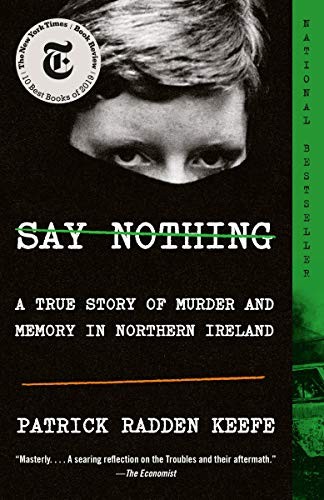
Say Nothing
by Patrick Radden Keefe · 2019
A mother of ten disappears off a Belfast street in 1972, and Keefe uses her unsolved murder to unravel the entire Troubles -- the IRA members who did it, the silence that protected them for decades, and what happens when a violent movement's veterans have to live with what peace cost them.
Worth reading? Keefe picks Jean McConville's disappearance as the thread that pulls the whole Troubles into focus, and it works because the case leads directly to real IRA figures -- Dolours Price, Brendan Hughes, Gerry Adams -- whose later lives force a reckoning with what the 'good' side of a war does to the people who fought it. It reads like true crime and delivers real history, and the ending, when the code of silence finally cracks, lands harder than most conventional histories manage.
| Full Title | Say Nothing: A True Story of Murder and Memory in Northern Ireland |
|---|---|
| Author | Patrick Radden Keefe |
| Published | 2019 |
| Publisher | Doubleday |
| Category | History |
| Favorite quote | “Whisht, they said. Say nothing.” |
The Verdict
Keefe’s smartest choice is refusing to write a sweeping institutional history of the Troubles and instead following one unsolved murder all the way down. Jean McConville’s disappearance becomes the thread that pulls in IRA recruitment, ideology, the “say nothing” code that protected killers for decades, and what happens to true believers once the war they fought is technically over.
It reads like true crime and delivers real history, which is a hard combination to pull off. Read it for the best entry point into the Troubles currently in print. Skip it only if you want full political-science coverage of the conflict – this stays tight on one case and a handful of lives.
you want narrative-driven history that reads like a true-crime investigation, using one disappearance to explain the machinery, ideology, and moral compromises of the Troubles
you want a broad political-science overview of the Northern Ireland conflict -- this stays tight on one case and a handful of IRA figures, not a comprehensive institutional history
Book Summary
A single unsolved crime can function as a lens onto an entire conflict's machinery -- Keefe uses Jean McConville's 1972 disappearance to trace IRA recruitment, ideology, internal discipline, and the code of silence ('whisht,' or 'say nothing') that protected perpetrators for decades.
Political violence doesn't end cleanly when a peace agreement is signed. The people who committed acts of violence in service of a cause have to keep living, often unpunished, alongside the families of their victims, and that unresolved tension outlasts the formal conflict.
Belief and complicity can survive intact in people who genuinely thought they were fighting for justice. Keefe is careful not to flatten IRA members like Dolours Price into either monsters or simple idealists -- both truths coexist in the same person.
Top 8 Lessons from Say Nothing
- A single unsolved crime can function as a lens onto an entire conflict's ideology, recruitment, and internal discipline.
- Political violence doesn't end cleanly at a peace agreement -- unpunished perpetrators and grieving families keep living alongside each other.
- A code of silence ('say nothing') can protect a cause for decades at the direct expense of victims' families ever getting answers.
- People who commit political violence can genuinely believe they're fighting for justice without that belief making the violence less real.
- Oral history projects meant to preserve truth (the Boston College tapes) can themselves become dangerous evidence once a peace holds.
- Movements that recruit committed idealists often demand acts from them that outlast their own certainty about the cause.
- Reconciliation processes can leave victims' families with peace but without justice, and both outcomes are real.
- The line between soldier and criminal blurs inside irregular, ideologically driven conflicts.
Top 1 Quotes from Say Nothing
"Whisht, they said. Say nothing."
Patrick Radden Keefe, Say Nothing
Frequently Asked Questions
Is Say Nothing worth reading?
Yes -- it's one of the best-reviewed narrative histories of the last decade, reading like true crime while delivering a serious account of the Troubles.
What is Say Nothing about?
The 1972 disappearance and murder of Jean McConville in Belfast, used by Patrick Radden Keefe to trace the IRA, its code of silence, and the unresolved legacy of the Troubles.
Is Say Nothing a comprehensive history of the Troubles?
No -- it stays focused on the McConville case and a handful of IRA figures rather than covering the full institutional and political history of the conflict.
Does Say Nothing reveal who killed Jean McConville?
It builds a strong, well-sourced case based on the Boston College oral history tapes and other evidence, though some details remain contested.
Ready to read it?
Get Say Nothing on Amazon