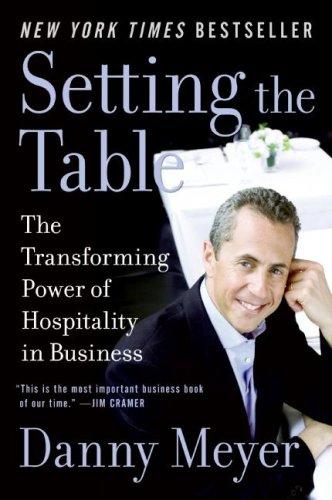
Setting the Table
by Danny Meyer · 2006
Restaurateur Danny Meyer's case that genuine hospitality, not just good service, is the real competitive edge.
Worth reading? Meyer draws a distinction most business books miss entirely: service is technically doing things right, hospitality is making the other person feel like you're on their side. Built from his own restaurant career (Union Square Cafe, Shake Shack), the book is candid about how hard that distinction is to actually train and sustain at scale. Skip it if your business has no direct customer relationship, the whole thesis assumes someone across the counter from you.
| Full Title | Setting the Table: The Transforming Power of Hospitality in Business |
|---|---|
| Author | Danny Meyer |
| Published | 2006 |
| Category | Business & Money |
| Favorite quote | “Business, like life, is all about how you make people feel. It's that simple, and it's that complicated.” |
The Verdict
Meyer draws a distinction most business books miss entirely: service is technically doing things right, hospitality is making the other person feel like you’re on their side. Built from his own restaurant career (Union Square Cafe, Shake Shack), the book is candid about how hard that distinction is to actually train and sustain at scale. Skip it if your business has no direct customer relationship, the whole thesis assumes someone across the counter from you.
founders and managers in any customer-facing business who confuse service with hospitality
you're not in a people-facing business and want pure operations advice
Book Summary
Restaurateur Danny Meyer's case that genuine hospitality, not just good service, is the real competitive edge. It earns its place by naming a distinction most customer-service advice blurs together. Service is doing things right; hospitality is how the customer feels while you do them. Hire for emotional skills first; technical skills can be taught. The practical move is to read it once, then act on the one idea that maps to your current bottleneck, rereading the whole thing rarely adds more than executing the part you skipped.
Top 14 Lessons from Setting the Table
- Service is doing things right; hospitality is how the customer feels while you do them.
- Hire for emotional skills first, warmth and generosity can't be trained the way a technical skill can.
- Employees who feel genuinely cared for pass that feeling straight to the guest; the chain starts inside.
- Enlightened Hospitality ranks the guest first, then the community, then the team, then the suppliers, then the investors, and that order is the point.
- Constant, honest self-critique after every service , 'what would we do differently', compounds over years.
- A great meal is remembered for how it made someone feel, not just what was on the plate.
- Hospitality has to be modeled by leadership, not just written into a training manual.
- Community relationships with suppliers, neighbors, and regulars are part of the hospitality, not separate from it.
- Open, confident body language and eye contact are teachable skills that change a guest's whole experience.
- Mistakes happen; what separates a great restaurant is how quickly and graciously you recover in front of the guest.
- Build a distinctive culture on purpose. Meyer's '51% Solution' is about hiring people who are already more than half the way there.
- Know your neighborhood and let the room reflect it, rather than importing a generic concept from somewhere else.
- Be willing to reinvent a beloved concept (Shake Shack grew out of a hot-dog cart) when the guest and the moment call for it.
- Long-term relationships with regulars matter more than maximizing any single table's check.
Top 3 Quotes from Setting the Table
"Business, like life, is all about how you make people feel. It's that simple, and it's that complicated."
Danny Meyer, Setting the Table
"Hospitality is present when something happens for you. It is absent when something happens to you."
Danny Meyer, Setting the Table
"Constant, gentle pressure."
Danny Meyer, Setting the Table
Frequently Asked Questions
Is Setting the Table worth reading?
Yes, if the description fits you, founders and managers in any customer-facing business who confuse service with hospitality. Skip it if you're not in a people-facing business and want pure operations advice.
What is the main idea of Setting the Table?
Danny Meyer distinguishes service (doing things right) from hospitality (how the customer feels while you do them), and argues the second is the real, harder-to-copy competitive edge.
Who should read Setting the Table?
Founders and managers in any customer-facing business. Skip it if your business has no direct customer relationship, the whole thesis assumes someone across the counter from you.
What will you get out of Setting the Table?
A clearer, opinionated take you can act on, plus the sharpest lessons pulled into a short list so you don't have to read the whole book to decide.
Ready to read it?
Get Setting the Table on Amazon