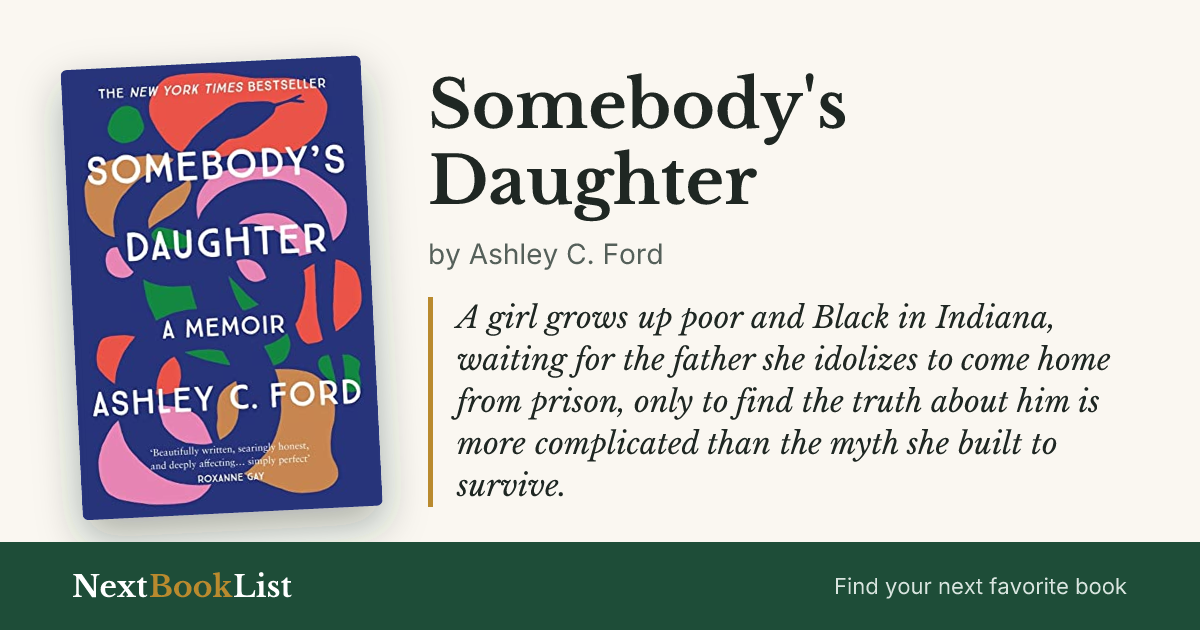
Somebody's Daughter
by Ashley C. Ford · 2021
A girl grows up poor and Black in Indiana, waiting for the father she idolizes to come home from prison, only to find the truth about him is more complicated than the myth she built to survive.
Worth reading? Ford spends her childhood mythologizing a father she barely knows, because a locked-up dad is easier to love in the abstract than the complicated adults actually raising her. The book earns its ending by refusing to resolve neatly -- Ford meets the real man behind the myth and has to rebuild what he means to her from the ground up. It's also, quietly, a memoir about growing up in a Black woman's body under scrutiny long before she understood why.
| Full Title | Somebody's Daughter: A Memoir |
|---|---|
| Author | Ashley C. Ford |
| Published | 2021 |
| Publisher | Flatiron Books |
| Category | Biographies & Memoirs |
The Verdict
Ford spends her whole childhood loving a version of her father that only exists because he isn’t there to complicate it. That’s the real subject of this book: not the crime that put him away, but the myth a kid builds to survive an absence, and what it costs to trade that myth for the actual person once he’s back.
It would’ve been easy to write this as a redemption story – dad comes home, family heals. Ford doesn’t let herself off that easy, and the book is better for it. Read it for a coming-of-age story that treats a Black girl’s body and family as subjects worth this much care. Skip it if you need the reunion to resolve into something tidier than real reunions usually are.
you want a coming-of-age memoir about body, race, and family loyalty, where the absent-parent story doesn't resolve into a clean reunion
you want the incarcerated-parent plot to end in redemption -- Ford's ending is honest, not triumphant, and some readers want triumphant
Book Summary
A parent's absence creates space for a child to build a myth in place of a person, and that myth can be more load-bearing to a kid's sense of self than the real relationship ever could be. Ford's idealization of her incarcerated father is protective, not naive.
Coming-of-age as a Black girl means learning to read how your body is perceived -- by family, by boys, by the world -- often years before you have language for what's happening to you or permission to object to it.
Reunion with an absent parent doesn't automatically deliver closure. Ford has to actively renegotiate who her father is to her once he's physically present again, and that process is slower and less satisfying than the fantasy that sustained her.
Top 8 Lessons from Somebody's Daughter
- A child will build an idealized myth around an absent parent because the myth is easier to love than the truth would be.
- Growing up under scrutiny of your body, as a Black girl, starts earlier and runs deeper than most adults around you acknowledge.
- Having a parent in prison shapes a childhood in ways that don't fit the redemption arcs pop culture assigns to that story.
- Family loyalty can require protecting secrets that also isolate you.
- A reunion with an absent parent is a beginning, not an ending -- the real relationship still has to be built.
- Sexual assault and its aftermath often go unspoken inside families that pride themselves on strength.
- Grandparents and extended family can fill a gap a parent left, imperfectly but genuinely.
- Writing your own story is one way to take back a narrative other people tried to write about you.
Frequently Asked Questions
Is Somebody's Daughter worth reading?
Yes. It's a well-observed coming-of-age memoir about family myth-making, and the writing is controlled even when the material is painful.
What is Somebody's Daughter about?
Ashley C. Ford's childhood in Indiana, defined by an incarcerated father she idolized from a distance, and the reckoning that follows his release.
Does Somebody's Daughter have a happy ending?
No clean one. Ford's father comes home, but the relationship she has to build with the real man is harder and less satisfying than the one she imagined.
Is Somebody's Daughter heavy subject matter?
Yes -- it covers sexual assault, incarceration, and poverty. Ford writes about all of it directly but without gratuitous detail.
Ready to read it?
Get Somebody's Daughter on Amazon