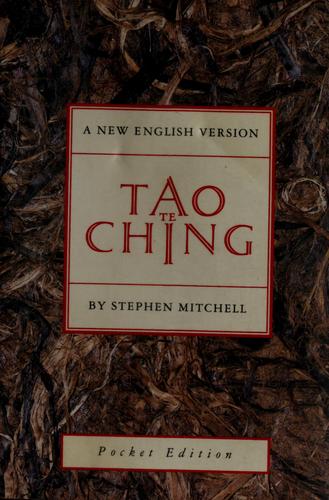
Tao Te Ching
by Lao Tzu, trans. Stephen Mitchell · 1988
2,500 years old, still the shortest path to 'stop forcing everything.'
Worth reading? The Tao Te Ching is the oldest book on this site by two thousand years, and it's still the tightest. Eighty-one short chapters, most under a page, arguing one idea from every angle: stop pushing, stop naming, stop controlling, and things settle on their own. Mitchell's version reads like poetry because he wrote it that way -- he doesn't speak classical Chinese and worked from existing scholarly translations plus decades of Zen practice, which purists will flag. Read it anyway. It's the readable door into a text that outlasted every empire that tried to ban it.
| Full Title | Tao Te Ching: A New English Version |
|---|---|
| Author | Lao Tzu, trans. Stephen Mitchell |
| Published | 1988 |
| Publisher | Harper Perennial Modern Classics |
| Category | Religion & Spirituality |
| Favorite quote | “The Tao that can be told is not the eternal Tao.” |
The Verdict
The Tao Te Ching has survived two and a half thousand years of empires, wars, and every fad philosophy that came after it, which tells you something the self-help shelf can’t. Mitchell’s version strips it down to plain, clean English, and the chapters are short enough to read one a day for months without running out.
It’s not a system. There’s no five-step plan here, and if you want one, this isn’t your book. What you get instead is one argument, restated eighty-one ways: stop naming, stop forcing, stop competing, and watch how much settles on its own. Read it if you want the source material behind half the modern advice about letting go. Skip it if you need something with footnotes and a scholarly apparatus – Mitchell’s version trades precision for readability on purpose.
you want the source text behind half of modern mindfulness and leadership advice, in plain English
you want scholarly fidelity to the Chinese -- Mitchell's version is a poetic rendering, not a literal translation
Book Summary
The Tao (the "way") can't be fully named or grasped by the thinking mind, and the harder you try to define or control it, the further you get from it. The book opens by admitting this straight out: the true Tao can't be spoken, only pointed at.
Wu wei, action without forcing, is the practical core. Water beats rock not by fighting it but by yielding to it completely and eroding it over time. Leaders, parents, and anyone trying to control an outcome do better stepping back than pushing harder.
Opposites define each other and constantly cycle: hard and soft, empty and full, strength and weakness. The sage doesn't try to win the cycle, he stops competing with it -- which the text presents as the actual source of lasting power.
Top 9 Lessons from Tao Te Ching
- The more you name and define a thing, the further you get from what it actually is.
- Water is the model for power: soft, yielding, and it wears down rock over time anyway.
- Forcing an outcome usually produces the opposite of what you wanted.
- The best leader is one people barely notice is leading.
- Opposites (hard/soft, full/empty) define each other and can't exist without each other.
- Wanting less, not accumulating more, is presented as the actual route to satisfaction.
- Competing to be first is a losing game; stepping back is the winning move.
- Simplicity and restraint outperform cleverness and ambition over the long run.
- A sage acts through non-action -- doing least often accomplishes most.
Top 6 Quotes from Tao Te Ching
"The Tao that can be told is not the eternal Tao."
Lao Tzu, trans. Stephen Mitchell, Tao Te Ching
"When people see some things as beautiful, other things become ugly."
Lao Tzu, trans. Stephen Mitchell, Tao Te Ching
"Nature does not hurry, yet everything is accomplished."
Lao Tzu, trans. Stephen Mitchell, Tao Te Ching
"Mastering others is strength. Mastering yourself is true power."
Lao Tzu, trans. Stephen Mitchell, Tao Te Ching
"The Tao never does anything, yet through it all things are done."
Lao Tzu, trans. Stephen Mitchell, Tao Te Ching
"Do you have the patience to wait till your mud settles and the water is clear?"
Lao Tzu, trans. Stephen Mitchell, Tao Te Ching
Frequently Asked Questions
Is the Tao Te Ching worth reading?
Yes -- it's the source text behind a huge chunk of modern advice about non-attachment, leadership, and letting go of control, and Mitchell's version reads in an afternoon.
Is Stephen Mitchell's translation accurate?
It's a poetic rendering, not a literal one -- Mitchell doesn't read classical Chinese and worked from existing scholarly translations. It captures the spirit well but purists prefer more literal versions like D.C. Lau's.
What is the main idea of the Tao Te Ching?
Stop forcing outcomes. The Tao (the way things naturally flow) works best when you yield to it like water, not when you push against it.
How long does it take to read the Tao Te Ching?
About an hour. It's 81 short chapters, most a page or less, meant to be reread rather than read once.
Do I need to know Taoism to understand it?
No. It's written as standalone aphorisms that make sense without any background -- the ideas (non-forcing, simplicity, yielding) land on their own.
Ready to read it?
Get Tao Te Ching on Amazon