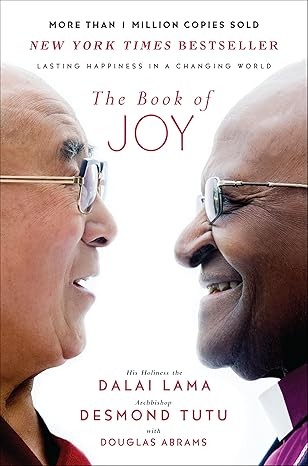
The Book of Joy
by Dalai Lama, Desmond Tutu, Douglas Abrams · 2016
Two men who've survived exile and apartheid sit down for a week and tell you what actually produces joy.
Worth reading? The Book of Joy has more moral authority than almost anything else on this shelf, because it's not theory. The Dalai Lama has lived in exile since 1959; Desmond Tutu spent his life inside apartheid and its aftermath. Abrams spent a week recording their conversation for the Dalai Lama's 80th birthday, and the book is that conversation plus his framing. What comes out is unusually concrete for a book about joy: eight pillars, from perspective and humility to acceptance and forgiveness, each backed by something one of them actually lived through. Read it for the two men's friendship and hard-won authority. Skip it if you want a tactical program -- this is closer to eavesdropping on wisdom than following instructions.
| Full Title | The Book of Joy: Lasting Happiness in a Changing World |
|---|---|
| Author | Dalai Lama, Desmond Tutu, Douglas Abrams |
| Published | 2016 |
| Publisher | Avery |
| Category | Religion & Spirituality |
| Favorite quote | “Discovering more joy does not, save us from the inevitability of hardship and heartbreak.” |
The Verdict
What makes this book different from most joy books is who’s talking. The Dalai Lama has been in exile for over six decades. Desmond Tutu lived through and helped dismantle apartheid. Abrams spent a week with both of them recording a birthday conversation, and the result reads less like a self-help book and more like eavesdropping on two old friends who’ve earned the right to talk about suffering and joy in the same breath.
The eight pillars give it structure, but the real substance is in the specific memories each man attaches to each one. Read it for that authority and that friendship. Skip it if you’re after a program with exercises and homework – this is conversation, not curriculum.
you want joy explained by people who earned the right to talk about it, not a productivity guru
you want a step-by-step program -- this is a recorded conversation with commentary, not a workbook
Book Summary
Joy is not the absence of suffering, it's something you build in the presence of it. Both men lost enormously, exile for one, apartheid and its violence for the other, and both locate their joy as something forged through that loss, not despite it or after it ended.
The book organizes around eight pillars of joy: perspective, humility, humor, acceptance, forgiveness, gratitude, compassion, and generosity. None of these are abstract virtues here -- each is illustrated with a specific memory from one of the two men's actual lives.
Compassion directed outward is repeatedly framed as the fastest route out of your own suffering. Both men describe turning attention toward someone else's pain as the move that reliably breaks their own rumination, more reliably than trying to think their way out of it.
Top 9 Lessons from The Book of Joy
- Joy is built through suffering, not achieved by avoiding it.
- Perspective, zooming out on a problem's actual scale, is one of the fastest ways to defuse it.
- Humility keeps you from over-identifying with your own suffering as uniquely important.
- Humor is treated as a serious spiritual tool, not a distraction from serious things.
- Acceptance of what already happened frees energy that resistance would otherwise burn.
- Forgiveness is framed as something you do for your own freedom, not a favor to the other person.
- Turning attention to someone else's suffering is presented as the fastest way to interrupt your own.
- Gratitude and generosity are treated as practices, repeated daily, not one-time realizations.
- A real friendship, not shared ideology, is shown as one of the most durable sources of joy available.
Top 4 Quotes from The Book of Joy
"Discovering more joy does not, save us from the inevitability of hardship and heartbreak."
Dalai Lama, Desmond Tutu, Douglas Abrams, The Book of Joy
"When we see others as fundamentally 'like me,' as human beings like ourselves, our sense of isolation and loneliness is dispelled."
Dalai Lama, Desmond Tutu, Douglas Abrams, The Book of Joy
"When we see others as separate, they become a threat. When we see others as part of us, as connected, as interdependent, then there is no challenge we cannot face -- together."
Dalai Lama, Desmond Tutu, Douglas Abrams, The Book of Joy
"We are fragile creatures, and it is from this weakness, not despite it, that we discover the possibility of true joy."
Dalai Lama, Desmond Tutu, Douglas Abrams, The Book of Joy
Frequently Asked Questions
Is The Book of Joy worth reading?
Yes -- it carries unusual authority because both men are describing joy they built through exile and apartheid, not abstract theory, and the eight pillars framework is genuinely useful.
What are the eight pillars of joy in the book?
Perspective, humility, humor, acceptance, forgiveness, gratitude, compassion, and generosity -- each illustrated with a specific memory from the Dalai Lama's or Desmond Tutu's own life.
Is The Book of Joy religious?
It draws on Buddhist and Christian frameworks since that's who's speaking, but the pillars themselves are presented as universal, not doctrine-specific.
Is The Book of Joy a self-help book?
Not in the tactical sense. It's closer to a recorded conversation with framing commentary than a workbook with exercises.
Who should read The Book of Joy?
Anyone looking for what joy actually looks like when it's built by people who survived real hardship, rather than joy as a productivity hack.
Ready to read it?
Get The Book of Joy on Amazon