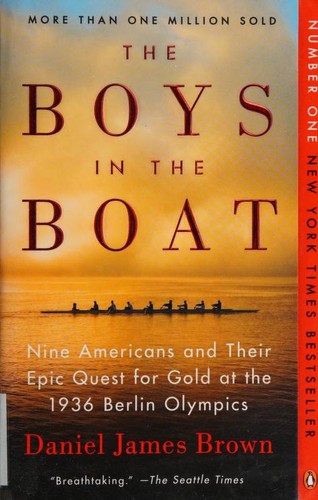
The Boys in the Boat
by Daniel James Brown · 2013
A crew of working-class University of Washington rowers, most of them sons of loggers and farmers scraping through the Depression, beat elite East Coast teams and Hitler's showcase German squad to win Olympic gold in 1936.
Worth reading? Brown's real subject is Joe Rantz, whose Depression-era childhood -- abandoned by his family, working through college to survive -- gives the book its emotional throughline, while the Berlin Olympics setting against Hitler's propaganda machine gives the underdog sports story real historical weight beyond a typical triumph narrative.
| Full Title | The Boys in the Boat: Nine Americans and Their Epic Quest for Gold at the 1936 Berlin Olympics |
|---|---|
| Author | Daniel James Brown |
| Published | 2013 |
| Publisher | Viking / Penguin |
| Category | History |
| Favorite quote | “Harmony, balance, and rhythm. They're the three things that stay with you your whole life. Without them civilization is out of whack.” |
The Verdict
Rantz’s personal story is what elevates this above a standard sports underdog narrative – his abandonment and years of near self-sufficiency during the Depression give the eventual triumph real emotional stakes beyond just “will they win the race.”
Brown doesn’t skimp on the political backdrop either. Staging the American win against Hitler’s specifically-built propaganda showcase gives the book historical weight a typical sports story doesn’t carry.
The technical rowing detail – boat construction, stroke mechanics, crew psychology – is genuinely well-researched but is also where the pacing slows most for readers without existing interest in the sport.
Read it if you want an underdog sports story anchored in real Depression-era stakes and Nazi-era political context. Skip it if rowing mechanics and boat-building detail aren’t going to hold your interest between the historical sections.
you want an underdog sports story grounded in real historical stakes -- Depression-era poverty, Nazi Germany's propaganda machine -- rather than just a play-by-play of races
you're not interested in rowing as a sport -- Brown gets technical about boat-building, stroke mechanics, and crew dynamics, which some non-rowing readers find slower going than the historical sections
Book Summary
The book centers on Joe Rantz, a University of Washington rower who was abandoned by his family as a teenager during the Depression and had to support himself entirely while attending college, using his place on the crew team as one of the few stable structures in a chaotic life. Brown weaves Rantz's personal survival story into the larger story of the 1936 U.S. Olympic eight-man rowing team, made up largely of working-class sons of loggers, farmers, and shipyard workers who had to out-row wealthier, more established East Coast programs just to make the Olympic team.
The 1936 Berlin Olympics were staged by Hitler's regime as a propaganda showcase for Nazi Germany, complete with a specially built boathouse and course designed partly to advantage the German crew, and Brown situates the American team's gold medal win directly against that political backdrop -- an underdog, working-class American crew beating a state-sponsored German team on Hitler's own showcase stage.
Brown also spends real attention on George Yeoman Pocock, the English-born boat builder who crafted the shells the American crews rowed in and became a mentor figure to the University of Washington team, using Pocock's craft and philosophy of rowing as a throughline about precision, trust, and the specific psychology required for a boat crew to row as one unit rather than eight individuals.
Top 8 Lessons from The Boys in the Boat
- Joe Rantz's Depression-era abandonment by his family and years of near-total self-sufficiency give the book its emotional core, framing the rowing team as the first stable structure he'd had in years.
- The 1936 U.S. Olympic crew was made up largely of working-class sons of loggers, farmers, and laborers, competing against wealthier, more established East Coast rowing programs to even qualify for the Olympics.
- Hitler's regime staged the 1936 Berlin Olympics as a propaganda showcase, including a course and boathouse built partly to favor the German team, framing the American win as a political as well as athletic upset.
- Boat builder George Yeoman Pocock's craftsmanship and philosophy of rowing -- precision, trust, and the psychology of a crew moving as one unit -- runs through the book as a throughline about what makes an eight-man crew actually work.
- Rowing at an elite level requires a degree of synchronized trust between crew members that Brown treats as almost spiritual, arguing the sport rewards selflessness in a way few others do.
- The team's path to the Olympics required beating established, better-funded East Coast programs in domestic trials, meaning the underdog story starts well before Berlin.
- Brown draws heavily on interviews with Joe Rantz's daughter and Rantz's own late-life recollections, giving the book a direct source for its most intimate details about his childhood.
- The book situates athletic triumph inside its Depression-era economic context -- for these rowers, making the team wasn't just about sport, it was often tied to survival, scholarship money, and escape from poverty.
Top 4 Quotes from The Boys in the Boat
"Harmony, balance, and rhythm. They're the three things that stay with you your whole life. Without them civilization is out of whack."
Daniel James Brown, The Boys in the Boat
"Good crews are good blends of personalities: someone to lead the charge, someone to hold something in reserve; someone to pick a fight, someone to make peace; someone to think things through, someone to charge ahead without thinking. Even after the right mixture is found, each man or woman in the boat must recognize his or her place in the fabric of the crew, accept it, and accept the others as they are. It is an exquisite thing when it all comes together in just the right way."
Daniel James Brown, The Boys in the Boat
"The ability to yield, to bend, to give way, to accommodate, he said, was sometimes a source of strength in men as well as in wood, so long as it was helmed by inner resolve and by principle."
Daniel James Brown, The Boys in the Boat
"When all is said and done I think the story tells us that hope is the heroes domain, not the fools. Because we dare to hope, even when doing so might undo us."
Daniel James Brown, The Boys in the Boat
Frequently Asked Questions
Is The Boys in the Boat worth reading?
Yes -- it's an underdog sports story with real historical weight, grounded in Depression-era poverty and set against Hitler's 1936 Berlin Olympics as propaganda showcase.
What is The Boys in the Boat about?
A working-class University of Washington rowing crew, led by Joe Rantz, who overcame poverty and elite East Coast competition to win Olympic gold in the 1936 Berlin Games.
Is The Boys in the Boat a true story?
Yes, it's narrative history based on interviews, including with Joe Rantz's daughter, and extensive research into the 1936 Olympic rowing team.
Do you need to know rowing to enjoy the book?
No, but Brown does get technical about boat mechanics and crew dynamics, which is a slower read for those with no interest in the sport itself.
Is there a movie adaptation of The Boys in the Boat?
Yes, a 2023 film directed by George Clooney adapted the book, focusing primarily on the team's path to the 1936 Olympics.
Ready to read it?
Get The Boys in the Boat on Amazon