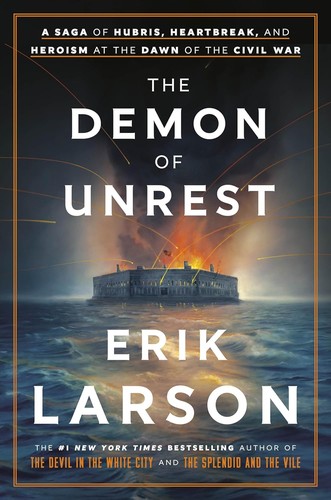
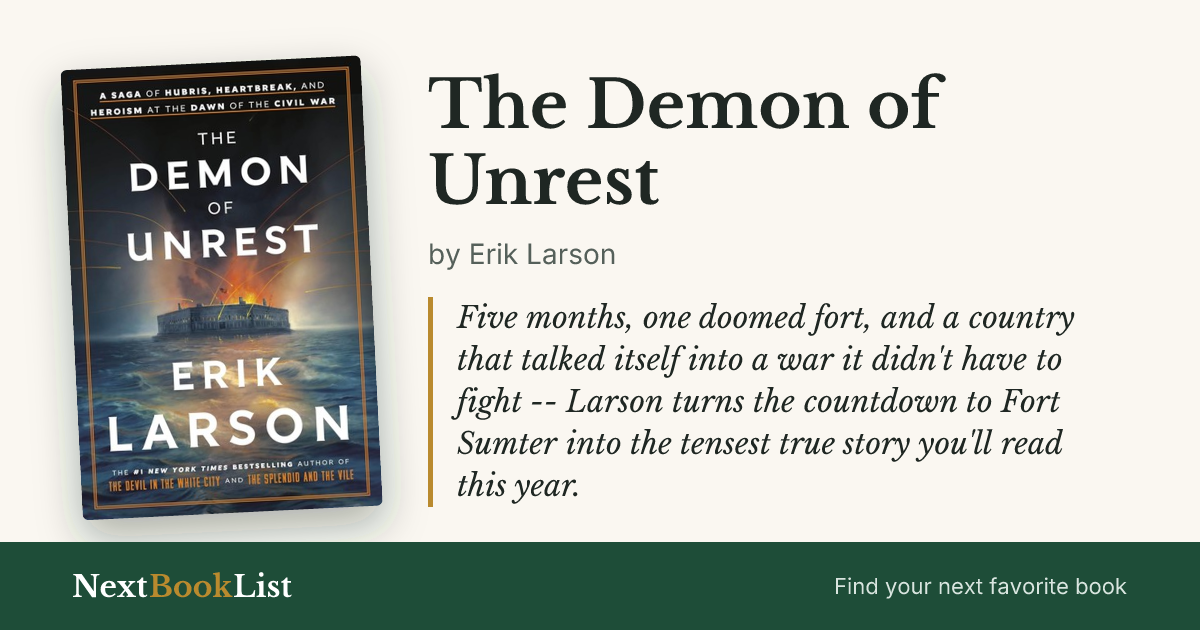
The Demon of Unrest
by Erik Larson · 2024
Five months, one doomed fort, and a country that talked itself into a war it didn't have to fight -- Larson turns the countdown to Fort Sumter into the tensest true story you'll read this year.
Worth reading? Larson's real subject is the five-month window between Lincoln's election and the first cannon fire, and he uses it to show that the Civil War wasn't some tragic accident -- it was a series of specific, avoidable choices made by specific, named people who chose escalation every time a de-escalation was on the table.
| Full Title | The Demon of Unrest: A Saga of Hubris, Heartbreak, and Heroism at the Dawn of the Civil War |
|---|---|
| Author | Erik Larson |
| Published | 2024 |
| Publisher | Crown |
| Category | History |
The Verdict
Larson does what he always does: takes a known outcome and makes you forget you know how it ends. You know Fort Sumter gets fired on. You know the war happens. And somehow the book still reads like it could go the other way at any moment, because Larson keeps showing you the off-ramps everyone drove past.
The best part isn’t Lincoln, though his sections are strong. It’s the secessionists in Charleston, a small, organized group who wanted this fight and built the conditions for it years before most of the country was paying attention. Watching how few people it actually took to drag an ambivalent nation into war is the book’s most unsettling lesson, and it doesn’t feel like ancient history.
Read it if you want to understand how wars actually start – not with inevitability, but with a series of specific people making specific choices to escalate instead of step back. Skip it if you’re looking for battles and generals – this book ends the moment the fighting begins.
you want to understand how a nation slides into a war nobody officially wanted, told at the ground level through the people who could have stopped it and didn't
you're after a full Civil War history -- this book stops at the first shots at Fort Sumter and never gets to the battles most people associate with the war
Book Summary
Secession wasn't a spontaneous act of Southern honor, it was a deliberate campaign run by a small, committed group of South Carolina fire-eaters who spent years positioning the state to leave the Union the moment a Republican won the White House. Larson shows how a determined minority can drag a much larger, more ambivalent population into a crisis by controlling the timeline and the narrative.
Fort Sumter became the flashpoint less because of its military value and more because both sides needed the other to fire first -- Lincoln needed the Confederacy to look like the aggressor to hold the North together, and the Confederacy needed a fight to force wavering states like Virginia off the fence. The shot that started the war was, in that sense, exactly what both sides were angling for.
Major Robert Anderson, the Union officer trapped inside Fort Sumter, spent the crisis trying to avoid a war he didn't believe in while everyone around him -- Washington, Charleston, his own government -- pushed him toward exactly the confrontation he wanted no part of. Individual restraint doesn't count for much when the institutions around you are built to escalate.
Top 8 Lessons from The Demon of Unrest
- A committed minority with a clear timeline can out-maneuver a larger, more divided population -- South Carolina's secessionists moved fast precisely because most Southerners weren't as certain as they were.
- Both sides in a standoff can want the same trigger event for opposite reasons -- Lincoln and the Confederacy each needed Sumter to look like the other side's fault.
- Symbolic targets matter more than strategic ones in a political crisis -- Fort Sumter had little military value but enormous value as a flashpoint everyone was watching.
- The person caught in the middle of an escalating crisis (Major Anderson) often has the least power to stop it, even when he's the one who most wants to.
- Buchanan's lame-duck inaction in the crisis's opening months is a case study in how a leader's passivity can hand momentum entirely to the side willing to act.
- Secession leaders needed a fight, not a peaceful separation -- a bloodless split from the Union wouldn't have rallied the wavering Upper South states behind them.
- Diaries and private letters (Mary Chesnut's especially) often capture a moment's true mood better than the official record, which gets rewritten by the winners and losers alike.
- Compromise proposals kept surfacing right up until the shooting started -- war wasn't inevitable at any single point until it actually happened.
Frequently Asked Questions
Is The Demon of Unrest worth reading?
Yes -- Larson makes the countdown to Fort Sumter feel as tense as a thriller, and the book is sharper on how wars actually start than most full-length Civil War histories.
What is The Demon of Unrest about?
It covers the five months between Lincoln's election in November 1860 and the first shots at Fort Sumter in April 1861, focusing on the people and decisions that turned a political crisis into a war.
Does The Demon of Unrest cover the whole Civil War?
No -- it ends where the war begins. If you want the battles and Reconstruction, you'll need a different book.
Who is the main character in The Demon of Unrest?
There isn't a single one -- Larson weaves together Major Robert Anderson at Fort Sumter, Lincoln in Washington, and South Carolina's secessionist leaders in Charleston, plus diarist Mary Chesnut as an on-the-ground witness.
How does The Demon of Unrest compare to Erik Larson's other books, like The Splendid and the Vile?
Same narrative style -- tight scenes, a ticking clock, character-driven history -- applied to a shorter, more contained crisis than his World War II books.
Ready to read it?
Get The Demon of Unrest on Amazon