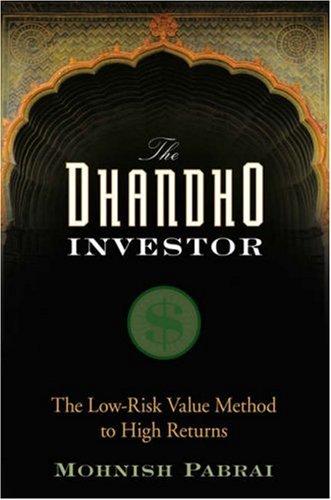
The Dhandho Investor
by Mohnish Pabrai · 2007
Heads I win, tails I don't lose much -- value investing explained by a guy who actually made money doing it.
Worth reading? The Dhandho Investor and The Little Book That Still Beats the Market both promise a repeatable edge, but they're built on different bets. Greenblatt hands you a formula and tells you to run it mechanically across hundreds of stocks. Pabrai tells you to make a handful of concentrated, low-risk, high-uncertainty bets and wait, Patels-running-motels style, for fat pitches. If you want a system you can automate, take Greenblatt. If you want a mental model for how to think about risk versus uncertainty before you ever open a spreadsheet, take Pabrai. Skip it if you're hoping for stock picks or a screening tool -- Pabrai's examples are dated and the point was never the specific companies. The point is the framework: bet big only when the odds are heavily in your favor and you can't lose much if you're wrong.
| Full Title | The Dhandho Investor: The Low-Risk Value Method to High Returns |
|---|---|
| Author | Mohnish Pabrai |
| Published | 2007 |
| Category | Business & Money |
| Favorite quote | “Heads, I win; tails, I don't lose much.” |
The Verdict
Pabrai isn’t shy about where his ideas come from – Buffett and Munger, filtered through immigrant motel owners who bet the whole family on one property and won by being conservative, not reckless. The book works because it strips value investing down to a repeatable habit of mind: find the bets where you can’t lose much, then bet big.
you want value investing explained through simple bets, not spreadsheets and jargon
you want a rigorous academic treatment of valuation -- this is a philosophy book with stories, not a modeling course
Book Summary
Dhandho -- Pabrai's term, borrowed from the Gujarati business community his family comes from -- means "endeavors that create wealth," and the whole book is an argument that you can build wealth with low risk and high uncertainty at the same time, which most investors treat as a contradiction. Low risk means you can't lose much money. High uncertainty means the outcome is genuinely unclear to most people, which is exactly why the market misprices it and leaves room for outsized returns.
Pabrai's version of this is "Heads, I win; tails, I don't lose much" -- find bets where the downside is capped and the upside is large, then size the position heavily because the odds favor you. He draws this straight from Buffett and Munger but strips it down to a repeatable checklist: buy simple, understandable businesses, ideally ones already in distress or out of favor, at a big discount to intrinsic value, with a low-risk balance sheet, run by honest management, and wait.
The other half of the book is about behavior, not analysis: make very few investments, make them big when the odds are right, and make them rarely. Most investors do the opposite -- lots of small, mediocre bets because that feels safer. Pabrai argues that diversification across too many ideas just guarantees average returns, and the real edge comes from having the patience to do nothing until a genuine "fat pitch" shows up.
Top 11 Lessons from The Dhandho Investor
- Dhandho means low risk and high uncertainty at the same time -- that's the edge, not a contradiction.
- Heads I win, tails I don't lose much: cap your downside before you chase upside.
- Buy simple, understandable businesses you can actually underwrite.
- Look for distressed or out-of-favor situations -- that's where mispricing lives.
- Demand a big discount to intrinsic value before you buy anything.
- Make few bets, make them big, and make them infrequent.
- Diversifying across too many mediocre ideas just locks in average returns.
- Wait for a fat pitch instead of swinging at every pitch.
- Cloning proven business models (like Buffett and Munger did) beats reinventing the wheel.
- Management quality and balance-sheet strength matter as much as the price you pay.
- Patience is a position -- doing nothing is a legitimate investment decision.
Top 4 Quotes from The Dhandho Investor
"Heads, I win; tails, I don't lose much."
Mohnish Pabrai, The Dhandho Investor
"Dhandho, loosely translated, means 'endeavors that create wealth.'"
Mohnish Pabrai, The Dhandho Investor
"He bought an existing business with a well-defined business model and one with a long history of operations that he could analyze. This is waaaaaaaay less risky than doing a startup."
Mohnish Pabrai, The Dhandho Investor
"After three years, if the investment is still underwater, the cause is virtually always a misjudgment on the intrinsic value of the business or its critical value drivers. Don't hesitate to take a realized loss once three years have passed. Such losses are your best teachers to becoming a better investor."
Mohnish Pabrai, The Dhandho Investor
Frequently Asked Questions
Is The Dhandho Investor worth reading?
Yes if you want a plain-English framework for low-risk, high-uncertainty investing built on real examples. Skip it if you want valuation models -- this book is philosophy and behavior, not spreadsheets.
What is the main idea of The Dhandho Investor?
You can get high returns with low risk by betting on situations where the outcome is genuinely uncertain to the market but the downside is capped -- then sizing few, big, infrequent bets.
What does 'Dhandho' mean?
It's a Gujarati word Pabrai translates as 'endeavors that create wealth' -- the business philosophy of the Patel motel-owner community he grew up around, which he applies to stock investing.
Who should read The Dhandho Investor?
Investors who already understand basic value investing and want a sharper mental model for risk, position sizing, and patience -- not beginners looking for step-by-step valuation instruction.
Ready to read it?
Get The Dhandho Investor on Amazon