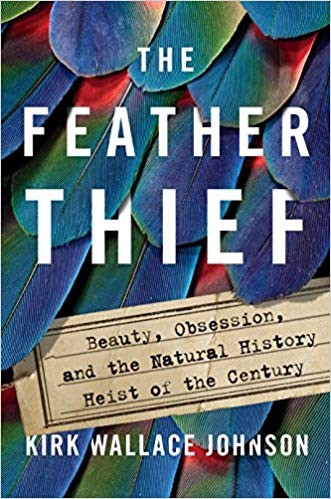
The Feather Thief
by Kirk Wallace Johnson · 2018
In 2009, a 20-year-old American flautist broke into a British natural history museum and stole hundreds of rare bird skins, some over 150 years old, to sell their feathers to obsessive Victorian-style fly-tiers online.
Worth reading? Johnson stumbled onto this story by accident (a fly-fishing guide mentioned it on a river trip) and became so obsessed with recovering the still-missing specimens that he essentially becomes the book's second protagonist. That obsessive-investigator layer, on top of an already bizarre heist, is what elevates this past a simple true-crime retelling.
| Full Title | The Feather Thief: Beauty, Obsession, and the Natural History Heist of the Century |
|---|---|
| Author | Kirk Wallace Johnson |
| Published | 2018 |
| Publisher | Viking |
| Category | History |
| Favorite quote | “Little did I know, my pursuit of justice would mean journeying deep into the feather underground, a world of fanatical fly-tiers and plume peddlers, cokeheads and big game hunters, ex-detectives and shady dentists.” |
The Verdict
The theft itself is bizarre enough to carry a book on its own – rare Victorian-collected bird skins stolen to feed an obsessive fly-tying subculture most readers have never heard of. What makes it better than a standard true-crime retelling is Johnson inserting himself into the story once the official case goes cold, chasing leads the police and museum had stopped chasing.
That second half doesn’t resolve neatly. Most of the specimens are still missing, and Johnson’s own pursuit runs into genuine dead ends. That’s a feature, not a failure of the book – it’s an honest account of what happens when a real loss (irreplaceable scientific data, not just a dollar value) outlives the legal system’s interest in it.
Read it if you want true crime built around a genuinely strange obsession, with real narrative tension. Skip it if you need every thread resolved by the last page – this one is honest about what stayed lost.
you want a true-crime story about an obsession you've never heard of -- exotic bird feathers as a black-market commodity among fly-tying hobbyists -- told with real narrative momentum
you want the case fully resolved with justice served -- Johnson's own pursuit of the missing specimens runs into real, frustrating dead ends that never get a tidy resolution
Book Summary
Edwin Rist, a young American studying music in London and a serious competitive fly-tier, broke into the Natural History Museum at Tring and stole nearly 300 rare bird skins, some collected by Alfred Russel Wallace in the 19th century, specifically to strip their feathers and sell them to a global subculture of fly-tiers willing to pay enormous sums for genuine antique plumage.
The theft caused irreversible scientific damage far beyond its dollar value: museum specimens carry irreplaceable data (collection location, date, the collector's original labels) that gets destroyed the moment a skin is stripped for its feathers, meaning the loss to science was permanent even for skins that were eventually recovered.
Johnson's own pursuit of the missing feathers, after the legal case closed with a light sentence and most of the stolen skins still unaccounted for, turns the book into a study of unofficial justice -- what happens, and doesn't happen, when the official system treats a case as closed while real damage remains unresolved.
Top 8 Lessons from The Feather Thief
- A niche subculture (competitive Victorian-style fly-tying) can generate a genuine black market with prices and obsession rivaling any conventional smuggling trade.
- Museum specimens carry scientific value (collection data, original labels) that's destroyed the moment they're stripped for a different purpose, making the damage often irreversible even when items are later recovered.
- A light legal sentence doesn't mean a case is actually resolved -- most of the stolen specimens in this story were never recovered even after the trial ended.
- An investigator's personal obsession with an unresolved case can extend the pursuit of justice well past the point the legal system considers the matter closed.
- Rare natural objects (feathers, specimens, artifacts) can hold radically different value to different communities -- scientific, aesthetic, criminal -- simultaneously.
- Historical colonial-era collecting expeditions (like Alfred Russel Wallace's) left behind irreplaceable scientific archives that remain vulnerable to modern theft.
- A seemingly bizarre, low-profile crime can still cause damage on the scale of a much more conventional major theft, once you understand what was actually destroyed.
- Institutions (museums, courts) often lack the resources or mandate to fully pursue restitution, leaving that work to obsessed individuals outside the system.
Top 4 Quotes from The Feather Thief
"Little did I know, my pursuit of justice would mean journeying deep into the feather underground, a world of fanatical fly-tiers and plume peddlers, cokeheads and big game hunters, ex-detectives and shady dentists."
Kirk Wallace Johnson, The Feather Thief
"Indeed, when the Titanic went down in 1912, the most valuable and highly insured merchandise in its hold was forty crates of feathers, second only to diamonds in the commodities market."
Kirk Wallace Johnson, The Feather Thief
"Lionel Walter Rothschild would grow up to earn many distinctions: the Right Honorable Lord, Baron de Rothschild, member of Parliament, adulterer, blackmail victim, and one of the most tragically obsessive bird collectors ever to roam the earth."
Kirk Wallace Johnson, The Feather Thief
"Between 1883 and 1898, bird populations in twenty-six states dropped by nearly half."
Kirk Wallace Johnson, The Feather Thief
Frequently Asked Questions
Is The Feather Thief worth reading?
Yes -- it's a genuinely strange true-crime story told with real narrative drive, and Johnson's own obsessive pursuit of the missing specimens adds a second layer most true-crime books don't have.
What is The Feather Thief about?
The 2009 theft of nearly 300 rare bird skins from Britain's Natural History Museum at Tring by Edwin Rist, a young flautist and competitive fly-tier, to sell their feathers on the black market, and author Kirk Wallace Johnson's own pursuit of the still-missing specimens.
Is The Feather Thief a true story?
Yes -- it's narrative nonfiction built from court records, interviews, and Johnson's own investigation, not a fictionalized account.
Was the case ever fully solved?
No -- most of the stolen bird skins were never recovered, and the book's back half follows Johnson's own frustrating, unresolved attempts to track them down after the legal case closed.
Why would anyone steal bird feathers specifically?
A global subculture of competitive Victorian-style salmon fly-tiers pays enormous sums for genuine antique feathers from specific rare species, creating a real black market Johnson traces in detail.
Ready to read it?
Get The Feather Thief on Amazon