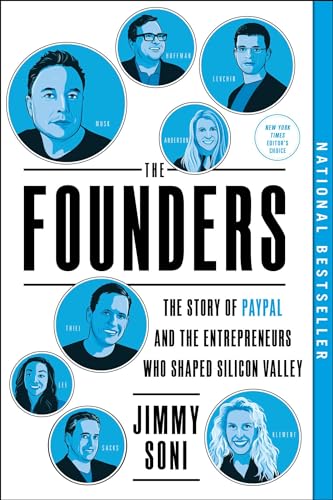
The Founders
by Jimmy Soni · 2022
One failing payments startup accidentally trained the founders and executives who would go on to build Tesla, SpaceX, LinkedIn, Palantir, and YouTube.
Worth reading? The Founders is the best account of PayPal's early years because Soni had access to the people who lived it and doesn't flatten their conflicts into a clean legend -- Musk and Thiel clashed hard, the company nearly died from fraud multiple times, and the 'mafia' framing came later, in hindsight. Skip it if you want a smooth success story; this one is genuinely messy.
| Full Title | The Founders: The Story of PayPal and the Entrepreneurs Who Shaped Silicon Valley |
|---|---|
| Author | Jimmy Soni |
| Published | 2022 |
| Publisher | Simon & Schuster |
| Category | Business & Money |
| Favorite quote | “If the team hadn't closed that one hundred million, there would be no SpaceX, no LinkedIn, and no Tesla.” |
The Verdict
Soni got the access that makes this book work – interviews with most of the surviving key players, willing to talk candidly about a period most of them remember as genuinely brutal, not the tidy legend it became later. That’s the book’s real value: the “PayPal Mafia” framing is something Silicon Valley constructed in hindsight, and Soni shows you the messier reality underneath it.
What stands out most is how close PayPal came to just dying – fraud rings nearly bankrupted it more than once, the Musk/Thiel merger was a genuine mess, and success was never obvious in the moment. Read it if you want to understand how a near-failure produced a generation of founders. Skip it if you want a clean, linear success story, because that’s not what actually happened.
you want the origin story of the 'PayPal Mafia' -- Elon Musk, Peter Thiel, Reid Hoffman, Max Levchin, and a dozen others -- and how one chaotic startup produced so many of the founders who followed
you're looking for a tidy, linear success story -- PayPal itself was a near-death, chaotic mess for most of its life, and the book doesn't smooth that over
Book Summary
PayPal's early years were defined by near-constant existential threats -- organized fraud rings that nearly bankrupted the company, a chaotic merger between Musk's X.com and Thiel/Levchin's Confinity, and a business model (peer-to-peer digital payments) that regulators and banks were actively hostile toward. Survival, not vision, was the daily preoccupation for years.
The company's internal culture rewarded relentless problem-solving under pressure and put remarkably talented, ambitious people in the same room competing and collaborating simultaneously -- which is a big part of why so many later went on to found or fund massive companies (Musk at Tesla/SpaceX, Thiel funding Facebook and founding Palantir, Hoffman founding LinkedIn, Levchin founding Affirm).
The "PayPal Mafia" label is a retrospective story Silicon Valley told about itself after the fact -- the book is careful to show that at the time, PayPal's alumni network wasn't a deliberate strategy or a tight-knit brotherhood, it was a group of talented, often disagreeing people who happened to go through a formative crucible together and later succeeded independently.
Top 8 Lessons from The Founders
- Surviving existential threats (organized fraud, near-bankruptcy, hostile regulators) forces a level of operational discipline that calmer companies never develop.
- A chaotic, contentious merger (X.com and Confinity) can still produce a stronger combined company than either founding team would have built alone, even if the process is genuinely painful.
- Talent density in a single early team -- putting many ambitious, capable people in the same building under pressure -- compounds into outsized future success even when the original company's outcome is modest by comparison.
- Retrospective narratives (the 'PayPal Mafia') are usually cleaner than the lived reality -- contemporaries often disliked and disagreed with each other far more than the legend suggests.
- Founder conflict (Musk vs. Thiel) doesn't have to be fatal to a company if the underlying product and market opportunity are strong enough to survive the friction.
- Building in a heavily regulated, trust-dependent space (digital payments) requires solving fraud and compliance problems as core product work, not an afterthought.
- A company's most valuable long-term export can be its people and their later ventures, not the company's own eventual outcome (PayPal's IPO and sale to eBay were solid but modest next to what its alumni later built).
- Early-career crucible experiences (a near-death startup) shape a generation of founders' instincts about risk, speed, and survival in ways that show up decades later in how they run their own companies.
Top 2 Quotes from The Founders
"If the team hadn't closed that one hundred million, there would be no SpaceX, no LinkedIn, and no Tesla."
Jimmy Soni, The Founders
"PayPal was the first company to force users to prove their humanity in this fashion."
Jimmy Soni, The Founders
Frequently Asked Questions
Is The Founders worth reading?
Yes, if you want the real, chaotic story behind PayPal and the 'PayPal Mafia' rather than the cleaned-up Silicon Valley legend. It's deeply researched and doesn't shy from the founders' conflicts.
What is the 'PayPal Mafia'?
The nickname for PayPal's early founders and executives -- including Elon Musk, Peter Thiel, Reid Hoffman, Max Levchin, and others -- who went on to found or fund major companies like Tesla, SpaceX, LinkedIn, YouTube, and Palantir.
Does The Founders cover the Musk-Thiel conflict?
Yes, extensively -- the contentious X.com/Confinity merger and the boardroom conflict that eventually removed Musk as CEO are covered in detail, without the smoothing-over some other accounts give it.
How long is The Founders?
It's a substantial book, over 450 pages, reflecting the depth of Soni's interviews and research into PayPal's founding years.
Ready to read it?
Get The Founders on Amazon