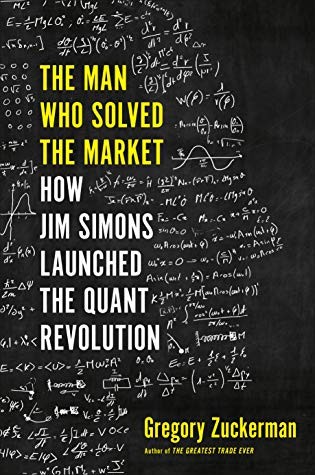
The Man Who Solved the Market
by Gregory Zuckerman · 2019
A reclusive mathematician built a hedge fund that beat Warren Buffett, George Soros, and every other investor on earth -- without a single trader on staff who understood the companies they traded.
Worth reading? The Man Who Solved the Market is the best hedge fund book because Zuckerman explains how Jim Simons's Renaissance Technologies achieved returns no one else has matched, using scientists and mathematicians instead of traditional Wall Street analysts. Skip it if you're hunting for actionable investing tips; this is a story about a method you can't personally use, not a manual.
| Full Title | The Man Who Solved the Market: How Jim Simons Launched the Quant Revolution |
|---|---|
| Author | Gregory Zuckerman |
| Published | 2019 |
| Publisher | Portfolio |
| Category | Business & Money |
| Favorite quote | “We're right 50.75 percent of the time... but we're 100 percent right 50.75 percent of the time. You can make billions that way.” |
The Verdict
Zuckerman had a genuinely hard reporting problem here – Renaissance Technologies is one of the most secretive firms in finance, and Jim Simons avoided the spotlight his entire career. That he got this many insiders talking, on a firm this guarded, is the book’s real achievement.
What makes the story worth your time isn’t just the returns, which are absurd enough on their own (60%-plus annually for decades, a number no other investor has matched). It’s watching Simons build an entire firm on the premise that hiring physicists instead of stockbrokers would beat Wall Street at its own game – and then watching that bet pay off more completely than anyone could have reasonably expected. Read it for the method. Don’t read it expecting to replicate it.
you want to understand how mathematical and algorithmic trading actually works, told through the most successful hedge fund in history, Renaissance Technologies
you want investing advice you can apply yourself -- Renaissance's Medallion Fund strategies are proprietary, math-heavy, and explicitly not something a retail investor can replicate
Book Summary
Jim Simons, a former codebreaker and mathematician, built Renaissance Technologies on the premise that markets contain exploitable statistical patterns invisible to traditional fundamental analysis, and staffed his firm almost entirely with mathematicians, physicists, and computer scientists rather than career Wall Street traders.
Renaissance's flagship Medallion Fund produced average annual returns above 60% before fees for decades, a track record unmatched by any other investor in history, achieved through systematic, algorithm-driven trading that ignores traditional narratives about companies and instead hunts for statistically persistent patterns in price data.
The firm's culture prized secrecy and pure quantitative rigor over ego or public visibility -- Simons himself avoided the spotlight compared to figures like Buffett or Soros, and Renaissance's methods remain deliberately opaque even after decades of unmatched success, partly because the firm's edge depends on competitors not understanding exactly how it works.
Top 8 Lessons from The Man Who Solved the Market
- Hiring scientists and mathematicians instead of traditional finance professionals can produce a fundamentally different, and in this case superior, approach to markets.
- Markets contain statistical patterns that don't require understanding a company's business at all -- Renaissance's approach treats price data as a pattern-recognition problem, not a fundamentals problem.
- Sustained outperformance at Renaissance's scale required systematizing the entire process (data, model-building, execution) rather than relying on individual star traders' judgment calls.
- A firm's edge can depend partly on secrecy -- Renaissance's unwillingness to explain its methods, even to investors, is treated as a deliberate competitive protection, not just paranoia.
- Recruiting from academia and being willing to pay top scientific talent Wall Street-level compensation can out-recruit traditional finance firms for the best quantitative minds.
- Even a systematic, algorithm-driven fund still requires constant human oversight and refinement -- Renaissance's models needed continual adjustment as markets and data changed.
- Public visibility and hedge-fund celebrity (the Buffett/Soros model) is not a requirement for extraordinary investment success -- Simons built the best-performing fund in history while staying deliberately low-profile.
- Simons's later philanthropy and political spending show how quantitative-investing wealth, built through opaque and highly technical means, still ends up shaping public life well beyond the trading floor.
Top 3 Quotes from The Man Who Solved the Market
"Simons and his team are among the most secretive traders Wall Street has encountered, loath to drop even a hint of how they'd conquered financial markets."
Gregory Zuckerman, The Man Who Solved the Market
"It's one thing to have good ideas, it's another to recognize when others do."
Gregory Zuckerman, The Man Who Solved the Market
"We're right 50.75 percent of the time... but we're 100 percent right 50.75 percent of the time. You can make billions that way."
Gregory Zuckerman, The Man Who Solved the Market
Frequently Asked Questions
Is The Man Who Solved the Market worth reading?
Yes, if you want to understand quantitative investing and the most successful hedge fund in history. It's well-reported given how secretive Renaissance Technologies is.
Can I use the strategies in The Man Who Solved the Market to invest myself?
No -- Renaissance's Medallion Fund strategies are proprietary, extremely math-heavy, and only available to Renaissance employees. The book explains the approach, not a replicable system.
Who is Jim Simons?
A former mathematician and codebreaker who founded Renaissance Technologies, whose Medallion Fund produced average annual returns above 60% before fees for decades -- the best track record in investing history.
Is The Man Who Solved the Market technical or accessible to non-finance readers?
It's written for a general audience -- Zuckerman explains the concepts without requiring a math or finance background, focusing more on the people and culture than the underlying equations.
Ready to read it?
Get The Man Who Solved the Market on Amazon