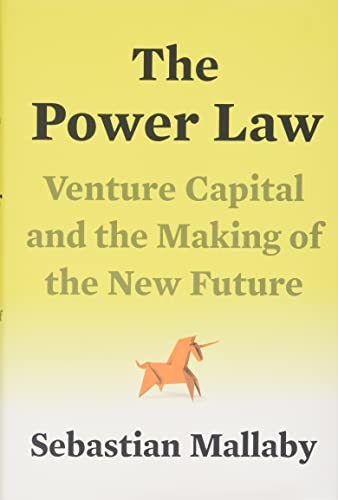
The Power Law
by Sebastian Mallaby · 2022
Venture capital doesn't work by picking winners carefully -- it works by making enough bets that one Google or one Facebook covers every loss ten times over.
Worth reading? The Power Law is the best history of venture capital because Mallaby explains the actual math of the business -- that returns come from power-law outliers, not consistent picks -- while telling genuinely good stories about the people who bet on Apple, Google, and WeWork. Skip it if you want fundraising tactics; read it if you want to understand the industry funding every tech founder you've heard of.
| Full Title | The Power Law: Venture Capital and the Making of the New Future |
|---|---|
| Author | Sebastian Mallaby |
| Published | 2022 |
| Publisher | Penguin Press |
| Category | Business & Money |
| Favorite quote | “Venture capital was about backing 10 horses, nine of whom you know are going to fall before the final hurdle, but one is going to strike enormously rich. It was originally called 'adventure' capital.” |
The Verdict
Mallaby’s real contribution here is making the math legible: once you understand that a VC fund’s entire return can come down to one Google-sized bet, half the industry’s behavior stops looking irrational and starts looking like the only strategy that makes sense at that scale. That’s worth the price of admission by itself.
The WeWork chapter is where the book earns its skepticism. SoftBank’s approach – write checks big enough to force a deal, then push the founder toward maximum ambition – is the power-law logic taken to its most reckless extreme, and Mallaby doesn’t let Masayoshi Son off easy for it. Read this if you want to understand the industry that funds nearly every tech company you’ve heard of, warts included.
you want to understand how venture capital actually generates returns, told through the founders and firms (Sequoia, Kleiner Perkins, SoftBank, Benchmark) that shaped the industry
you're looking for a how-to-raise-a-round guide -- this is industry history and mechanics, not founder-facing fundraising advice
Book Summary
Venture capital returns follow a power law, not a normal distribution -- a handful of investments (Google for Kleiner Perkins and Sequoia, for instance) generate the overwhelming majority of a fund's total returns, while most portfolio companies fail or return modest multiples. The entire business model is built around this asymmetry: make enough bets, be right about a few, and the losers barely matter.
The book traces VC's evolution from a clubby, reputation-driven Sand Hill Road business (Arthur Rock, Don Valentine at Sequoia, Kleiner Perkins) into a much more institutionalized, competitive, and global industry, with SoftBank's Masayoshi Son representing a newer, far more aggressive style of writing enormous checks to win deals through sheer capital size rather than careful diligence.
Mallaby is candid about VC's failure modes too -- WeWork and Adam Neumann are the book's clearest cautionary case, where SoftBank's check-size-as-strategy approach helped inflate a company's valuation and ambitions well past what its fundamentals supported, showing that the same power-law logic that builds legendary funds can also fund legendary disasters.
Top 8 Lessons from The Power Law
- Venture capital returns are driven by power-law outliers, not consistent stock-picking -- a fund's success usually comes down to one or two enormous wins covering every other loss.
- Because of the power-law dynamic, top VCs are incentivized to back founders who could plausibly become a 100x outcome, not founders who look like the safest bet.
- Access to the best deals compounds over time -- a firm's reputation from one generation of wins (Sequoia backing Apple, then Google) makes it easier to get into the next generation's best deals.
- Writing unusually large checks (SoftBank's Vision Fund strategy) can itself become a competitive advantage, letting a firm win deals purely through capital size rather than superior judgment.
- The same capital-size strategy that wins access to hot deals can also inflate a founder's ambitions and valuation beyond what the business can support, as WeWork showed.
- VC due diligence has real limits -- sophisticated investors backed Adam Neumann and WeWork despite governance red flags that look obvious in hindsight.
- Venture capital has globalized and institutionalized considerably since its Sand Hill Road, handshake-deal origins, becoming a much larger and more competitive capital market.
- A VC firm's culture and decision-making process (partnership consensus vs. a single powerful figure like Masayoshi Son) shapes which kinds of bets it's willing to make.
Top 3 Quotes from The Power Law
"Venture capital was about backing 10 horses, nine of whom you know are going to fall before the final hurdle, but one is going to strike enormously rich. It was originally called 'adventure' capital."
Sebastian Mallaby, The Power Law
"You succeed in venture capital by backing the right deals, not by haggling over valuations."
Sebastian Mallaby, The Power Law
"Was this luck, or was it more than that? Proving skill is difficult in venture investing because it hinges on subjective judgment calls rather than objective metrics."
Sebastian Mallaby, The Power Law
Frequently Asked Questions
Is The Power Law worth reading?
Yes, if you want to understand venture capital's actual economics and history rather than the Silicon Valley mythology around it. It's thorough and well-sourced.
What is the 'power law' in venture capital?
It's the idea that VC fund returns are dominated by a small number of massive winners, not spread evenly across a portfolio -- one or two investments can return more than every other investment in the fund combined.
Does The Power Law cover WeWork and SoftBank?
Yes -- SoftBank's Masayoshi Son and the WeWork/Adam Neumann story are treated as a case study in what happens when capital-size-as-strategy meets weak governance.
Is The Power Law a good book for founders raising venture capital?
It's useful context for understanding what VCs are actually optimizing for, but it's not a fundraising how-to guide -- pair it with something more tactical if you're actively raising.
Ready to read it?
Get The Power Law on Amazon