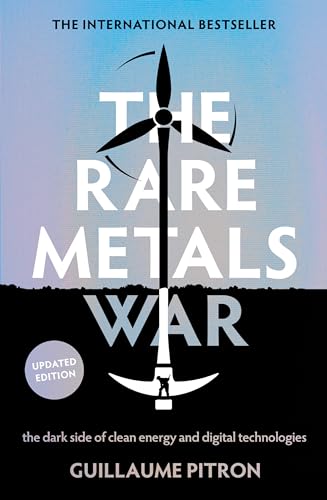
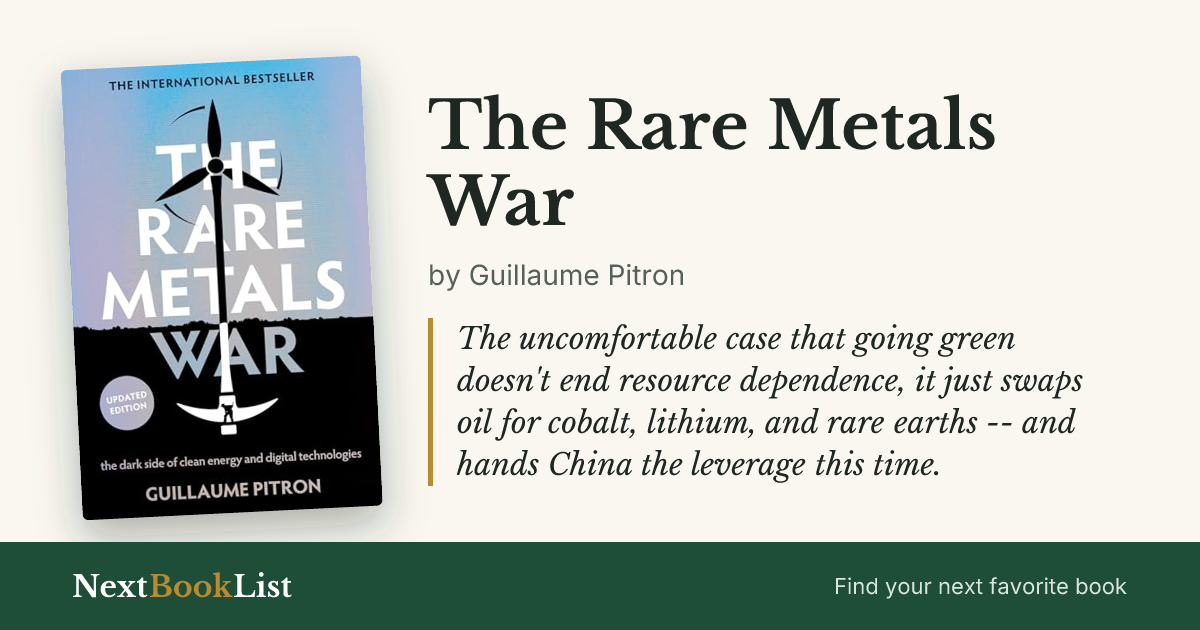
The Rare Metals War
by Guillaume Pitron · 2020
The uncomfortable case that going green doesn't end resource dependence, it just swaps oil for cobalt, lithium, and rare earths -- and hands China the leverage this time.
Worth reading? Pitron's argument cuts against the grain of most clean-energy coverage: solar panels, wind turbines, and EV batteries all depend on rare metals whose extraction and processing is dirtier, more concentrated, and more geopolitically fraught than the fossil-fuel dependence they're replacing. Compared to The War Below's on-the-ground American mining conflicts, this is a wider-lens, more international investigation, with China's near-monopoly on refining as the central character. It's a genuine corrective to green-tech marketing, six years of reporting across a dozen countries, but it's stronger as an exposé than a roadmap; don't expect a clear policy prescription at the end. Read it if you want the supply-chain reality behind "clean" energy. Skip it if you already know the rare-earth story and want solutions, not diagnosis.
| Full Title | The Rare Metals War: The Dark Side of Clean Energy and Digital Technologies |
|---|---|
| Author | Guillaume Pitron |
| Published | 2020 |
| Publisher | Scribe |
| Category | Business & Money |
| Favorite quote | “By breaking free of fossil fuels, we are in fact setting ourselves up for a new dependence -- on rare metals such as cobalt, gold, and palladium.” |
The Verdict
Pitron spent six years reporting across a dozen countries to make an uncomfortable point: the metals inside a solar panel or EV battery come from a supply chain at least as dirty, and far more concentrated in one country’s hands, as the oil it’s meant to replace.
you want the environmental-cost counterweight to the clean-energy optimism most coverage leads with
you're looking for policy solutions -- Pitron is strong on diagnosis and weak on what to actually do about it
Book Summary
The shift away from fossil fuels doesn't eliminate resource dependence, it relocates it. Solar panels, EV batteries, and wind turbines all require rare metals (cobalt, lithium, neodymium, and others) whose mining and refining is often dirtier and more concentrated than oil ever was.
China doesn't just have large rare-earth deposits, it deliberately built a near-monopoly on refining and processing these metals over decades, meaning even countries with their own deposits often still depend on Chinese processing capacity to make the raw ore usable.
"Green" technology's environmental marketing obscures its extraction footprint. The mines and refineries that make electric cars and solar panels possible are frequently in countries with weaker environmental and labor protections, so the pollution is real, it's just been moved somewhere less visible to Western consumers.
Top 7 Lessons from The Rare Metals War
- Clean energy doesn't end resource dependence, it relocates it from oil to rare metals like cobalt and lithium.
- China's rare-earth dominance came from deliberately building refining capacity, not just from having the raw deposits.
- Even countries with their own rare-earth deposits often still depend on Chinese processing to make the ore usable.
- The environmental cost of green tech is real, it's just been moved to mining and refining sites Western consumers rarely see.
- Rare-metal extraction is frequently concentrated in countries with weaker environmental and labor protections.
- Digital technology, not just clean energy, depends on the same rare-metal supply chains -- smartphones and green tech compete for the same inputs.
- The book is stronger at diagnosing the rare-metals dependency problem than at prescribing a policy fix for it.
Top 1 Quotes from The Rare Metals War
"By breaking free of fossil fuels, we are in fact setting ourselves up for a new dependence -- on rare metals such as cobalt, gold, and palladium."
Guillaume Pitron, The Rare Metals War
Frequently Asked Questions
Is The Rare Metals War worth reading?
Yes, if you want the environmental and geopolitical counterweight to clean-energy optimism. It's a strong exposé, weaker on policy solutions.
What is the main argument of The Rare Metals War?
Moving away from fossil fuels doesn't end resource dependence -- it shifts it to rare metals like cobalt, lithium, and rare earths, whose extraction is often dirtier and more geopolitically concentrated (largely in China) than oil ever was.
How does this compare to The War Below?
The Rare Metals War takes a wider international view with China's refining monopoly as the central story; The War Below is a more ground-level look at specific American mining conflicts.
Ready to read it?
Get The Rare Metals War on Amazon