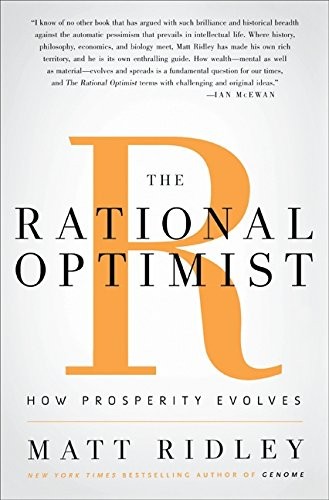
The Rational Optimist
by Matt Ridley · 2010
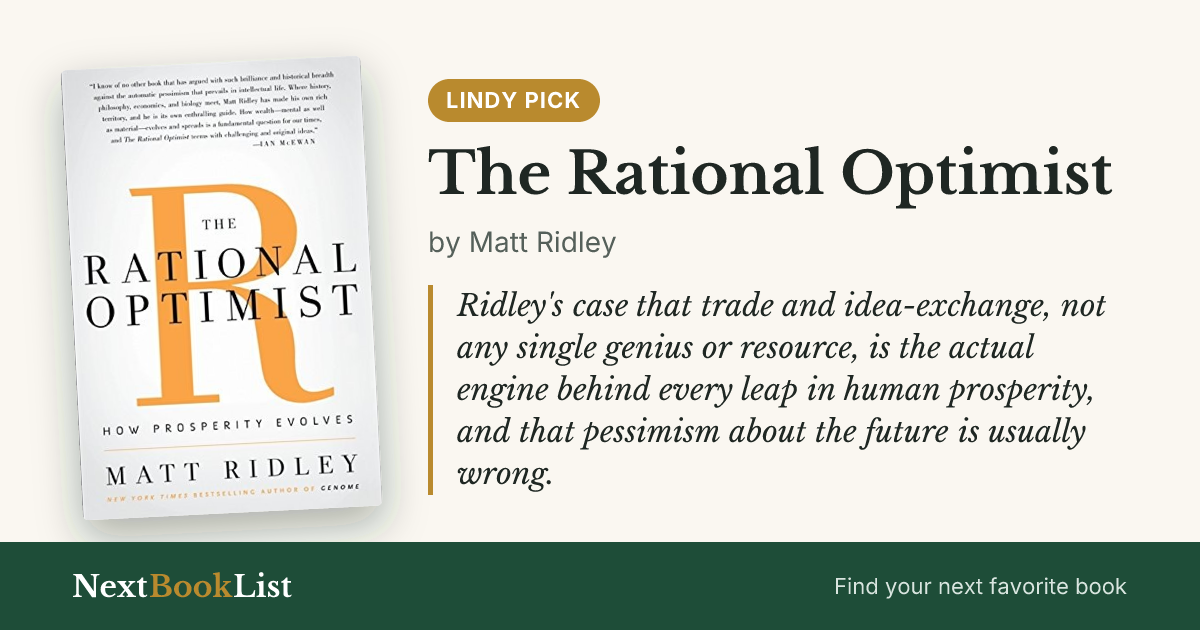
Ridley's case that trade and idea-exchange, not any single genius or resource, is the actual engine behind every leap in human prosperity, and that pessimism about the future is usually wrong.
Worth reading? Ridley's core argument is that human prosperity comes from exchange, ideas having sex, as he puts it, not from any single innovation, resource, or genius acting alone. He marshals evidence across archaeology, economics, and history to argue that doom-laden predictions have been wrong for two centuries running, and that specialization plus trade is the actual mechanism behind every major leap in living standards. Naval Ravikant has called it one of the most brilliant books he's read in years and cites four of Ridley's books among his all-time favorites. Read it as a rigorously argued corrective to reflexive pessimism about the future. Skip it if you want a neutral weighing of risk, this book is explicitly making the optimist's case.
| Full Title | The Rational Optimist: How Prosperity Evolves |
|---|---|
| Author | Matt Ridley |
| Published | 2010 |
| Category | Science & Nature |
| Favorite quote | “The generation that has experienced more peace, freedom, leisure time, education, medicine, travel, movies, mobile phones and massages than any generation in history is lapping up gloom at every opportunity.” |
The Verdict
Ridley isn’t just cheerleading, he’s building a historical case, brick by brick, for why betting against human ingenuity has been the losing bet for two centuries straight. Naval calls him one of his favorite authors for a reason, and this is the book to start with before working through the rest of Ridley’s catalog.
readers who want a rigorously argued, evidence-heavy case for optimism about human progress
you want a balanced weighing of risks, Ridley is explicitly making the optimist's case, not a neutral one
Book Summary
Ridley's central metaphor, "ideas having sex," argues that human prosperity accelerates specifically when specialized knowledge from different people and cultures combines and recombines through trade, not when isolated geniuses work alone. Specialization lets each person get better at one thing while trade lets everyone benefit from everyone else's specialization, a self-reinforcing loop he traces from Stone Age tool exchange through the modern global economy.
He pairs this with a systematic historical case against pessimism, showing that predictions of resource exhaustion, overpopulation catastrophe, and civilizational collapse have recurred every generation for centuries and been wrong every time, not because problems don't exist, but because human innovation under market pressure has consistently found solutions faster than pessimists predicted.
Top 7 Lessons from The Rational Optimist
- Prosperity comes from exchange and specialization compounding together, not from isolated genius or raw resources.
- 'Ideas having sex': innovation accelerates when different specialized knowledge combines through trade.
- Predictions of resource exhaustion and civilizational collapse have recurred for centuries and been wrong every time.
- Trade is a form of cooperation that doesn't require agreement or even mutual liking between parties.
- Specialization only creates value when paired with a market to trade the resulting surplus.
- Historical pessimism has a poor track record precisely because it underestimates how markets respond to scarcity.
- Optimism about the future isn't naivety, it can be a rigorously evidenced position, which is Ridley's whole project here.
Top 3 Quotes from The Rational Optimist
"The generation that has experienced more peace, freedom, leisure time, education, medicine, travel, movies, mobile phones and massages than any generation in history is lapping up gloom at every opportunity."
Matt Ridley, The Rational Optimist
"At some point, human intelligence became collective and cumulative in a way that happened to no other animal."
Matt Ridley, The Rational Optimist
"What is miraculous is that in modern society you can trust and be trusted by a shopkeeper you do not know."
Matt Ridley, The Rational Optimist
Frequently Asked Questions
Is The Rational Optimist worth reading?
Yes, especially if you want a rigorously argued, historically grounded case for optimism about human progress, rather than a vague feel-good message.
What is The Rational Optimist about?
Matt Ridley's argument that trade and the exchange of specialized ideas, not any single genius or resource, is the actual mechanism behind every major leap in human prosperity across history.
Why does Naval Ravikant recommend The Rational Optimist?
Naval has called it one of the most brilliant and enlightening books he's read in years, and cites four of Matt Ridley's books among his all-time favorites for their optimistic, evidence-based take on human progress.
Ready to read it?
Get The Rational Optimist on Amazon