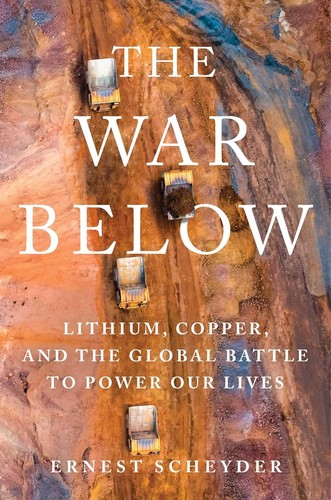
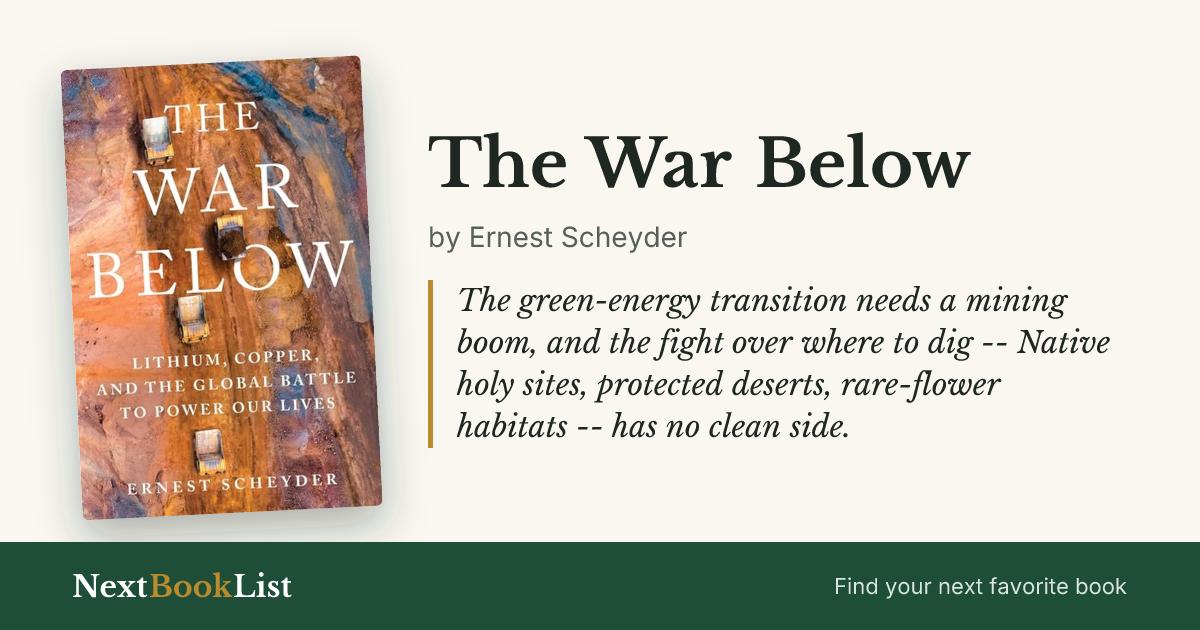
The War Below
by Ernest Scheyder · 2024
The green-energy transition needs a mining boom, and the fight over where to dig -- Native holy sites, protected deserts, rare-flower habitats -- has no clean side.
Worth reading? Scheyder, a Reuters reporter who covers critical minerals, refuses to hand the reader a villain. A Nevada lithium mine threatens a rare wildflower found nowhere else on earth. A California rare-earth restart depends on expertise it doesn't want to admit still comes from China. A proposed Arizona copper mine sits under land sacred to a Native tribe. Compared to The Rare Metals War's global, China-centric investigation, this is ground-level American reporting: specific mines, specific communities, specific fights. Its strength is refusing to pick a side between climate goals and the local costs of mining for them; its weakness, by the book's own design, is that it doesn't offer a way out of that tension. Read it if you want the human, on-the-ground version of the rare-metals supply chain story. Skip it if you're looking for solutions rather than a clear-eyed account of the tradeoffs.
| Full Title | The War Below: Lithium, Copper, and the Global Battle to Power Our Lives |
|---|---|
| Author | Ernest Scheyder |
| Published | 2024 |
| Publisher | Atria Books |
| Category | Business & Money |
The Verdict
Scheyder doesn’t let you pick an easy side: every mine in this book pits a real climate need against a real local cost, and he’s more interested in making you sit with that tension than resolving it for you.
you want ground-level, on-the-record reporting on specific American mining fights, not a global overview
you want Pitron-style international scope -- this is deliberately U.S.-centric, following specific mines and the people fighting over them
Book Summary
The green-energy transition requires far more mining, not less, because EVs, solar panels, and grid batteries all depend on lithium, copper, cobalt, and rare earths that have to come out of the ground somewhere, and "somewhere" is never uncontested land.
Nearly every proposed U.S. mine in the book runs into the same collision: climate goals that need the minerals versus local costs (endangered species, sacred land, water rights, indigenous rights) that mining imposes on a specific place and a specific community.
America's rare-earth and critical-mineral independence from China is more fragile than politicians suggest, several domestic mining restarts still depend on Chinese processing expertise or approval, meaning the "reshoring" story is more complicated than it's usually presented.
Top 8 Lessons from The War Below
- The green transition needs more mining, not less -- EVs and grid batteries all trace back to minerals that have to be dug up somewhere.
- Nearly every U.S. mine in the book collides climate goals against a specific local cost: an endangered species, sacred land, or water rights.
- A proposed Nevada lithium mine threatens a rare wildflower that exists nowhere else on earth.
- Some American rare-earth mining restarts still depend on Chinese processing expertise, complicating the 'reshoring' narrative.
- A proposed Arizona copper mine sits on land considered sacred by a Native American tribe, with no resolution that satisfies both sides.
- Scheyder deliberately avoids naming a villain -- miners, regulators, and activists all get treated as acting on legitimate interests.
- Cobalt and nickel mining fights extend even into U.S. wetlands, not just remote deserts, showing how widespread the tension has become.
- The book's throughline is that there's no version of the clean-energy transition that avoids new mining conflicts entirely.
Frequently Asked Questions
Is The War Below worth reading?
Yes, if you want ground-level, specific reporting on the mining conflicts the clean-energy transition is creating in the U.S. It deliberately doesn't offer solutions, just a clear-eyed account of the tradeoffs.
What is The War Below about?
It follows specific American mining fights, a Nevada lithium mine, a California rare-earth restart, an Arizona copper mine, showing how the minerals needed for EVs and clean energy collide with endangered species, indigenous land rights, and local communities.
How does The War Below compare to The Rare Metals War?
The Rare Metals War takes a global, China-centric view of rare-metal dependency. The War Below is U.S.-centric and ground-level, following named mines and the specific people fighting over them.
Ready to read it?
Get The War Below on Amazon