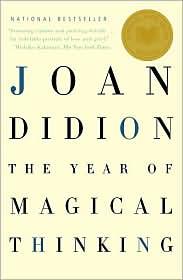
The Year of Magical Thinking
by Joan Didion · 2005
Joan Didion's precise, unsentimental account of the year after her husband dropped dead of a heart attack at their dinner table -- while their only daughter lay gravely ill in the hospital.
Worth reading? Didion, a writer known for exact, almost forensic prose, turns that same precision on her own unraveling and the result is one of the sharpest grief books ever written -- not because it's the most emotional, but because it's the most honest about the specific, irrational mechanics of grief (keeping his shoes because he'd need them, rereading the same paragraph of a coroner's report). Twenty years later it's still the reference point the genre gets measured against.
| Author | Joan Didion |
|---|---|
| Published | 2005 |
| Category | Biographies & Memoirs |
| Favorite quote | “Life changes fast. Life changes in the instant. You sit down to dinner and life as you know it ends.” |
The Verdict
The book’s staying power is partly circumstantial and partly craft: circumstantial because Quintana’s death shortly after publication turned it into an unintentional prologue to Didion’s next memoir, Blue Nights; craft because Didion never once reaches for a comforting cliché about grief, which is exactly why the book still gets handed to people going through it two decades later.
you want the book most literary readers point to as the definitive account of grief in plain, exact prose -- no forced uplift, no tidy stages, just what it's actually like when magical thinking (the belief that you can somehow undo it) takes hold
you want warmth or comfort -- Didion's prose is famously controlled and clinical even under the weight of the material, which some readers find devastating in the right way and others find cold or distancing
Book Summary
The title names the book's central idea: "magical thinking" is Didion's term for the irrational bargains grief produces -- the part of her that couldn't give away her husband's shoes because he'd need them when he came back, even while she consciously knew he wasn't coming back. The book is an anatomy of that gap between knowing and believing.
A second thread is grief's total unpredictability -- Didion had spent a career as a professional observer of chaos and meaning, and the book is partly about how completely that skill failed her in the face of a loss this close, undercutting any idea that intelligence or preparation insulates you from grief's actual mechanics.
The book was also written while her daughter Quintana was gravely ill and would die shortly after publication (a fact Didion addressed in a later book, Blue Nights) -- meaning the memoir was composed inside an active, compounding crisis, not in retrospective safety.
Top 9 Lessons from The Year of Magical Thinking
- Grief isn't a linear set of stages -- it produces genuinely irrational thinking (magical thinking) even in people who know better, and that's normal, not a failure of coping.
- Small, concrete details (a pair of shoes, a specific date, an exact sentence someone said) carry more emotional weight during loss than abstractions do.
- No amount of professional composure or intelligence exempts you from grief's disorientation -- expertise in observing life doesn't transfer to surviving its worst moments.
- Writing precisely about pain, rather than performing emotion, can be its own form of honesty -- restraint isn't the same as avoidance.
- Sudden loss and ongoing crisis (her daughter's illness) can overlap rather than happening in sequence, and grief doesn't wait for a clear moment to process it.
- Marriage after decades together creates a shared, specific language and routine that grief then strips away piece by piece, not all at once.
- Grief can leave a person fully functional in public while privately convinced of something they know is false -- the two states coexist rather than replacing each other.
- A memoir written from inside an unresolved crisis (Quintana's illness, still ongoing as Didion wrote) carries a different honesty than one written safely after the fact.
- Ordinary rituals -- a nightly routine, a particular chair, a specific drink -- become unbearable precisely because they're the parts of a marriage that keep hurting even though the other person is gone.
Top 4 Quotes from The Year of Magical Thinking
"Life changes fast. Life changes in the instant. You sit down to dinner and life as you know it ends."
Joan Didion, The Year of Magical Thinking
"Grief turns out to be a place none of us know until we reach it."
Joan Didion, The Year of Magical Thinking
"Grief comes in waves, paroxysms, sudden apprehensions that weaken the knees and blind the eyes and obliterate the dailiness of life."
Joan Didion, The Year of Magical Thinking
"We are imperfect mortal beings, aware of that mortality even as we push it away, failed by our very complication, so wired that when we mourn our losses we also mourn, for better or for worse, ourselves. As we were. As we are no longer. As we will one day not be at all."
Joan Didion, The Year of Magical Thinking
Frequently Asked Questions
Is The Year of Magical Thinking worth reading?
Yes -- it won the National Book Award and remains, twenty years on, one of the most cited grief memoirs in the genre. It's precise rather than sentimental, which is exactly its strength.
What is The Year of Magical Thinking about?
Joan Didion's account of the year following her husband John Gregory Dunne's sudden fatal heart attack, written while their daughter Quintana was also gravely ill.
What does 'magical thinking' mean in the book?
Didion's term for the irrational grief-driven belief that events can somehow be undone or reversed -- for example, not giving away her husband's shoes because some part of her believed he'd need them again.
Is The Year of Magical Thinking a hard book to read?
Emotionally, yes, though the prose itself is spare and controlled rather than overwrought. It's short but dense with grief, and best read when you can sit with it.
Ready to read it?
Get The Year of Magical Thinking on Amazon