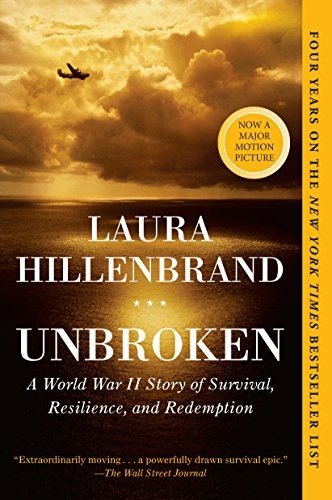
Unbroken
by Laura Hillenbrand · 2010
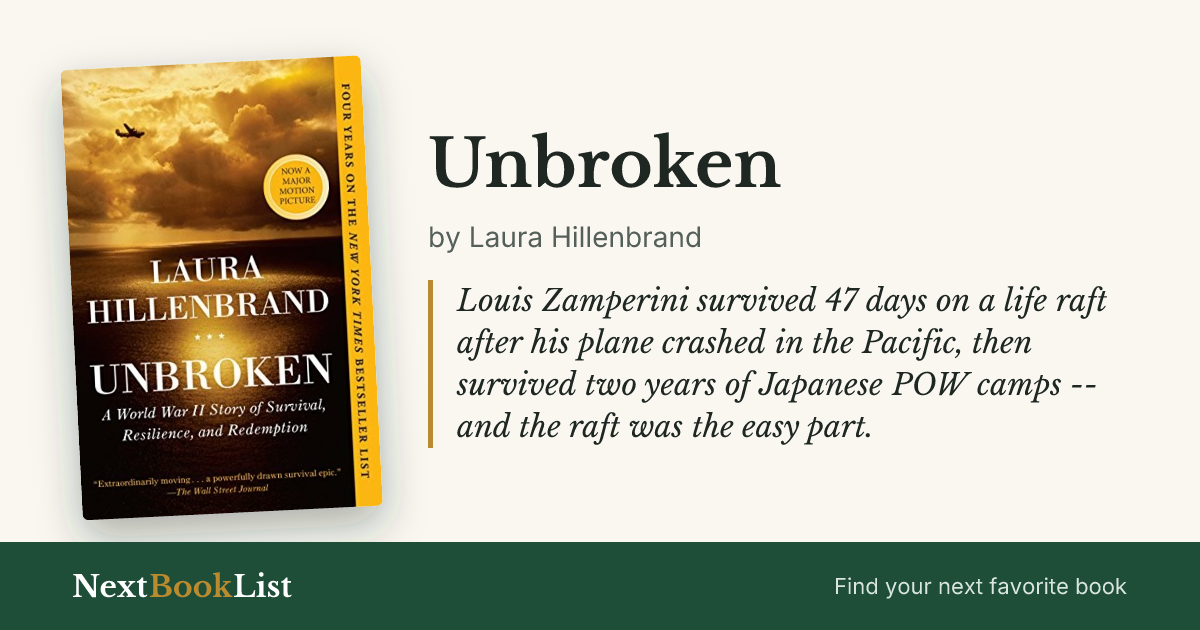
Louis Zamperini survived 47 days on a life raft after his plane crashed in the Pacific, then survived two years of Japanese POW camps -- and the raft was the easy part.
Worth reading? Hillenbrand's real subject isn't the survival story everyone remembers -- the raft, the sharks, the ocean -- it's what comes after: the years of PTSD and alcoholism that followed Zamperini home, and the harder, slower redemption that took longer than the war itself.
| Full Title | Unbroken: A World War II Story of Survival, Resilience, and Redemption |
|---|---|
| Author | Laura Hillenbrand |
| Published | 2010 |
| Publisher | Random House |
| Category | History |
| Favorite quote | “If I can take it, I can make it.” |
The Verdict
Everyone remembers Unbroken for the raft: 47 days adrift, sharks circling, near-starvation, somehow surviving all of it. That part is remarkable, but it’s not what makes this book worth your time. Hillenbrand’s real accomplishment is refusing to end the story where the movie does.
The POW camp years that follow are harder to read, and they should be – sustained, deliberate cruelty from a guard who’d singled Zamperini out for reasons that never quite make sense. Then comes the part most adaptations cut: years of PTSD and drinking after he came home, because surviving the ordeal and recovering from it turned out to be two completely different fights.
Read it if you want a true story of endurance that goes past the obvious survival narrative into what actually comes after. Skip it if graphic depictions of torture are more than you want to sit with – this book doesn’t soften that material to make you comfortable.
you want a true story of endurance so extreme it reads like fiction, with a real redemption arc that doesn't feel manufactured
you're sensitive to graphic depictions of torture and abuse -- the POW camp sections describe sustained physical and psychological cruelty in detail
Book Summary
Physical endurance -- 47 days adrift on a raft with almost no food or water, fending off sharks and near-starvation -- turns out to be only the first act of Zamperini's ordeal. The two years of systematic abuse he endured afterward in Japanese POW camps, particularly at the hands of one sadistic guard nicknamed 'the Bird,' represent a different and in some ways harder kind of survival: staying human under deliberate, sustained cruelty.
Coming home from extreme trauma doesn't automatically mean recovery. Zamperini's postwar collapse into alcoholism and PTSD-driven rage shows that survival and healing are separate problems -- he'd beaten the ocean and the camps, then spent years losing to a war that had already technically ended.
Zamperini's eventual recovery came through a specific, deliberate act of letting go: converting to a renewed Christian faith after a Billy Graham revival and finding a way to forgive his former captors, including 'the Bird' himself -- reframing an unresolvable trauma into something he could live alongside instead of being consumed by.
Top 8 Lessons from Unbroken
- Surviving a physical ordeal (the raft) and surviving its psychological aftermath (PTSD, alcoholism) are two separate battles, and the second one can be harder than the first.
- Extreme endurance often depends less on physical strength than on maintaining a sense of purpose and identity under conditions designed to strip both away.
- A single individual's cruelty (the guard known as 'the Bird') can define years of suffering more than the broader system that enabled it.
- Coming home from war doesn't end the war for the person who fought it -- reintegration can be its own prolonged crisis.
- Forgiveness, even of someone who caused severe harm, can function as a practical tool for ending your own suffering rather than a favor done for the offender.
- Athletic training (Zamperini was an Olympic runner before the war) can build a mental toughness that later transfers into completely different, unimaginable survival situations.
- Institutional accounts of a war (official military records) often undercount the scale of suffering that individual survivors actually experienced in captivity.
- A dramatic conversion or turning point (Zamperini's religious experience) can be a legitimate hinge in a real recovery story, not just a narrative convenience.
Top 1 Quotes from Unbroken
"If I can take it, I can make it."
Laura Hillenbrand, Unbroken
Frequently Asked Questions
Is Unbroken worth reading?
Yes -- it's one of the most extreme true survival stories on record, and it goes further than the raft-and-shark section most people already know, into a harder postwar recovery arc.
What is Unbroken about?
It follows Louis Zamperini, an Olympic runner turned World War II airman, through a plane crash, 47 days adrift in the Pacific, two years in Japanese POW camps, and his difficult postwar recovery from PTSD.
Is Unbroken a true story?
Yes -- it's narrative nonfiction based on extensive interviews with Zamperini himself and historical research, not a fictionalized account.
Is Unbroken very graphic?
Yes -- the POW camp sections describe sustained physical and psychological torture in detail. Go in prepared for that if you're sensitive to it.
How does Unbroken compare to the movie adaptation?
The 2014 film covers the raft and POW camp ordeal well but largely skips the book's postwar section on PTSD, alcoholism, and Zamperini's eventual recovery -- which is arguably the book's most important part.
Ready to read it?
Get Unbroken on Amazon