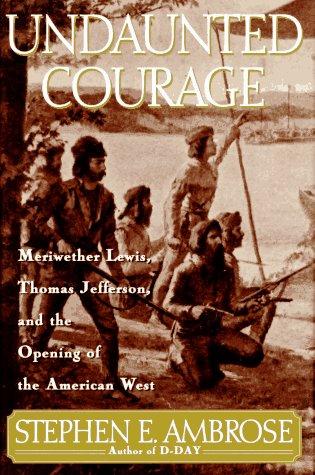
Undaunted Courage
by Stephen Ambrose · 1996
Jefferson sent Meriwether Lewis west with almost no idea what he'd find, and Ambrose turns the two-year journey into a portrait of exploration, ambition, and the man who couldn't survive returning home.
Worth reading? Undaunted Courage is popular history at its most readable: Ambrose turns thousands of pages of expedition journals into a fast, vivid account of the Corps of Discovery's two-year trek to the Pacific and back. It's less strong as a reckoning with what the expedition meant for the Native nations it moved through, which is worth knowing going in.
| Full Title | Undaunted Courage: Meriwether Lewis, Thomas Jefferson, and the Opening of the American West |
|---|---|
| Author | Stephen Ambrose |
| Published | 1996 |
| Publisher | Simon & Schuster |
| Category | History |
The Verdict
Ambrose writes exploration the way some writers write combat – fast, physical, and full of near-misses. The rapids, the winter starvation, the Continental Divide crossing that nearly ends the whole expedition all land with real tension even though you know how the story ends.
The Lewis-after-the-journey chapters are the most underrated part of the book. Ambrose doesn’t let the triumphant Pacific arrival be the ending; he follows Lewis into a decline that makes the expedition’s glory feel more complicated in hindsight.
Read it if you want a fast-moving, journal-grounded account of Lewis and Clark’s expedition and its human cost. Skip it if you want a book centered on Native perspectives rather than the explorers’ own.
you want a vivid, propulsive narrative history of the Lewis and Clark expedition grounded in the explorers' own journals
you want a book that fully reckons with the expedition's impact on Native nations -- Ambrose's focus stays mostly on Lewis and the journey itself
Book Summary
Ambrose builds the book around Meriwether Lewis, the personal secretary Jefferson chose to lead an expedition across the recently acquired Louisiana Territory to the Pacific, mapping the land, cataloging its plants and animals, and establishing relationships with Native nations along the way.
The narrative follows the Corps of Discovery's actual two-and-a-half-year journey in granular detail, drawing on Lewis and Clark's own journals to reconstruct the expedition's near-disasters, the crucial assistance of Sacagawea and various Native nations, and the sheer physical difficulty of crossing the continent with 1804 technology.
The book's final chapters cover Lewis's difficult return to civilian life after the expedition, his struggles with alcohol and depression as territorial governor, and his death by apparent suicide just three years after the journey's triumphant conclusion, a coda Ambrose treats as tragic rather than incidental to the story.
Top 7 Lessons from Undaunted Courage
- The Lewis and Clark expedition depended on assistance from multiple Native nations along the route, including crucial help from the Shoshone facilitated by Sacagawea, without which the crossing likely fails.
- Jefferson's instructions to Lewis went well beyond military reconnaissance -- he wanted botanical, zoological, and geographic documentation, making the expedition as much a scientific mission as a strategic one.
- The expedition's survival repeatedly hinged on decisions made with incomplete information about the terrain ahead, since accurate maps of the region simply didn't exist yet.
- Lewis's difficulty adjusting to life after the expedition, ending in his likely suicide, complicates the triumphant framing of the journey and shows how a defining achievement doesn't guarantee a stable life afterward.
- The expedition opened the door to westward expansion that would, within decades, displace the Native nations who had made the crossing possible in the first place.
- Ambrose's reliance on Lewis and Clark's own journals means the book largely tells the story from the explorers' perspective, with Native accounts and viewpoints represented secondhand at best.
- The Corps of Discovery's return, having been presumed dead by much of the country, was met with a level of celebration that set up Lewis for a fall he couldn't sustain once the mission ended.
Frequently Asked Questions
Is Undaunted Courage worth reading?
Yes, as a fast, vivid narrative account of the Lewis and Clark expedition, though pair it with more recent scholarship for a fuller account of the Native nations involved.
Is Undaunted Courage mostly about Lewis or the whole expedition?
It's centered on Meriwether Lewis specifically, using him as the throughline for the broader story of the Corps of Discovery.
How does the book handle Native American perspectives?
It relies primarily on Lewis and Clark's own journals, so Native perspectives come through secondhand rather than as an equal narrative voice -- a limitation worth knowing before reading.
What happened to Meriwether Lewis after the expedition?
He struggled with alcohol, debt, and depression as territorial governor of Louisiana and died in 1809, likely by suicide, just three years after the expedition's celebrated return.
Ready to read it?
Get Undaunted Courage on Amazon