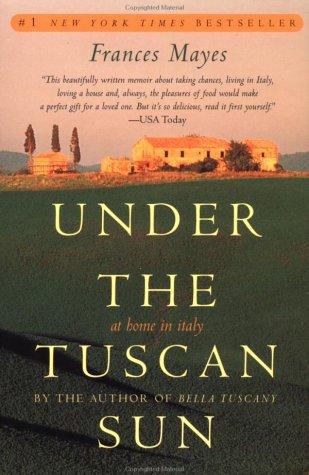
Under the Tuscan Sun
by Frances Mayes · 1996
A newly divorced poet buys a crumbling Tuscan villa on a whim and spends the memoir renovating it room by room, turning home repair, local food, and the Italian countryside into the real plot instead of a backdrop.
Worth reading? Under the Tuscan Sun isn't really about renovation, it's about what physical, unglamorous work does for someone rebuilding a life after divorce. Mayes never states that connection outright, which is the book's strength -- you feel the emotional repair happening underneath the literal repair without her having to spell it out.
| Full Title | Under the Tuscan Sun: At Home in Italy |
|---|---|
| Author | Frances Mayes |
| Published | 1996 |
| Publisher | Broadway Books |
| Category | Biographies & Memoirs |
The Verdict
Mayes writes about grout and plaster and stubborn Italian contractors with the same care most memoirists save for their big emotional scenes, and that’s deliberate. The book trusts you to notice that rebuilding a house room by room is also, quietly, how she’s rebuilding herself.
The food writing is genuinely good, not padding – olive harvests and market trips read like Mayes actually cared about capturing the rhythm of a place, not just checking a travel-memoir box.
Read it if you want a slow, sensory memoir about physical work and place doing the emotional heavy lifting instead of a stated arc. Skip it if you need real narrative tension – the biggest conflicts here are leaky roofs and slow contractors.
you want a slow, sensory memoir about rebuilding a life through physical work on a house, with long digressions on Tuscan food and landscape
you want narrative tension or a clear arc -- there's no real conflict here beyond leaky roofs and stubborn contractors, and the book is content to just sit in a place and describe it
Book Summary
Mayes, recently divorced, impulsively buys Bramasole, an abandoned villa in the Tuscan countryside, and the book chronicles the years-long process of restoring it -- replastering walls, replanting the garden, negotiating with local contractors -- as much as it chronicles her adjustment to a new life in Italy.
The memoir treats food, cooking, and the region's agricultural rhythms as central subjects in their own right, with long passages on olive harvests, local markets, and traditional recipes that function as a way of understanding the culture rather than as travel-writing filler.
Without ever making it explicit, the book runs the renovation of the house parallel to Mayes's own emotional recovery from divorce -- physical restoration standing in for a process she never directly narrates as personal healing.
Top 10 Lessons from Under the Tuscan Sun
- Mayes never explicitly frames the villa renovation as a metaphor for her own post-divorce recovery, but the parallel is unmistakable and is the book's real emotional engine.
- The memoir treats local food and agricultural rhythms -- olive harvests, wine, markets -- as central to understanding a place, not as decorative travel-writing detail.
- Renovating Bramasole requires Mayes to navigate unfamiliar local bureaucracy and contractor relationships, and the friction of that process becomes as much the story as the finished house.
- The book is structured seasonally rather than as a single dramatic arc, mirroring the agricultural calendar of the region she's settling into.
- Mayes buys the villa on impulse, without a clear plan, and the memoir treats that impulsiveness as the necessary first step of rebuilding a life rather than a reckless mistake.
- The book helped popularize a specific genre -- the expatriate home-restoration memoir -- that many later travel and lifestyle books explicitly modeled themselves on.
- Mayes works through Bramasole's restoration almost room by room -- roof, wiring, plumbing, floors -- and the memoir's structure tracks that practical checklist as much as it tracks any emotional arc.
- Local craftsmen and neighbors are written as full characters Mayes has to earn trust and understanding with, not just hired hands executing her plans.
- Italian bureaucracy and permit delays recur as comic frustration rather than real grievance, an early signal that the book treats obstacles as part of the deal, not something to resent.
- By the book's end, physically restoring one specific piece of land has become Mayes's way of choosing to belong somewhere -- rootedness as something built, not something handed to her.
Frequently Asked Questions
Is Under the Tuscan Sun worth reading?
Yes, if you want a slow, sensory memoir about rebuilding a home and a life in Tuscany -- it's less about plot than about place and process.
What is Under the Tuscan Sun about?
A newly divorced writer buys and restores an abandoned villa in Tuscany, and the memoir follows years of renovation alongside her adjustment to a new life in Italy.
Is Under the Tuscan Sun a novel or a memoir?
It's a memoir -- Frances Mayes and the villa, Bramasole, are real, though the book has a leisurely, almost novelistic pace.
Was Under the Tuscan Sun made into a movie?
Yes -- the 2003 film adaptation starring Diane Lane took significant liberties with the book's plot, adding a romantic storyline not in the memoir.
Does Under the Tuscan Sun include recipes?
Yes -- the book includes Tuscan recipes woven throughout its chapters on food and local cooking.
Ready to read it?
Get Under the Tuscan Sun on Amazon