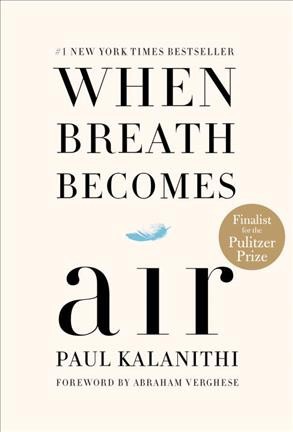
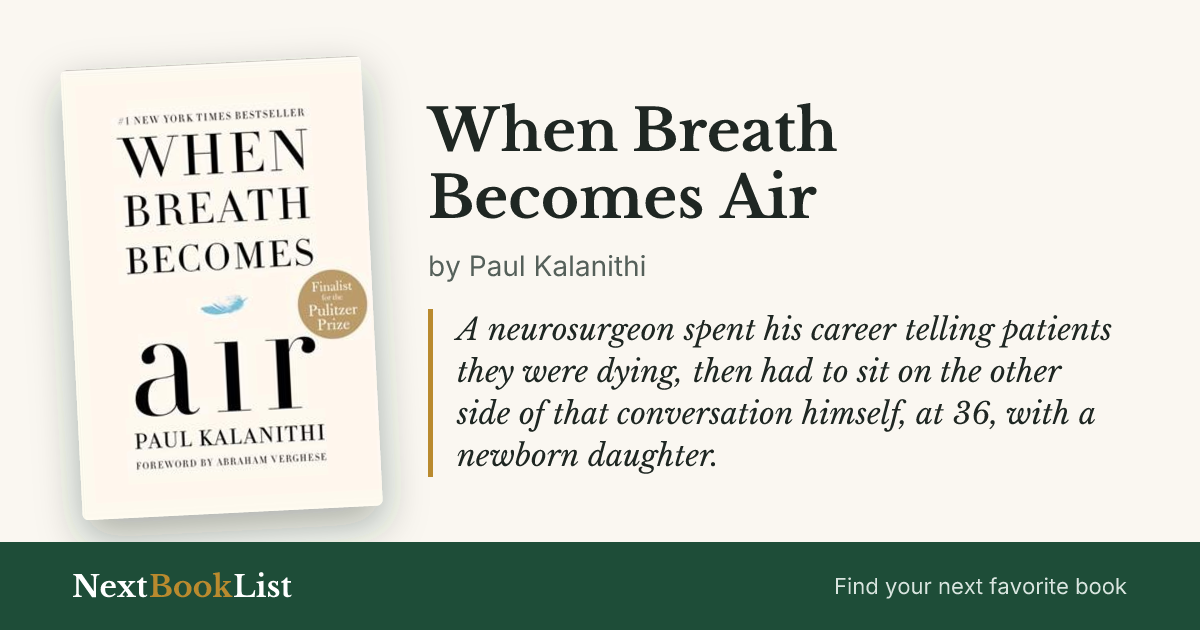
When Breath Becomes Air
by Paul Kalanithi · 2016
A neurosurgeon spent his career telling patients they were dying, then had to sit on the other side of that conversation himself, at 36, with a newborn daughter.
Worth reading? Kalanithi trained for a decade to become a neurosurgeon specifically to understand what makes a life meaningful when confronted with mortality -- and then was diagnosed with stage IV lung cancer just as that training was complete, at 36, with a one-year-old daughter. The book he wrote in his final months, unfinished at his death and completed with an epilogue by his wife Lucy, asks what makes life worth living with more precision than most philosophy manages, because he's asking from inside the answer running out. It's short, literary, and genuinely devastating -- read it when you can sit with that.
| Author | Paul Kalanithi |
|---|---|
| Published | 2016 |
| Category | Biographies & Memoirs |
| Favorite quote | “You can't ever reach perfection, but you can believe in an asymptote toward which you are ceaselessly striving.” |
The Verdict
Kalanithi’s medical precision about his own dying is what separates this from most illness memoirs – he can name exactly what’s happening in his body while also grappling with what it means, and the combination is rare. Read it slowly; it’s short enough to finish in a sitting, but it deserves more time than that.
you want an unflinching, literary account of facing terminal illness from someone who understood exactly what was happening to his own body
you're not in a place to read directly about death and mortality right now -- this book doesn't soften that material, and it shouldn't be read as comfort reading
Book Summary
Kalanithi's medical training gave him unusual clarity about his own diagnosis and prognosis, which turns out to be both a gift and a curse -- he can read his own scans and understand exactly what's coming, stripped of the uncertainty most patients are spared, and the book is partly about what it costs to know that precisely. His years as a neurosurgeon, sitting across from patients receiving terminal diagnoses, didn't prepare him for what it actually felt like from the other chair.
The book's central question -- what makes a life worth living when time is explicitly limited -- gets answered not through abstraction but through specific choices: continuing to operate as long as he physically could, having a daughter with his wife despite (or because of) the diagnosis, and writing this book itself as an act of meaning-making rather than despair. He doesn't resolve the question neatly; he lives inside it until he can't anymore.
Top 7 Lessons from When Breath Becomes Air
- Confronting mortality directly, rather than avoiding it, can clarify what actually matters in daily choices.
- Professional expertise about death (as a doctor) doesn't insulate you from its weight when it's your own diagnosis.
- Meaning is built through specific continued action (operating, writing, having a child) even under a terminal timeline, not through resignation.
- The medical relationship between doctor and patient looks different once you've been the patient -- Kalanithi writes candidly about what his training missed.
- Time-limited choices (having a child while dying) can be acts of meaning rather than denial.
- Writing and articulating your own experience, even incomplete, is itself a way of making sense of an unresolvable situation.
- A good life isn't measured only in duration -- the quality and intention of the time you have is a separate, equally real measure.
Top 6 Quotes from When Breath Becomes Air
"You can't ever reach perfection, but you can believe in an asymptote toward which you are ceaselessly striving."
Paul Kalanithi, When Breath Becomes Air
"The physician's duty is not to stave off death or return patients to their old lives, but to take into our arms a patient and family whose lives have disintegrated and work until they can stand back up and face, and make sense of, their own existence."
Paul Kalanithi, When Breath Becomes Air
"I began to realize that coming to grips with my own mortality... was much harder than I ever imagined."
Paul Kalanithi, When Breath Becomes Air
"Human knowledge is never contained in one person. It grows from the relationships we create between each other and the world, and still it is never complete."
Paul Kalanithi, When Breath Becomes Air
"There is a moment, a cusp, when the sum of gathered experience is worn down by the details of living. We are never so wise as when we live in this moment."
Paul Kalanithi, When Breath Becomes Air
"What makes life meaningful enough to go on living?"
Paul Kalanithi, When Breath Becomes Air
Frequently Asked Questions
Is When Breath Becomes Air worth reading?
Yes, though it's genuinely difficult material -- a neurosurgeon's account of his own terminal cancer diagnosis, written in his final months. It's short, literary, and one of the most direct meditations on mortality in the memoir genre.
What is When Breath Becomes Air about?
Paul Kalanithi's memoir of being diagnosed with stage IV lung cancer at 36, just as he completed a decade of neurosurgery training, exploring what makes life meaningful when time is explicitly limited.
Did Paul Kalanithi finish the book before he died?
No -- the book was unfinished at his death in March 2015. His wife, Lucy Kalanithi, wrote the epilogue completing the story, and the book was published in 2016.
Is this book only relevant to people facing terminal illness?
No. While it's directly about facing a terminal diagnosis, the underlying question -- what makes a life worth living -- resonates with readers regardless of their own health situation, which is part of why it became a bestseller.
Ready to read it?
Get When Breath Becomes Air on Amazon