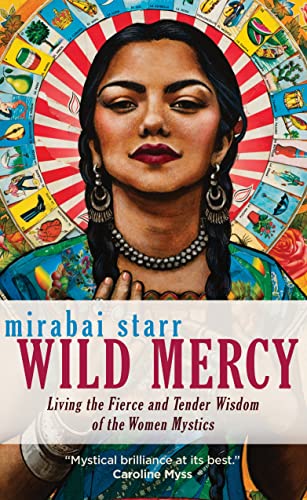
Wild Mercy
by Mirabai Starr · 2019
A translator of Teresa of Ávila and Julian of Norwich argues the feminine mystical tradition, fierce as much as tender, has been sidelined from spiritual history and needs reclaiming.
Worth reading? Wild Mercy earns its authority the hard way: Starr has spent decades translating Teresa of Ávila, John of the Cross, and Julian of Norwich, so when she argues the feminine mystical tradition got written out of spiritual history, she's arguing from primary sources, not secondhand enthusiasm. The book moves across traditions, Hildegard von Bingen, Rabia al-Basri, Julian of Norwich, contemporary voices, refusing to stay inside one denomination, and Starr's central claim is that this wisdom was never soft: it's fierce and tender in the same breath, embodied and erotic as often as it's contemplative. It reads best as an invitation into specific historical women rather than an abstract argument about feminine spirituality in general, which is what keeps it from drifting into vague inspirational territory.
| Full Title | Wild Mercy: Living the Fierce and Tender Wisdom of the Women Mystics |
|---|---|
| Author | Mirabai Starr |
| Published | 2019 |
| Publisher | Sounds True |
| Category | Religion & Spirituality |
| Favorite quote | “The feminine face of the sacred has been suppressed.” |
The Verdict
Starr isn’t a tourist in this material. She’s spent years translating Teresa of Ávila and Julian of Norwich directly, so when she argues the feminine mystical tradition got quietly written out of spiritual history, it’s an argument built on primary sources, not borrowed enthusiasm. The range she covers, Hildegard von Bingen, Rabia al-Basri, Julian of Norwich, contemporary voices, crosses Christian, Sufi, Jewish, and Buddhist lines without apology, and the through-line she draws between them is more convincing for being specific rather than abstract.
Her central move is refusing to let this tradition get flattened into “soft” spirituality. Fierce and tender sit in the same sentence throughout, embodied, sometimes erotic, sometimes furious. Read it if you want real historical women mystics as your entry point rather than a generic argument about the feminine divine. Skip it if you want a book that stays inside one denomination’s doctrine, Starr deliberately doesn’t.
you want a spirituality book grounded in specific women mystics, Hildegard, Teresa of Ávila, Rabia, rather than a generic feminine-spirituality framework
you want a strictly Christian, doctrine-first devotional book -- Starr draws freely across Christian, Sufi, Jewish, and Buddhist women mystics and blends them

Book Summary
The mystical tradition carried by women, Hildegard von Bingen, Teresa of Ávila, Julian of Norwich, Rabia al-Basri, was sidelined from mainstream spiritual history, and Starr argues recovering it matters for both women and men today, not as a niche interest but as missing half of the map.
This wisdom was never purely gentle. Starr insists the feminine mystical voice is fierce as often as it's tender, embodied and often erotically charged in its language for divine union, not the soft, passive spirituality it sometimes gets reduced to.
The tradition crosses religious lines freely, Christian, Sufi, Jewish, Buddhist women mystics all appear, and Starr treats that cross-pollination as a feature: the wisdom these women arrived at independently rhymes across traditions more than institutional religion usually admits.
Top 8 Lessons from Wild Mercy
- The feminine mystical tradition, specific historical women like Hildegard and Teresa of Ávila, was sidelined from mainstream spiritual history and is worth actively recovering.
- This tradition was never simply gentle -- Starr insists on 'fierce and tender' together, not soft spirituality as a stereotype.
- Mystical language for divine union is often embodied and erotically charged, not purely abstract or contemplative.
- Women mystics across very different religious traditions, Christian, Sufi, Jewish, Buddhist, arrive at strikingly similar insights independently.
- Grief and darkness are treated as legitimate mystical territory, not detours from the spiritual path, drawing on Julian of Norwich and others who wrote through real suffering.
- Rage and fierceness belong inside spiritual practice, not outside it -- Starr resists any framing that asks women to spiritually bypass anger.
- Direct, unmediated experience of the divine was often what got these women in trouble with religious institutions of their time.
- Reclaiming this tradition isn't only a project for women readers -- Starr frames the missing wisdom as relevant to anyone's spiritual life.
Top 1 Quotes from Wild Mercy
"The feminine face of the sacred has been suppressed."
Mirabai Starr, Wild Mercy
Frequently Asked Questions
Is Wild Mercy worth reading?
Yes, especially if you want a spirituality book grounded in specific historical women mystics rather than a generic feminine-spirituality framework -- Starr writes from real translation expertise.
Who are the women mystics covered in Wild Mercy?
Starr draws on figures including Hildegard von Bingen, Teresa of Ávila, Julian of Norwich, and Rabia al-Basri, spanning Christian, Sufi, Jewish, and Buddhist traditions.
What is the main idea of Wild Mercy?
The feminine mystical tradition was sidelined from mainstream spiritual history, and it was never purely soft -- Starr argues it was fierce and tender at once, and worth actively reclaiming.
Is Wild Mercy a strictly Christian book?
No, Starr moves freely across Christian, Sufi, Jewish, and Buddhist women mystics rather than staying inside one denomination.
Is Wild Mercy only for women readers?
Starr frames the recovered wisdom as relevant to anyone's spiritual life, not a niche interest limited to women readers.
Ready to read it?
Get Wild Mercy on Amazon