Wild Swans
by Jung Chang · 1991
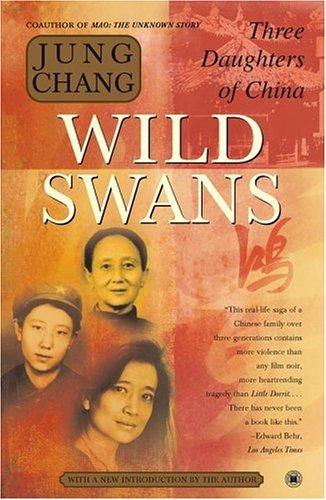
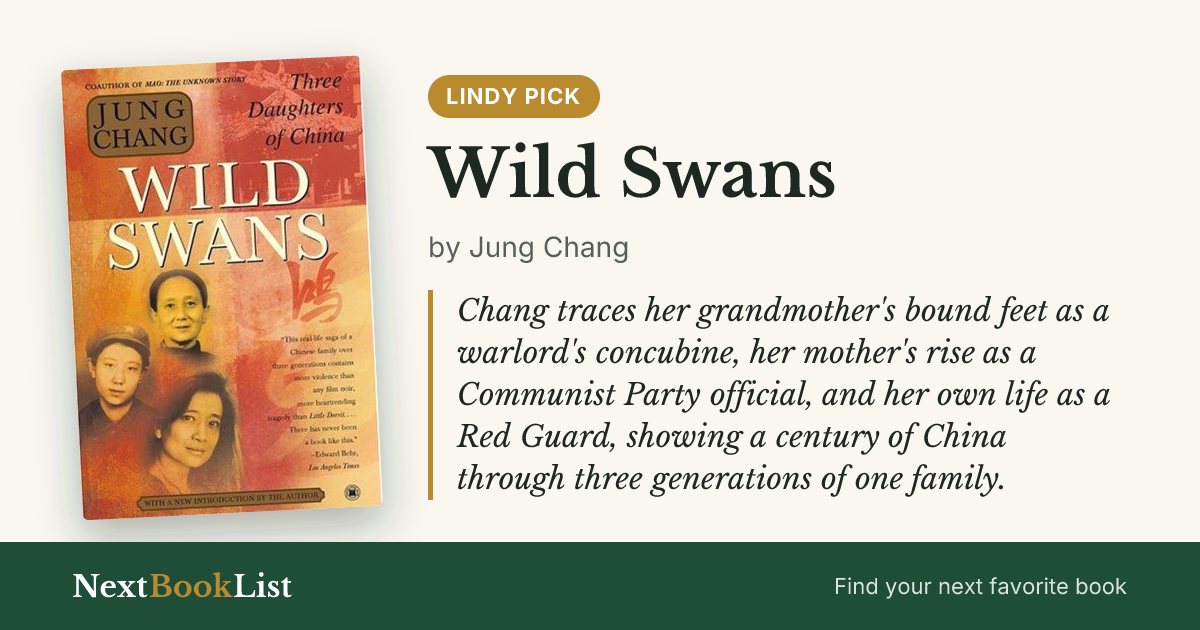
Chang traces her grandmother's bound feet as a warlord's concubine, her mother's rise as a Communist Party official, and her own life as a Red Guard, showing a century of China through three generations of one family.
Worth reading? Wild Swans works on two levels at once: as a rigorous account of how imperial China, warlordism, Japanese occupation, civil war, and Mao's Communist Party each reshaped the same family, and as an intimate, specific memoir of what it actually felt like to live through the Cultural Revolution as a believer who slowly stopped believing. Few books manage both that well.
| Full Title | Wild Swans: Three Daughters of China |
|---|---|
| Author | Jung Chang |
| Published | 1991 |
| Publisher | Simon & Schuster (UK) / Anchor Books (US) |
| Category | Biographies & Memoirs |
The Verdict
Chang could have written a straightforward history of the Cultural Revolution and it would still be worth reading. What makes Wild Swans exceptional is refusing to separate the history from the family, so you feel the ideology’s costs through specific people instead of abstract casualty counts.
The disillusionment arc, watching a true believer’s faith collapse in real time as her own parents are destroyed by the movement she served, is the book’s hardest and most honest material. Chang doesn’t retrofit hindsight onto her younger self’s belief; she shows you how genuine it was before it broke.
Read it if you want the fullest, most personal account of what Mao-era China actually did to the people living inside it. Skip it if you’re looking for a detached academic history rather than a memoir with real stakes.
you want a sweeping, deeply personal account of twentieth-century Chinese history told through three generations of women who each lived through a completely different version of the country
you want a strictly academic or dispassionate history -- this is unapologetically a family memoir first, filtered through Chang's own experience and perspective
Book Summary
Chang structures the book around three generations of women in her family: her grandmother, given as a concubine to a warlord general with bound feet in the early twentieth century; her mother, an early and committed Communist Party official who rose through the ranks after 1949; and Chang herself, who grew up a devoted Red Guard during the Cultural Revolution before that devotion collapsed under the weight of what she witnessed.
The book uses this three-generation structure to trace nearly a century of Chinese upheaval, warlord era, Japanese occupation, civil war between the Nationalists and Communists, the early Communist state, and then the Cultural Revolution's purges, forced denunciations, and public humiliations, showing how each political system reshaped what was possible and expected for women specifically.
Chang's own disillusionment forms the book's emotional center: watching her Communist Party official parents get denounced, humiliated, and imprisoned by the same revolutionary movement they'd devoted their lives to, Chang describes losing faith in Mao and the Party from the inside, as a true believer confronting the gap between ideology and what she was seeing happen to people she loved.
Top 8 Lessons from Wild Swans
- Chang's grandmother's bound feet and status as a warlord's concubine illustrate how thoroughly a woman's life could be controlled by others in early twentieth-century China, with almost no agency over her own body or future.
- Chang's mother's rise as a committed Communist Party official shows the genuine idealism many early Party members brought to the revolution, before the movement turned on many of its own believers.
- The Cultural Revolution's system of public denunciation could turn children against parents and neighbors against neighbors, using ideological loyalty as a weapon that reshaped family and community bonds.
- Chang's own history as a devoted young Red Guard before her disillusionment shows how genuine belief, not just coercion, drove much of the Cultural Revolution's early energy.
- Watching her parents, loyal Party officials, get purged and imprisoned by the same movement they'd served is what finally broke Chang's faith in the ideology she'd grown up inside.
- The book demonstrates how quickly political status could invert in Mao-era China -- yesterday's revolutionary hero could become tomorrow's denounced enemy with little warning.
- Three generations of women in one family lived under three fundamentally different political and social systems, each reshaping what survival and success meant for a woman in China.
- Wild Swans was banned in mainland China, illustrating how directly the book's honest account of the Cultural Revolution conflicts with the Party's preferred historical narrative.
Frequently Asked Questions
Is Wild Swans worth reading?
Yes -- it's widely regarded as one of the essential firsthand accounts of twentieth-century Chinese history, personal and historically rigorous at the same time.
Is Wild Swans banned in China?
Yes -- the book has been banned in mainland China since its publication, largely for its unflinching account of the Cultural Revolution and criticism of Mao.
Is Wild Swans a memoir or a history book?
Both -- it's Chang's own family memoir, but it's researched and structured carefully enough to also function as a genuine history of China across three generations.
Do I need background knowledge of Chinese history to read it?
No -- Chang explains the historical context as the narrative unfolds, making it accessible without prior knowledge of the period.
Ready to read it?
Get Wild Swans on Amazon