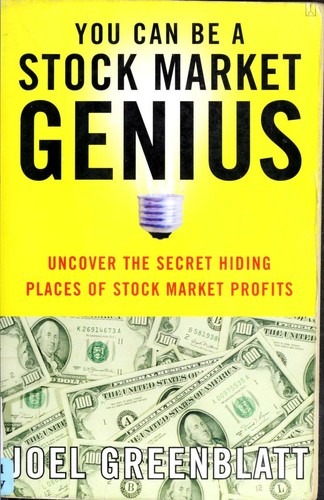
You Can Be a Stock Market Genius
by Joel Greenblatt · 1997
A hedge fund manager's guide to overlooked, unglamorous corners of the market, spinoffs, mergers, bankruptcies, where the pros aren't looking as hard.
Worth reading? Greenblatt, who ran the hedge fund Gotham Capital to a reported 50%+ annualized return over 10 years, argues the best opportunities live in situations most investors ignore because they're too small, complicated, or temporarily unglamorous: spinoffs, merger arbitrage, and post-bankruptcy stocks specifically. It's more technical and situation-specific than The Intelligent Investor's broad value framework, and it rewards readers who already understand basic financial analysis -- start with a foundational value-investing book first if you're new.
| Full Title | You Can Be a Stock Market Genius: Uncover the Secret Hiding Places of Stock Market Profits |
|---|---|
| Author | Joel Greenblatt |
| Published | 1997 |
| Category | Business & Money |
| Favorite quote | “The market is not efficient, but it is generally right.” |
The Verdict
Greenblatt writes from real fund-management experience, and the specificity shows – this isn’t general philosophy, it’s a hunting guide for particular market inefficiencies most investors never think to look for. Read it once you’ve got the fundamentals down; it’s the advanced elective, not the intro course.
you're an experienced investor looking for specific, less-crowded strategies (spinoffs, risk arbitrage, post-bankruptcy equities) beyond standard buy-and-hold value investing
you're a beginner investor, this assumes real familiarity with financial statements and market mechanics; start with The Intelligent Investor or One Up on Wall Street first

Book Summary
Institutional investors systematically ignore certain categories of opportunity for structural reasons unrelated to quality: spinoffs are too small for large funds to bother with initially, merger arbitrage requires specialized analysis most generalist investors skip, and post-bankruptcy equities carry a stigma that keeps prices depressed even after the underlying business has stabilized. Greenblatt argues these structural blind spots, not superior stock-picking insight, are where individual investors can realistically find an edge over professionals.
Spinoffs specifically get detailed treatment: when a company spins off a division into a separate public entity, the new stock is often dumped indiscriminately by shareholders of the parent company who never wanted the spinoff shares in the first place, creating temporary price dislocation from the spinoff's actual underlying value -- a pattern Greenblatt argues is systematically exploitable if you know to look for it.
Top 7 Lessons from You Can Be a Stock Market Genius
- Structural blind spots (situations institutional investors ignore for size or complexity reasons) are where individual investors can realistically find an edge.
- Spinoffs often get dumped indiscriminately by parent-company shareholders, creating temporary price dislocation from true value.
- Merger arbitrage requires specialized analysis most generalist investors skip, which can create opportunity for those willing to do the work.
- Post-bankruptcy equities carry a stigma that keeps prices depressed even after the underlying business stabilizes.
- Read spinoff prospectuses and SEC filings directly rather than relying on secondhand summaries -- the detail is where the edge lives.
- Small, complicated situations that are too minor for large funds to bother with can be genuinely inefficient markets for individual investors.
- An investing edge, per Greenblatt, comes from structural inefficiency, not from superior general stock-picking intuition.
Top 1 Quotes from You Can Be a Stock Market Genius
"Spinoffs, as a general rule, tend to outperform the market."
Joel Greenblatt, You Can Be a Stock Market Genius
Frequently Asked Questions
Is You Can Be a Stock Market Genius worth reading?
Yes, for investors who already understand financial statement analysis and want specific, less-crowded strategies beyond standard value investing. It's more technical than beginner-friendly.
What is the main idea of You Can Be a Stock Market Genius?
Institutional investors systematically ignore certain categories of opportunity (spinoffs, merger arbitrage, post-bankruptcy stocks) for structural reasons, and individual investors can find a real edge by specializing in those overlooked situations.
Who is Joel Greenblatt?
A hedge fund manager who ran Gotham Capital to reportedly high annualized returns and later authored The Little Book That Beats the Market, in addition to this earlier, more technical book on special-situation investing.
Is this book for beginner investors?
No -- it assumes real familiarity with financial statements and market mechanics. Beginners should start with The Intelligent Investor or One Up on Wall Street before this more specialized, situation-driven book.
Ready to read it?
Get You Can Be a Stock Market Genius on Amazon