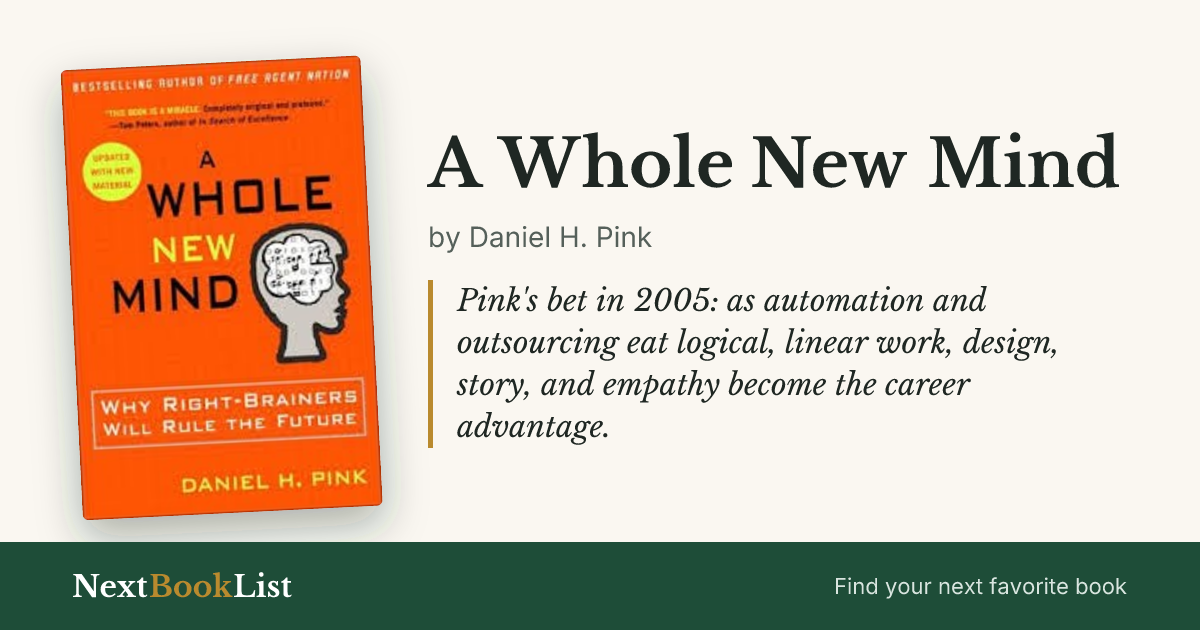
A Whole New Mind
by Daniel H. Pink · 2005
Pink's bet in 2005: as automation and outsourcing eat logical, linear work, design, story, and empathy become the career advantage.
Worth reading? A Whole New Mind and Range make complementary, not competing, cases about what wins in a changing economy. Pink argues in 2005 that right-brain aptitudes -- design, story, symphony, empathy, play, meaning -- become the differentiator once left-brain, rule-based work gets automated or outsourced. Epstein's Range, over a decade later, argues generalists who connect ideas across domains out-perform narrow specialists in complex, unpredictable fields. Read them together and the throughline is the same: breadth, synthesis, and human judgment age better than narrow, mechanical expertise. Worth reading for the framing, which held up better than most 2005 futurism -- design and storytelling skills are more explicitly valued in hiring now than they were then. Skip it if you want the specific automation examples to feel current; some of the outsourcing-to-India-and-China framing reads as dated against the AI-automation conversation happening now.
| Full Title | A Whole New Mind: Why Right-Brainers Will Rule the Future |
|---|---|
| Author | Daniel H. Pink |
| Published | 2005 |
| Category | Business & Money |
| Favorite quote | “The MFA is the new MBA.” |
The Verdict
Pink was making a genuinely contrarian bet in 2005 – that art-school skills would outcompete spreadsheet skills – and enough of it landed (design roles, UX, brand storytelling all became mainstream career paths) that the book reads less like futurism now and more like an early, accurate diagnosis with some dated examples still attached.
you want a case for why creative, relational skills are becoming more valuable, not less, in an automated economy
you want current AI-era analysis -- this is a 2005 book, and its automation and outsourcing framing predates large language models by over a decade
Book Summary
Pink's argument rests on three forces reshaping which skills pay off: Abundance (material wants are largely met in developed economies, so functional-only products lose to ones with design and meaning attached), Asia (routine white-collar work gets outsourced to lower-cost markets), and Automation (software increasingly does the rule-based analytical work that used to require a person). Together these forces devalue narrow left-brain, logical-sequential skills and increase the premium on right-brain aptitudes that are harder to automate or outsource.
He organizes those aptitudes into six "senses": Design (not just function, but something beautiful, whimsical, or emotionally engaging), Story (context and narrative persuade more than facts and bullet points alone), Symphony (the ability to synthesize disparate pieces into a whole, seeing the big picture across specialties), Empathy (understanding what makes another person tick, which logic alone can't replicate), Play (games, humor, and lightness improve work and health), and Meaning (purpose and spirituality as a driver, not a distraction from productivity).
Pink's punchiest claim -- that "the MFA is the new MBA" -- captures the whole book's thesis in one line: an art degree, once seen as economically impractical next to a business degree, becomes more relevant as design and creativity become the actual differentiator in crowded, commoditized markets.
Top 10 Lessons from A Whole New Mind
- Abundance, Asia, and Automation are the three forces devaluing narrow left-brain work.
- Products need design and meaning attached, not just function, to stand out in abundant markets.
- Story persuades more durably than facts and bullet points alone.
- Symphony -- synthesizing across specialties -- is a skill you can deliberately build.
- Empathy is a competitive skill, not just a soft one, because logic alone can't replicate it.
- Play and humor genuinely improve work quality and are not just a break from it.
- Meaning and purpose are legitimate motivators, not distractions from productivity.
- Rule-based, routine work is the most exposed to automation and outsourcing.
- Right-brain aptitudes (design, story, empathy) are harder to automate than left-brain ones.
- The MFA becoming 'the new MBA' captures how creative skills gained economic value.
Top 2 Quotes from A Whole New Mind
"The MFA is the new MBA."
Daniel H. Pink, A Whole New Mind
"Abundance has satisfied, and even oversatisfied, the material needs of a good many people."
Daniel H. Pink, A Whole New Mind
Frequently Asked Questions
Is A Whole New Mind worth reading?
Yes for the framework -- design, story, empathy, and meaning as career skills held up well since 2005. Skip it if you want current AI-era analysis; the automation examples are dated.
What is the main idea of A Whole New Mind?
As abundance, outsourcing, and automation devalue routine logical work, right-brain aptitudes like design, storytelling, and empathy become the real career and business differentiator.
What does 'the MFA is the new MBA' mean?
Pink's claim that creative, design-oriented skills, once seen as economically impractical, became more valuable than traditional business-degree skills as markets got more crowded and commoditized.
How does A Whole New Mind compare to Range by David Epstein?
Both argue breadth beats narrow specialization, from different angles -- Pink focuses on right-brain creative aptitudes replacing automatable left-brain skills, Epstein focuses on generalists outperforming specialists in complex fields.
Ready to read it?
Get A Whole New Mind on Amazon