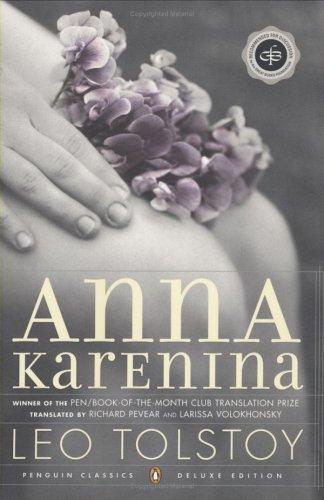
Anna Karenina
by Leo Tolstoy · 1878
One of the most famous opening lines in fiction sets up a novel about two marriages -- one collapsing in scandal, one quietly working -- and Tolstoy refuses to let either verdict be simple.
Worth reading? Anna Karenina has outlasted most 19th-century romantic tragedies because Tolstoy refuses to simplify Anna into either a victim or a cautionary tale. It beats most 'tragic affair' novels because the parallel story of Levin and Kitty's quieter, harder-won marriage keeps the book from being purely a morality play. Skip it only if you need constant momentum -- Levin's chapters are a genuine tonal shift from Anna's.
| Full Title | Anna Karenina (Pevear & Volokhonsky Translation) |
|---|---|
| Author | Leo Tolstoy |
| Published | 1878 |
| Publisher | Penguin Classics |
| Category | Fiction |
| Favorite quote | “Happy families are all alike; every unhappy family is unhappy in its own way.” |
The Verdict
The opening line is famous enough to be a cliche at this point, and it still holds up as the thesis statement for the entire book. What makes this better than a standard tragic-affair novel is Levin’s parallel story – Tolstoy clearly believes something, and it’s not simply “affairs end badly.”
Anna’s chapters are the ones people remember, but Levin’s slower, more awkward path to a real marriage is doing just as much work. Read both halves, don’t skip to the Anna parts.
you want the definitive novel about marriage, desire, and social hypocrisy, with a tragic heroine the book never fully condemns or fully excuses
you want a fast plot -- there are long sections following Levin's farming and philosophical struggles that have nothing directly to do with Anna's story, and they're not filler, but they do slow the book down
Book Summary
Anna Karenina, married to a cold, status-obsessed government official, falls into an affair with the dashing Count Vronsky and is slowly destroyed by the social hypocrisy that punishes her openly while barely touching Vronsky or the many men in her circle doing the same thing. Her arc ends in one of literature's most famous tragic conclusions.
Running parallel is Konstantin Levin, an awkward, sincere landowner whose slow, unglamorous courtship of Kitty Shcherbatskaya and struggle with religious and existential doubt is Tolstoy's answer to Anna's story: love and meaning built through patience and honesty rather than passion and self-deception.
The novel's real subject is the gap between what society claims to value (fidelity, propriety) and what it actually punishes (visibility, female desire specifically). Anna doesn't do anything the men around her don't also do -- she's just the one who gets caught, judged, and isolated for it.
Top 8 Lessons from Anna Karenina
- Anna's affair with Vronsky is punished by society far more harshly than the identical behavior in men around her, including her own brother Stiva -- the novel is explicit about this double standard.
- Levin's slow, awkward courtship of Kitty (including a failed first proposal) is deliberately contrasted with Anna and Vronsky's fast, passionate collapse.
- Anna's son, whom she's forced to leave behind, remains a source of grief throughout the novel -- her affair costs her motherhood as much as her reputation.
- Karenin, Anna's husband, is more complicated than a simple villain -- he genuinely struggles with forgiveness and cruelty in ways the novel doesn't let the reader dismiss easily.
- Levin's crisis of religious and philosophical doubt, resolved only partially by the novel's end, runs as a serious parallel plot to Anna's romantic one -- both are searches for meaning.
- Anna's increasing isolation from society, and eventually from Vronsky himself, tracks a slow psychological unraveling rather than a single dramatic fall.
- Vronsky's own restlessness and inability to fully commit is shown clearly enough that the novel doesn't let him off the hook even as society does.
- The train imagery that opens and closes Anna's arc (she and Vronsky first meet at a train station where a worker is killed) foreshadows her fate from the very first chapters.
Top 4 Quotes from Anna Karenina
"Happy families are all alike; every unhappy family is unhappy in its own way."
Leo Tolstoy, Anna Karenina
"Everything that I understand, I understand only because I love."
Leo Tolstoy, Anna Karenina
"If you look for perfection, you'll never be content."
Leo Tolstoy, Anna Karenina
"There are no conditions to which a person cannot become accustomed, especially if he sees that all around him are living in the same way."
Leo Tolstoy, Anna Karenina
Frequently Asked Questions
Is Anna Karenina worth reading?
Yes -- it's the definitive novel about marriage and social hypocrisy, and Tolstoy refuses to reduce Anna to either a simple victim or a cautionary tale.
Is Anna Karenina hard to read?
It's long and has a large cast, but the prose itself is clear. The main challenge is tracking two parallel storylines (Anna's and Levin's) that don't fully intersect until late.
What is the main theme of Anna Karenina?
The gap between what society claims to value and what it actually punishes -- Anna is judged for an affair that men in her circle commit without consequence.
Who should read Anna Karenina?
Readers who want a serious, unflinching novel about marriage and desire. Skip it if you need a single, fast-moving plot -- Levin's parallel story is a real tonal shift from Anna's.
Ready to read it?
Get Anna Karenina on Amazon