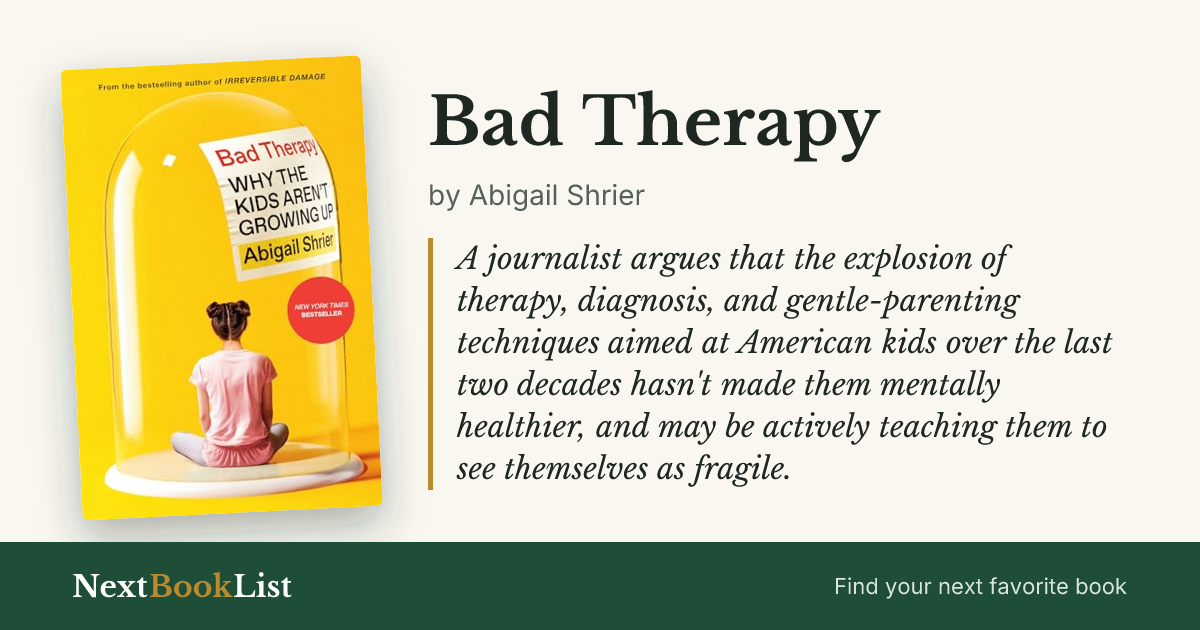
Bad Therapy
by Abigail Shrier · 2024
A journalist argues that the explosion of therapy, diagnosis, and gentle-parenting techniques aimed at American kids over the last two decades hasn't made them mentally healthier, and may be actively teaching them to see themselves as fragile.
Worth reading? Shrier's argument is that the sharp rise in youth anxiety, depression, and self-reported mental illness over the past fifteen years correlates suspiciously with the sharp rise in exposure to therapeutic language, school-based mental health screening, and gentle-parenting techniques aimed at validating kids' feelings rather than building their resilience, and that correlation, she argues through interviews with therapists, parents, and researchers, likely runs in the causal direction fewer people expect: the intervention is partly creating the problem it claims to treat. It's a real, testable, and uncomfortable hypothesis, well-reported through firsthand interviews, but it's also explicitly a prosecutor's brief rather than a balanced literature review, and mainstream child psychologists have pushed back hard on both the causal story and Shrier's characterization of evidence-based practices like SEL (social-emotional learning) and trauma-informed care.
| Full Title | Bad Therapy: Why the Kids Aren't Growing Up |
|---|---|
| Author | Abigail Shrier |
| Published | 2024 |
| Publisher | Sentinel |
| Category | Sociology & Culture |
The Verdict
Shrier’s case, stripped to its core claim: youth anxiety and depression exploded over roughly the same fifteen years that therapeutic language, school mental health screening, and gentle parenting went mainstream, and she thinks that’s not a coincidence. The intervention, she argues, is part of what’s producing the crisis it claims to be solving.
That’s a real, falsifiable hypothesis, and she reports it seriously, interviewing therapists, school counselors, and parents who describe watching kids get worse the more their feelings get processed, named, and validated instead of just moved through. The strongest material in the book is this firsthand reporting, therapists candidly describing the incentive and practice problems inside their own field.
Where you need to bring some skepticism of your own: this is written as advocacy, not adjudication. Shrier is building a case, and mainstream child psychologists and researchers have pushed back hard, both on the correlation-isn’t-causation problem (kids might be more anxious for reasons having nothing to do with therapy, and getting screened more because the crisis is real, not caused by the screening) and on her characterization of programs like social-emotional learning as more harmful than the research on them generally shows. Read the pushback alongside the book, not after settling on Shrier’s version first.
Read it if you’re a parent, teacher, or counselor uneasy about how much emotional processing and diagnostic language surrounds kids today, and want the fullest, most specific version of the argument that this might be backfiring, rather than the flattened social-media version of the debate.
Skip it if you or your kid are currently getting real help from therapy that’s working, this isn’t written to account for that case, and it can read as dismissive of genuine clinical need if you’re in the middle of it. Skip it too if you want a fair-minded weighing of both sides in one book. Get Shrier’s case here, then read a serious child psychologist’s response before deciding where you land.
you're a parent or educator worried that constant emotional check-ins, diagnosis-seeking, and therapeutic language around kids might be doing more harm than good, and want the argument laid out with data and specific case interviews
you or your child are currently in therapy that's working, or you want a book that engages generously with mainstream child psychology's counterarguments -- Shrier writes as an advocate building a case, not a neutral referee, and treats the therapeutic establishment as largely complicit rather than well-intentioned but imperfect
Book Summary
Shrier argues that the dramatic rise in reported youth anxiety and depression since the mid-2010s has coincided with a parallel rise in therapeutic intervention aimed at kids, school-based mental health screening, social-emotional learning curricula, and gentle-parenting philosophies, and that this is not merely coincidence.
Her central causal claim is that constantly asking children to name, examine, and validate their negative emotions, rather than teaching them to tolerate distress and move through it, trains a kind of psychological fragility and rumination that increases rather than decreases anxiety, an argument she supports with interviews with therapists, school counselors, and parents describing this dynamic firsthand.
She's particularly critical of "gentle parenting" as commonly practiced, arguing that a parenting style built around constant emotional negotiation and avoidance of a child's distress deprives kids of the frustration tolerance and independence that build genuine resilience, and contrasts this with what she frames as more effective, if less fashionable, authoritative parenting.
The book also targets school-based mental health infrastructure specifically, including universal screening questionnaires and SEL curricula, arguing these programs may be manufacturing self-perception of illness in kids who would otherwise not have identified as anxious or depressed, a claim that drew significant pushback from psychologists and educators who argue screening catches real, previously undiagnosed need.
Top 8 Lessons from Bad Therapy
- Youth anxiety and depression rates rose sharply over the same period that therapeutic intervention, school mental health screening, and gentle-parenting philosophy became mainstream -- a correlation Shrier argues is causal, not coincidental.
- Constantly prompting kids to name and examine negative emotions may train rumination and fragility rather than resilience, according to therapists Shrier interviews who've observed this in practice.
- Gentle parenting, as commonly practiced, can deprive kids of frustration tolerance by avoiding the distress that builds independence and coping skill.
- School-based universal mental health screening may manufacture self-perceived illness in kids who would not otherwise have identified as anxious or depressed, a claim contested by many educators and psychologists.
- Labeling a child's normal developmental struggle as a diagnosable condition can become self-fulfilling, shaping the child's identity around fragility.
- Authoritative (not authoritarian) parenting -- clear expectations plus warmth, rather than constant emotional negotiation -- correlates with better outcomes in the parenting research Shrier cites.
- The therapeutic industry has financial and institutional incentives to expand its own client base, which Shrier argues creates a subtle conflict of interest in how aggressively diagnosis and intervention get recommended.
- Kids given more unsupervised independence and responsibility, rather than more emotional processing, often show more confidence and lower anxiety in the anecdotal cases Shrier reports.
Frequently Asked Questions
Is Bad Therapy worth reading?
Read it if you want the fullest version of a real, contested hypothesis: that therapeutic overreach and gentle parenting may be worsening, not fixing, youth mental health. It's a prosecutor's brief, well-reported through interviews, not a neutral literature review, so pair it with mainstream child psychology's response before treating it as settled.
What is Bad Therapy's main argument?
That the rise in youth anxiety and depression since the mid-2010s correlates with a parallel rise in therapeutic intervention, school mental health screening, and gentle parenting, and that Shrier argues the intervention is partly causing the problem rather than solving it.
Is Bad Therapy's argument accepted by mainstream psychologists?
No, not broadly -- many child psychologists and educators have pushed back on both the causal story (correlation isn't causation) and on Shrier's characterization of evidence-based practices like social-emotional learning and trauma-informed care as harmful.
Is Bad Therapy anti-therapy?
It's specifically critical of therapeutic approaches aimed at children in schools and gentle-parenting contexts, arguing they can manufacture fragility, rather than arguing therapy itself never helps anyone -- though critics say the book's framing reads as broader than that in places.
Who should read Bad Therapy?
Parents and educators wrestling with how much emotional processing and diagnosis-seeking is actually healthy for kids, who want Shrier's case laid out with her interviews and data rather than the compressed, more polarized version of the argument that circulates online.
Ready to read it?
Get Bad Therapy on Amazon